
Xysticus is a genus of ground crab spiders described by C. L. Koch in 1835, belonging to the order Araneae, family Thomisidae. The genus name is derived from the Ancient Greek root xyst, meaning "scraped, scraper".

Attulus is a genus of jumping spiders that was first described by Eugène Louis Simon in 1889. The name is a diminutive form of a common prefix for salticid genera, -attus.

Chalcoscirtus is a genus of jumping spiders that was first described by Philipp Bertkau in 1880. The name is derived from the Ancient Greek chalc-, meaning "copper", and scirt-, meaning "leap".

Pellenes is a genus of jumping spiders that was first described by Eugène Louis Simon in 1876. It is considered a senior synonym of Hyllothyene.
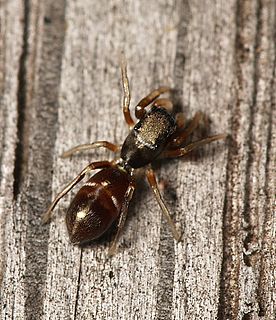
Synageles is a genus of jumping spiders that was first described by Eugène Louis Simon in 1876.
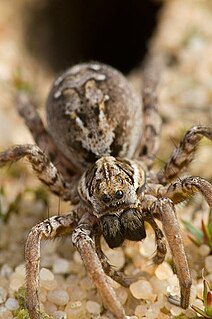
Alopecosa is a spider genus in the family Lycosidae, with about 160 species. They have a largely Eurasian distribution, although some species are found in North Africa and North America.

Drassodes is a genus of ground spiders that was first described by Niklas Westring in 1851. They are brown, gray, and red spiders that live under rocks or bark in mostly dry habitats, and are generally 3.8 to 11.6 millimetres long, but can reach up to 20 millimetres (0.79 in) in length.

Diaea is a genus of crab spiders first described by Tamerlan Thorell in 1869. Most species are found in specific locations except for D. livens, which occurs both in the United States and D. dorsata, which has a palearctic distribution. Adults are 5 millimetres (0.20 in) to 7 millimetres (0.28 in) and tend to hide in and around vegetation, especially flowers, where their color allows them to blend in to their surroundings.

Ozyptila is a genus of crab spiders that was first described by Eugène Louis Simon in 1864. It has been misspelled as "Oxyptila" in multiple accounts.

Pardosa is a large genus of wolf spiders, with more than 500 described species that are found in all regions of the world.

Walckenaeria is a genus of dwarf spiders that was first described by John Blackwall in 1833. It is a senior synonym of Paragonatium, as well as Wideria, Cornicularia, Prosopotheca, Tigellinus, and Trachynella.

Dictyna is a genus of cribellate araneomorph spiders in the family Dictynidae, and was first described by Carl Jakob Sundevall in 1833.

Gnaphosa is a genus of ground spiders that was first described by Pierre André Latreille in 1804. They all have a serrated keel on the retromargin of each chelicera.

Agyneta is a genus of dwarf spiders that was first described by J. E. Hull in 1911.

Lathys is a genus of cribellate araneomorph spiders in the family Dictynidae, and was first described by Eugène Simon in 1884. It is a replacement name for "Lethia" Menge, 1869 because that name was already in use as a synonym for a genus of moths.
