
Linyphiidae, spiders commonly known as sheet weavers, or money spiders is a family of very small spiders comprising 4706 described species in 620 genera worldwide. This makes Linyphiidae the second largest family of spiders after the Salticidae. The family is poorly understood due to their small body size and wide distribution; new genera and species are still being discovered throughout the world. The newest such genus is Himalafurca from Nepal, formally described in April 2021 by Tanasevitch. Since it is so difficult to identify such tiny spiders, there are regular changes in taxonomy as species are combined or divided.

Dictynidae is a family of cribellate, hackled band-producing spiders first described by Octavius Pickard-Cambridge in 1871. Most build irregular webs on or near the ground, creating a tangle of silken fibers among several branches or stems of one plant.
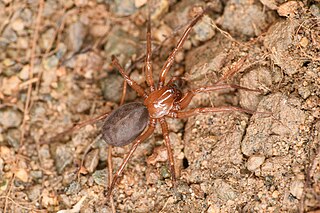
Cybaeidae is a family of spiders first described by Nathan Banks in 1892. The diving bell spider or water spider Argyroneta aquatica was previously included in this family, but is now in the family Dictynidae.

Callobius is a genus of tangled nest spiders first described by R. V. Chamberlin in 1947.
Vaine Wilton Ivie was an American arachnologist, who described hundreds of new species and many new genera of spiders, both under his own name and in collaboration with Ralph Vary Chamberlin. He was employed by the American Museum of Natural History in New York. He also was a supporter of the Technocracy movement.

Savignia is a genus of sheet weavers that was first described by John Blackwall in 1833. The name honors the French naturalist Marie Jules César Savigny.

Metepeira is a genus of orb-weaver spiders first described by F. O. Pickard-Cambridge in 1903. The name is derived from the Ancient Greek μετά and the obsolete genus name Epeira, denoting a genus similar to Epeira.
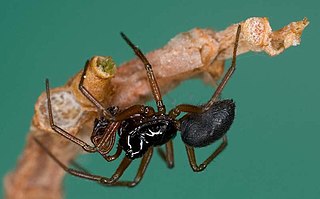
Erigone is a genus of dwarf spiders that was first described by Jean Victoire Audouin in 1826. They are carnivorous, preying on small insects such as Psylla and flies. One of the distinctive characters for this genus is the presence of teeth bordering the carapace.
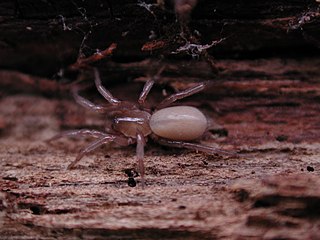
Cicurina, also called the cave meshweaver, is a genus of dwarf sheet spiders that was first described by Anton Menge in 1871. Originally placed with the funnel weavers, it was moved to the Dictynidae in 1967, then to the Hahniidae in 2017. The name is from the Latin root "cucur-", meaning "to tame".

Dictyna is a genus of cribellate araneomorph spiders in the family Dictynidae, and was first described by Carl Jakob Sundevall in 1833.

Agyneta is a genus of dwarf spiders that was first described by J. E. Hull in 1911.
Scotinotylus is a genus of sheet weavers that was first described by Eugène Louis Simon in 1884.
Spirembolus is a genus of North American sheet weavers that was first described by Ralph Vary Chamberlin in 1920.

Emblyna is a genus of cribellate araneomorph spiders in the family Dictynidae, and was first described by R. V. Chamberlin in 1948.
Varacosa is a genus of spiders in the family Lycosidae. It was first described in 1942 by Chamberlin & Ivie. As of 2017, it contains 6 North American species.
Tibioplus is a genus of sheet weavers that was first described by Ralph Vary Chamberlin & Vaine Wilton Ivie in 1947.
