Scarce bridle snake

Last updated

Scarce bridle snake
Scientific classification Red Pencil Icon.png
Kingdom: Animalia
Phylum: Chordata
Class: Reptilia
Order: Squamata
Suborder: Serpentes
Family: Colubridae
Genus: Lycodon
Species:
L. gracilis
Binomial name
Lycodon gracilis
(Günther, 1864)
Synonyms [1] [2]
  • Odontomus gracilis Günther, 1864 [3]
  • Odontomus fergusonii Haly, 1888
  • Hydrophobus gracilis (Günther, 1864)
  • Dryocalamus gracilis (Günther, 1864)

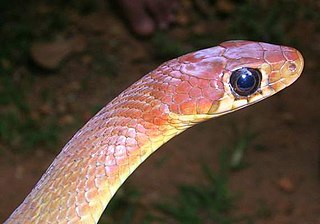
The scarce bridle snake (Lycodon gracilis) [4] is a species of snake found in South India, Sri Lanka, and Myanmar. [1] [2]

India Country in South Asia

India, also known as the Republic of India, is a country in South Asia. It is the seventh largest country by area and with more than 1.3 billion people, it is the second most populous country and the most populous democracy in the world. Bounded by the Indian Ocean on the south, the Arabian Sea on the southwest, and the Bay of Bengal on the southeast, it shares land borders with Pakistan to the west; China, Nepal, and Bhutan to the northeast; and Bangladesh and Myanmar to the east. In the Indian Ocean, India is in the vicinity of Sri Lanka and the Maldives, while its Andaman and Nicobar Islands share a maritime border with Thailand and Indonesia.
Sri Lanka Island country in South Asia

Sri Lanka, officially the Democratic Socialist Republic of Sri Lanka, is an island country in South Asia, located in the Indian Ocean to the southwest of the Bay of Bengal and to the southeast of the Arabian Sea. The island is historically and culturally intertwined with the Indian subcontinent, but is geographically separated from the Indian subcontinent by the Gulf of Mannar and the Palk Strait. The legislative capital, Sri Jayawardenepura Kotte, is a suburb of the commercial capital and largest city, Colombo.

Myanmar Republic in Southeast Asia

Myanmar, officially the Republic of the Union of Myanmar and also known as Burma, is a country in Southeast Asia. Myanmar is bordered by India and Bangladesh to its west, Thailand and Laos to its east and China to its north and northeast. To its south, about one third of Myanmar's total perimeter of 5,876 km (3,651 mi) forms an uninterrupted coastline of 1,930 km (1,200 mi) along the Bay of Bengal and the Andaman Sea. The country's 2014 census counted the population to be 51 million people. As of 2017, the population is about 54 million. Myanmar is 676,578 square kilometres in size. Its capital city is Naypyidaw, and its largest city and former capital is Yangon (Rangoon). Myanmar has been a member of the Association of Southeast Asian Nations (ASEAN) since 1997.

Contents

Description

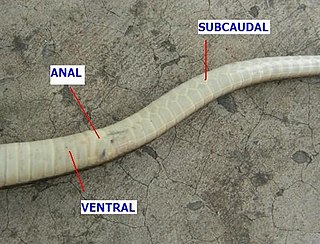
The holotype measures 53 cm (21 in) in length, including the 10 cm (4 in) tail. The holotype has 234 ventral scales, an entire anal scale, and 81–83 subcaudal scales. The ground colour is white. There are about 38 dark-brown crossbands, which are about 2–3 times as wide as the white interspaces. The interspaces are marbled with brown. The first crossband occupies the head. The lower parts are uniform white. [3]

Holotype single physical example (or illustration) of an organism, known to have been used when the species (or lower-ranked taxon) was formally described

A holotype is a single physical example of an organism, known to have been used when the species was formally described. It is either the single such physical example or one of several such, but explicitly designated as the holotype. Under the International Code of Zoological Nomenclature (ICZN), a holotype is one of several kinds of name-bearing types. In the International Code of Nomenclature for algae, fungi, and plants (ICN) and ICZN the definitions of types are similar in intent but not identical in terminology or underlying concept.

Ventral scales

In snakes, the ventral scales or gastrosteges are the enlarged and transversely elongated scales that extend down the underside of the body from the neck to the anal scale. When counting them, the first is the anteriormost ventral scale that contacts the paraventral (lowermost) row of dorsal scales on either side. The anal scale is not counted.

Anal scale

In snakes, the anal scale is the scale just in front of and covering the cloacal opening. This scale can be either single or paired. When paired, the division is oblique. The anal scale is preceded by the ventral scales and followed by the subcaudal scales.

Distribution

This species is known from scattered records, including just two specimens reported since 1888. [1] In India, it is known from Andhra Pradesh, Karnataka, and Orissa. [2] The Sri Lankan record is from Jaffna. Lastly, this species is known from False Island, off the Arakan coast of Myanmar. [1] The holotype was collected from the Anamallay Mountains by Richard Henry Beddome. [3]

Andhra Pradesh State in southern India

Andhra Pradesh is one of the 29 states of India. Situated in the south-east of the country, it is the eighth-largest state in India, covering an area of 162,970 km2 (62,920 sq mi). As per the 2011 census, it is the tenth most populous state, with 49,386,799 inhabitants. The largest city in Andhra Pradesh is Visakhapatnam. Telugu, one of the classical languages of India, is the major and official language of Andhra Pradesh.

Karnataka State in southern India

Karnataka is a state in the south western region of India. It was formed on 1 November 1956, with the passage of the States Reorganisation Act. Originally known as the State of Mysore, it was renamed Karnataka in 1973. The state corresponds to the Carnatic region. The capital and largest city is Bangalore (Bengaluru).

Arakan

Arakan is a historic coastal region in Southeast Asia. It borders faced the Bay of Bengal to its west, the Indian subcontinent to its north and Burma proper to its east. The Arakan Mountains isolated the region and made it accessible only by sea. The region now forms the Rakhine State in Myanmar.

Habitat

Lycodon gracilis occurs in moist and dry forests. Its Sri Lankan habitat has been described as "monsoon scrub jungle". [1]

Threats

This species could be threatened by habitat loss and degradation caused by agricultural and urban expansion. However, the impact of these threats is unknown as current records are lacking. [1]

Related Research Articles

<i>Hebius monticola</i> species of reptile

Hebius monticola is a harmless colubrid snake species endemic to the Western Ghats of India. They are especially well known from the Kodagu and Wayanad regions of the Western Ghats.

<i>Platyceps gracilis</i> species of reptile

Platyceps gracilis, commonly known as the graceful racer or slender racer, is a species of snake endemic to India.

The White-banded wolf snake, also known as the Northern large-toothed snake, is a species of colubrid snake found in Asia.

<i>Lycodon aulicus</i> species of reptile

Lycodon aulicus, commonly known as the Indian wolf snake, is a species of nonvenomous snake found in South Asia and Southeast Asia. Early naturalists have suggested its resemblance to the venomous common krait as an instance of Batesian mimicry.

<i>Lycodon jara</i> species of reptile

Lycodon jara, commonly known as the twin-spotted wolf snake, is a species of colubrid snake. It is endemic to Asia.

<i>Lycodon striatus</i> species of reptile

Lycodon striatus, commonly known as the northern wolf snake or the barred wolf snake, is a species of nonvenomous colubrid snake from southern Asia.

<i>Lycodon travancoricus</i> species of reptile

Lycodon travancoricus, commonly known as the Travancore wolf snake, is a species of colubrid snake endemic to Peninsular India.

Banded kukri snake species of reptile

The common kukri snake or banded kukri, Oligodon arnensis, is a species of nonvenomous colubrid found in Sri Lanka, India, Bangladesh, Pakistan, Bhutan and Nepal.

<i>Lycodon flavomaculatus</i> species of reptile

Lycodon flavomaculatus, commonly called the yellow-spotted wolf snake, is a species of colubrid snake found in the Western Ghats of India.

Lycodon laoensis, commonly known as the Laotian wolf snake, is a species of colubrid snake, which is endemic to Asia.

Lycodon zawi, commonly known as Zaw's wolf snake, is a species of nonvenomous colubrid snake.

<i>Sibynophis collaris</i> species of reptile

Sibynophis collaris, commonly known as the common many-toothed snake,Betty's many toothed snake or the collared black-headed snake, is a species of colubrid snake endemic to South Asia.

Platyplectrurus madurensis, commonly known as the Travancore Hills thorntail snake, Palni purple-brown worm thorntail snake, or Madurai shieldtail, is a species of uropeltid snake. It is found in southern India and, depending on the source, Sri Lanka.

<i>Bungarus candidus</i> Venomous snake, species of krait

Bungarus candidus, commonly known as the Malayan krait or blue krait, is a highly venomous species of snake. The blue krait is a member of the elapid family.

Blanfords bridle snake species of reptile

Blanford's bridle snake is a species of harmless colubrid snake endemic to Asia. Blanford's bridle snake is so named because its slim body resembles the bridle used to control horses.

Lycodon alcalai, also known as Alcala's wolf snake, is a species of colubrid snake found on the islands of Batan and Sabtang in the Philippines.

Lycodon chrysoprateros, also known as Ross' wolf snake, is a species of colubrid snake found on the island of Dalupiri in the Philippines.

Lycodon solivagus, also known as the Common wolf snake, is a species of colubrid snake found on Luzon Island in the Philippines.

Lycodon cardamomensis, also known as the Cardamom Mountains wolf snake, is a species of non-venomous colubrid snakes found in south-western Cambodia and south-eastern Thailand.

References

  1. 1 2 3 4 5 6 7 de Silva, A. (2010). "Dryocalamus gracilis". IUCN Red List of Threatened Species . 2010: e.T177551A7455336. doi:10.2305/IUCN.UK.2010-4.RLTS.T177551A7455336.en.
  2. 1 2 3 Lycodon gracilis at the Reptarium.cz Reptile Database. Accessed 14 September 2018.
  3. 1 2 3 Günther, Albert C. L. G. (1864). The Reptiles of British India. Ray Society (Series) No. 35. London: R. Hardwicke. (Odontomus gracilis: p. 234)
  4. "Dryocalamus gracilis Scarce Bridal Snake". snakedatabase.org. Retrieved 14 September 2018.