Related Research Articles

This article concerns the 200 BC decade,that lasted from 209 BC to 200 BC.
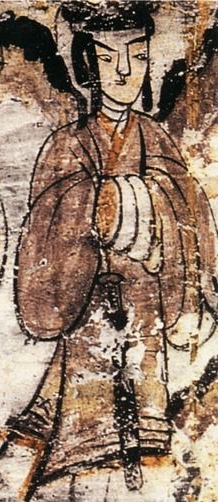
Zhang Liang,courtesy name Zifang,was a Chinese military strategist and politician who lived in the early Western Han dynasty. He is also known as one of the "Three Heroes of the early Han dynasty" (漢初三傑),along with Han Xin (韓信) and Xiao He. Zhang Liang contributed greatly to the establishment of the Han dynasty. After his death,he was honoured with the posthumous title "Marquis Wencheng" by Emperor Qianshao. Zhang Liang is depicted in the Wu Shuang Pu by Jin Guliang.

The Chu–Han Contention (楚漢相爭),also known as the Chu–Han War (楚漢戰爭),was an interregnum in Imperial China between the fall of the Qin dynasty and the establishment of the Han dynasty. After the Qin were overthrown by rebel forces in 206 BCE,the empire was divided into the Eighteen Kingdoms ruled by rebel leaders and former Qin generals according to Xiang Yu,the rebel leader. A civil war soon broke out,most prominently between two major contending powers –Xiang Yu and Liu Bang,who were respectively the rulers of the Chu and Han kingdoms. Some of the other kingdoms also waged war among themselves but these were largely insignificant compared to the main conflict between Chu and Han. The war ended with a Han victory at the Battle of Gaixia in 202 BCE,during which Xiang Yu committed suicide after having made a last stand. Liu subsequently proclaimed himself emperor of the newly established Han dynasty.
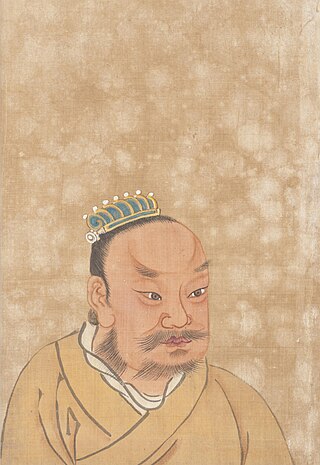
Xiang Yu,born Xiang Ji,was the Hegemon-King of Western Chu during the Chu–Han Contention period of China. A noble of the state of Chu,Xiang Yu rebelled against the Qin dynasty,destroying their last remnants and becoming a powerful warlord. He was granted the title of "Duke of Lu" (魯公) by King Huai II of the restoring Chu state in 208 BC. The following year,he led the Chu forces to victory at the Battle of Julu against the Qin armies led by Zhang Han. After the fall of Qin,Xiang Yu was enthroned as the "Hegemon-King of Western Chu" (西楚霸王) and ruled a vast area spanning central and eastern China,with Pengcheng as his capital. He engaged Liu Bang,the founding emperor of the Han dynasty,in a long struggle for power,known as the Chu–Han Contention,which concluded with his eventual defeat at the Battle of Gaixia and his suicide.
Zhang Han was a Chinese military general of the Qin dynasty. When uprisings erupted throughout China during the reign of Qin Er Shi,Zhang Han led the Qin armies and successfully quelled several of these rebel forces. In 207 BC,Zhang Han was defeated by Xiang Yu of Chu at the Battle of Julu,after which he surrendered along with his 200,000 troops. He was conferred the title "King of Yong" (雍王) by Xiang Yu and given part of the lands in Guanzhong as his fief when Xiang split the former Qin Empire into the Eighteen Kingdoms after the fall of the Qin dynasty. Zhang Han's territory was conquered by Liu Bang in 206 BC,and he committed suicide a year later.

Chu was an ancient Chinese state during the Zhou dynasty. Their first ruler was King Wu of Chu in the early 8th century BC. Chu was located in the south of the Zhou heartland and lasted during the Spring and Autumn period. At the end of the Warring States period it was destroyed by the Qin in 223 BC during the Qin's wars of unification.
Emperor Yi of Chu,also known as King Huai II of Chu before receiving his de jure emperor title,personal name Xiong Xin,was the ruler of the revived Chu state in the late Qin dynasty. He was a grandson of King Huai of Chu. In 223 BC,during the Warring States period,the Chu state was conquered by the Qin state,which unified the various Chinese feudal states in a series of wars and established the Qin dynasty in 221 BC. In 209 BC,when rebellions broke out throughout China to overthrow the Qin dynasty,the Chu state was revived as an insurgent state against Qin imperial rule. Xiong Xin was discovered by Xiang Liang,a rebel leader who descended from a famous Chu general,Xiang Yan,and installed on the Chu throne as "King Huai II of Chu". However,Xiong Xin was a puppet ruler because power was concentrated in Xiang Liang's hands,and while he was able to assert his power after Xiang Liang was killed in battle,eventually Xiang Liang's nephew,Xiang Yu,would concentrate power in his own hands through a coup against King Huai II's general Song Yi during the Battle of Julu. In 206 BC,the Qin dynasty was overthrown by the rebels,after which Xiang Yu,who was the de facto leader of all the rebel forces,divided the former Qin Empire into the Eighteen Kingdoms. He promoted King Huai II to a more "honourable" title –Emperor Yi of Chu –and made him the nominal sovereign ruler over all the Eighteen Kingdoms. Xiang Yu then had Emperor Yi relocated to Chen County and secretly ordered Ying Bu to assassinate the emperor during the journey.

The Three Qins refer to three of the Eighteen Kingdoms,the short-lived power-sharing arrangement formed in 206 BC after the collapse of the Qin dynasty. The three kingdoms were located in Guanzhong Plain,the heartland of the Qin Empire.

The Battle of Julu was fought in Julu in 207 BC primarily between forces of the Qin dynasty and the insurgent state of Chu. The Qin commander was Zhang Han,while the Chu leader was Xiang Yu. The battle concluded with a decisive victory for the rebels over the larger Qin army. The battle marked the decline of Qin military power as the bulk of the Qin armies were destroyed in this battle.
The Battle of Jingxing (井陘之戰),also known as the Battle of Tao River (洮水之戰),was fought in October 205 BC between the army of Han,commanded by Han Xin,and a Zhao army. The Zhao were led by Prince Zhao Xie (趙歇) of Zhao and Chen Yu (陳餘),also known as the Lord of Cheng An (成安君),who was serving as Zhao Xie's prime minister.
The Battle of Wei River was fought in November 204 BC between the Han and a combined force of Qi and Western Chu. The famous General Han Xin led the Han force,while the Chu were led by Long Ju (龍且) and the Qi by King Tian Guang (田廣). The result ended with Han Xin conquering the Qi kingdom.
Zang Tu was a Chinese military general,monarch,politician,and warlord who lived during the late Qin dynasty and early Han dynasty of China.

Qin's wars of unification were a series of military campaigns launched in the late third century BC by the state of Qin against the other six states remaining in China –Han,Zhao,Yan,Wei,Chu and Qi. Between 247 and 221 BC,Qin had developed into the most powerful of China's Seven Warring States that coalesced in the wake of the declining Zhou dynasty,which had been reduced to a weak and merely ceremonial position during the Warring States period. In 230 BC,Ying Zheng,the King of Qin,began the sequence of campaigns that would bring the Warring States period to a close,setting out to conquer each of the six states one by one. This was completed in 221 BC with the fall of Qi,which further led to a more centralised form of government replacing the fengjian system of the Zhou dynasty. Ying Zheng declared himself the First Emperor –or Shi Huangdi –of a unified China under the Qin dynasty.
Xiang Liang was a Chinese military leader who led a rebellion against the Qin dynasty.
Shen Yang was the ruler of the Kingdom of Henan (河南國) of the Eighteen Kingdoms during the Chu–Han Contention,an interregnum between the Qin and Hàn dynasties of China.
Gong Ao was a ruler of the Kingdom of Linjiang of the Eighteen Kingdoms during the Chu–Han Contention,an interregnum between the Qin dynasty and the Han dynasty.
Sima Xin was a military general of the Qin dynasty. He surrendered to Xiang Yu after the Battle of Julu in 207 BC. In 206 BC,following the collapse of the Qin dynasty,he was conferred the title of "King of Sai" by Xiang Yu and given part of the lands in Guanzhong as his fief when the latter split the former Qin Empire into the Eighteen Kingdoms.
Dong Yi was a military general of the Qin dynasty. He surrendered to Xiang Yu after the Battle of Julu in 207 BC. In 206 BC,following the collapse of the Qin dynasty,he was conferred the title of "King of Di" (翟王) by Xiang Yu and given part of the lands in Guanzhong as his fief when the latter split the former Qin Empire into the Eighteen Kingdoms.
The Battle of Pengcheng was fought in Pengcheng in April 205 BC between the kingdoms of Western Chu and Han,led by Xiang Yu and Liu Bang respectively. The Han forces were unprepared and suffered heavy losses. Several of Liu Bang's family members were captured and some of his allies defected to Chu as a result of his defeat.
Ying Bu was a Chinese military general,monarch,politician,and warlord who lived during the early Han dynasty. He was a native of Lu County. In his early life under the Qin dynasty,Ying Bu was convicted and sentenced to qing,so he was also called Qing Bu (黥布). He was then sent to Mount Li to perform hard labour by constructing Qin Shi Huang's mausoleum. He later escaped with some men and became the leader of a bandit gang. Ying Bu participated in the insurrection against the Qin dynasty after the Dazexiang Uprising broke out in 209 BC. After the uprising failed,he became part of a rebel force led by Xiang Liang. He assisted Xiang Liang's nephew and successor Xiang Yu in overthrowing the Qin dynasty. After the fall of Qin,he initially fought on Xiang Yu's side in the Chu–Han Contention,a power struggle for supremacy over China between Xiang Yu and Liu Bang. However,later,he defected to Liu Bang's side and helped Liu defeat Xiang Yu and become the emperor. During this period of time,Ying Bu held the title "King of Jiujiang". In c.August 203,Liu Bang appointed Ying Bu as a vassal king and granted him the title "King of Huainan". In 196 BC,Ying Bu rebelled against the Han dynasty but was defeated and killed.
References
- ↑ Sima Qian 1993 , p. 22
- ↑ Sima Qian 1993 , p. 23
- ↑ Sima Qian 1993 , p. 23
- ↑ Sima Qian 1993 , p. 23
- ↑ Sima Qian 1993 , p. 24
Sima Qian (1993). Records of the Grand Historian: Han Dynasty I, translated by Burton Watson . Columbia University Press. ISBN 0-231-08165-0.
| International | |
|---|---|
| National | |
