
Tuatara are reptiles endemic to New Zealand. Despite their close resemblance to lizards, they are part of a distinct lineage, the order Rhynchocephalia. The name tuatara is derived from the Māori language and means "peaks on the back". The single extant species of tuatara is the only surviving member of its order. Rhynchocephalians originated during the Triassic, reached worldwide distribution and peak diversity during the Jurassic and, with the exception of tuatara, were extinct by 60 million years ago. Their closest living relatives are squamates. For this reason, tuatara are of interest in the study of the evolution of lizards and snakes, and for the reconstruction of the appearance and habits of the earliest diapsids, a group of amniote tetrapods that also includes dinosaurs and crocodilians.

Skinks are lizards belonging to the family Scincidae, a family in the infraorder Scincomorpha. With more than 1,500 described species across 100 different taxonomic genera, the family Scincidae is one of the most diverse families of lizards. Skinks are characterized by their smaller legs in comparison to typical lizards and are found in different habitats except arctic and subarctic regions.
Barkudia is a little-known genus of skinks endemic to India. These lizards are thought to be semi-fossorial, and living in coastal areas of the east coast of India. Almost nothing is known about the natural history of this genus, except for classical taxonomic texts.
François Marie Daudin was a French zoologist.

Blue-tongued skinks comprise the Australasian genus Tiliqua, which contains some of the largest members of the skink family (Scincidae). They are commonly called blue-tongued lizards or simply blue-tongues or blueys in Australia. As suggested by these common names, a prominent characteristic of the genus is a large blue tongue that can be bared as bluff-warning to potential enemies. The type of predator/threat that is near will determine the intensity of colour present in the tongue. In addition, their blue tongue will produce a response in the prey which will in turn diminish the attack. The tongue can also deform itself and produce a thick mucus in order to catch prey. They are relatively shy in comparison with other lizards, and also significantly slower due to their shorter legs.
Colonel Richard Henry Beddome was a British military officer and naturalist in India, who became chief conservator of the Madras Forest Department. In the mid-19th century, he extensively surveyed several remote and then-unexplored hill ranges in Sri Lanka and south India, including those in the Eastern Ghats such as Yelandur, Kollegal, Shevaroy Hills, Yelagiri, Nallamala Hills, Visakhapatnam hills, and the Western Ghats such as Nilgiri hills, Anaimalai hills, Agasthyamalai Hills and Kudremukh. He described many species of plants, amphibians, and reptiles from southern India and Sri Lanka, and several species from this region described by others bear his name.

Chalcides pentadactylus, or five-fingered skink, is a species of skink found in the Western Ghats of India. Females of other species of the genus are viviparous, meaning that they give birth to live young. Almost nothing is known of C. pentadactylus. It is only known from the holotype which is lost [ fide Smith 1935]. Due to the loss of the only known specimen the true identity and origin of this skink, and its correct generic assignment, must await the examination of fresh material.

Riopa guentheri, commonly known as Günther's supple skink or Günther's writhing skink, is a species of skink, which is endemic to India.

Ristella rurkii, commonly known as Rurk's ristella, is a species of skink endemic to the Western Ghats of southern India. It is a small, insectivorous, diurnal skink found in shola grasslands and rainforests of hills ranges in parts of Tamil Nadu and Kerala states of India.
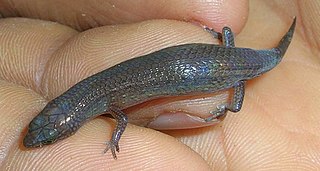
Ristella travancorica, commonly known as the Travancore cat skink or the Travancore ristella, is a species of skink endemic to the Western Ghats in India.

Kaestlea travancorica, also known as the Travancore ground skink or Barbour's ground skink, is a species of skink endemic to southern Western Ghats.

Sphenomorphus dussumieri, commonly known as Dussumier's forest skink and Dussumier's litter skink, is a species of skink, a lizard in the family Scincidae. The species is endemic to southern India.
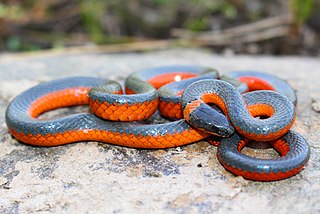
Diadophis punctatus, commonly known as the ring-necked snake or ringneck snake, is a harmless species of colubrid snake found throughout much of the United States, central Mexico, and south-eastern Canada. Ring-necked snakes are secretive, nocturnal snakes, so are rarely seen during the day time. They are best known for their unique defense posture of curling up their tails, exposing their bright red-orange posterior, ventral surface when threatened.

Brachyseps is a genus of skinks. They are all endemic to Madagascar. Some taxonomic authorities place the group in the genus Amphiglossus.

Brachyseps punctatus is a species of skink endemic to Madagascar.

