
The sac spiders of the family Clubionidae have a very confusing taxonomic history. Once, this family was a large catch-all taxon for a disparate collection of spiders, similar only in that they had eight eyes arranged in two rows and conical anterior spinnerets that touched, and were wandering predators that built silken retreats, or sacs, usually on plant terminals, between leaves, under bark, or under rocks. These are now recognized to include several families, some of which are more closely related to the three-clawed spiders, like lynx and wolf spiders, than to Clubionidae and related families.
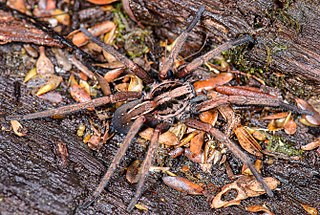
Miturgidae is a family of araneomorph spiders that includes nearly 170 species in 29 genera worldwide. First described by Eugène Simon in 1886, it has been substantially revised, including of previous family "Zoridae" as subfamily "Zorinae" and excluding the family "Xenoctenidae". Several genera have also been removed, such as the large genus Cheiracanthium, which was transferred to the Cheiracanthiidae.

Ground spiders comprise Gnaphosidae, the seventh largest spider family with nearly 2,000 described species in over 100 genera distributed worldwide. There are 105 species known to central Europe, and common genera include Gnaphosa, Drassodes, Micaria, Cesonia, Zelotes and many others. They are closely related to Clubionidae. At present, no ground spiders are known to be seriously venomous to humans.
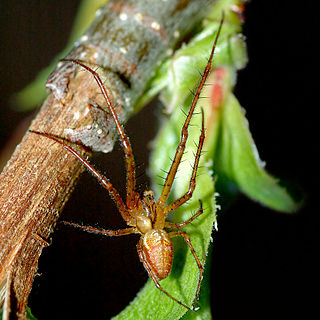
Long-jawed orb weavers or long jawed spiders (Tetragnathidae) is a family of araneomorph spiders first described by Anton Menge in 1866. They have elongated bodies, legs, and chelicerae, and build small orb webs with an open hub with few, wide-set radii and spirals with no signal line or retreat. Some species are often found in long vegetation near water.

Habronattus is a genus in the family Salticidae. Most species are native to North America. They are commonly referred to as paradise spiders due to their colorful courtship ornaments and complex dances, similar to birds-of-paradise.

Philoponella is a genus of uloborid spiders. Like all Uloboridae, these species have no venom.
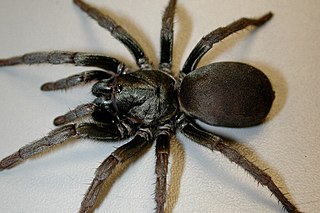
Nemesiidae, also known as funnel-web trapdoor spiders, is a family of mygalomorph spiders first described by Eugène Simon in 1889, and raised to family status in 1985. Before becoming its own family, it was considered part of "Dipluridae".

The Zorinae are a spider subfamily of the Miturgidae, with more than 70 described species in 13 genera.

Diguetia is a genus of coneweb spiders that was first described by Eugène Simon in 1895. Members of this genus are six-eyed spiders that are either white or patterned. They are common in the southwestern United States and Mexico, and one species is found in Argentina. In the United States, species have been found in Arizona, California, Nevada, New Mexico, and Texas. These spiders build a tubular retreat at the tip of their tent-like webs. Once an insect is caught in the web, the spider bites it and injects venom to stop its prey from moving, later wrapping it in silk. Both males and females use stridulation while mating, with females also stridulating when harassed. Two species of jumping spiders feed on its eggs. There are eleven Diguetia species.
Coneweb spiders (Diguetidae) are six-eyed haplogyne spiders that live in tangled space webs, fashioning a cone-like central retreat where they hide and lay eggs. It is a small family, containing only two genera with fifteen species and is confined to the New World, preferring deserts. Members of the genus Diguetia usually build their webs in shrubs or between cactus pads. They have the same eye arrangement as the venomous recluse spiders, but none are known to be harmful to humans.

Caponiidae is a family of ecribellate haplogyne spiders that are unusual in a number of ways. They differ from other spiders in lacking book lungs and having the posterior median spinnerets anteriorly displaced to form a transverse row with the anterior lateral spinnerets. Most species have only two eyes, which is also unusual among spiders. A few species of Caponiidae variously have four, six or eight eyes. In some species the number of eyes will increase when the spiderling changes its skin as it grows towards adulthood.

Cheiracanthiidae is a family of araneomorph spiders first described by Vladimir Wagner in 1887. The synonym Eutichuridae was used for a long time, but Cheiracanthiidae has priority. The largest genus currently recognized as belonging to this family is Cheiracanthium, which has previously been placed in both the Clubionidae and the Miturgidae.

Blabomma is a genus of araneomorph spiders in the family Cybaeidae, and was first described by R. V. Chamberlin & Wilton Ivie in 1937. Originally placed with the funnel weavers, it was moved to the Dictynidae in 1967, and to the Cybaeidae in 2017.
Miturga is a genus of spiders in the family Miturgidae. It was first described in 1870 by Thorell. As of 2017, it contains 17 species, all from Australia.
Syrisca is a genus of spiders in the family Miturgidae. It was first described in 1886 by Simon. As of 2017, it contains 9 species.
Odomasta is a genus of spiders in the family Miturgidae. It was first described in 1909 by Simon. As of 2017, it contains only one species, Odomasta guttipes, found in Tasmania.
Zoroides is a genus of spiders in the family Miturgidae. It was first described in 1924 by Berland. As of 2017, it contains only one species, Zoroides dalmasi, found in New Caledonia.
Xenoctenidae is a family of araneomorph spiders separated from Miturgidae in 2017.


