The Caatinga enclaves moist forests is an ecoregion of the Tropical moist forests Biome, and the South American Atlantic Forest biome. It is located in northeastern Brazil.

The orange-breasted bunting is a species of passerine bird in the family Cardinalidae. It is endemic to Mexico, where its natural habitats are subtropical or tropical dry forests and subtropical or tropical dry shrubland. With its wide range and large total population, the International Union for Conservation of Nature considers it as being of "least concern".

The white-wedged piculet is a species of bird in the family Picidae. It is found in Bolivia, Brazil and Paraguay, where its natural habitats are subtropical or tropical dry forests, subtropical or tropical moist lowland forests, and dry savannah. It hybridizes with the white-barred piculet where their ranges overlap.

The bar-breasted piculet is a species of bird in the family Picidae. It is found in Bolivia, Brazil, Colombia, and Peru.
The plain-breasted piculet is a species of bird in the woodpecker family. It is found in the Ucayali and Amazon floodplains in eastern Peru. Its natural habitats are subtropical or tropical moist lowland forests and heavily degraded former forest.
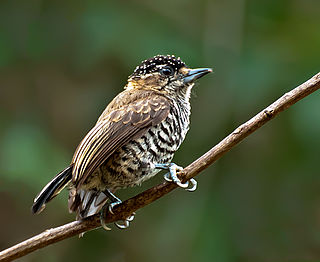
The white-barred piculet is a species of bird in the family Picidae, the woodpeckers, piculets, and wrynecks. It is found in south-eastern Brazil south and west to the Pantanal, and into south-eastern Bolivia, Paraguay and northern Argentina. A disjunct population occurs in the coastal parts of French Guiana, south to the Brazilian state of Amapá and west along the lower Amazon River up to around the Tapajós River. A small, apparently isolated population is found in southern Guyana and adjacent Roraima. Its natural habitats are subtropical or tropical dry forests, subtropical or tropical moist lowland forests, and heavily degraded former forest.

The ocellated piculet is a species of bird in the family Picidae. It is found in Argentina, Bolivia, and Peru. Its natural habitats are subtropical or tropical moist montane forests and heavily degraded former forest. It was first described in 1845 as Picumnus d’Orbignyanus by the French ornithologist Frédéric de Lafresnaye, being named in honour of the French naturalist Alcide d'Orbigny, but since then has been largely mis-spelt as P. dorbygnianus. It hybridizes with the white-barred piculet where their ranges overlap.
The rusty-necked piculet is a species of bird in the family Picidae. It is found on the Rondônia-Bolivian border. Both males and females are buffy cinnamon, with black crowns. Males have orange streaking on their crowns.

The greyish piculet is a species of bird in the family Picidae. It is endemic to Colombia.

The ochraceous piculet is a species of bird in the family Picidae. It is endemic to eastern Brazil.

The mottled piculet is a species of bird in the family Picidae. It is found in north eastern Argentina, south eastern Brazil, and Uruguay. Its natural habitat is subtropical or tropical moist lowland forests. It is becoming rare due to habitat loss.
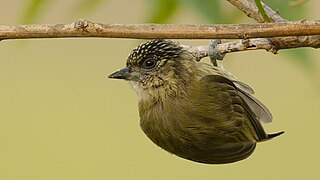
The olivaceous piculet is a species of bird in the family Picidae. Etymologically, piculet is as a double diminutive of the Latin picus, woodpecker, see also Picus. In Greek, δρύοψ is woodpecker, which shares its roots with δρῦς, 'tree'; 'oak' and Druids.
The Orinoco piculet is a species of bird in the family Picidae. It is found in Brazil, Colombia, and Venezuela. Its natural habitat is subtropical or tropical moist lowland forests.

The spotted piculet is a species of bird in the family Picidae. It is endemic to north-eastern Brazil.
The white-bellied piculet is a species of bird in the family Picidae. It is found in Brazil, French Guiana, Guyana, Suriname, and Venezuela.

The scaled piculet is a species of bird in the woodpecker family Picidae. It is found in Colombia and Venezuela. Its natural habitats are subtropical or tropical dry forests, subtropical or tropical moist lowland forests, and heavily degraded former forest. This bird was first described by the French naturalist Frédéric de Lafresnaye in 1854; five subspecies are recognised.
The speckle-chested piculet is a species of bird in the family Picidae (woodpeckers) endemic to Peru. Its natural habitats are tropical moist lowland and montane forests. It is threatened by habitat destruction as the forests are cleared to make way for agricultural land, and the IUCN has rated it as being an endangered species.

The ochre-collared piculet is a species of bird in the family Picidae. It is found in Argentina, Brazil, and Paraguay. Its natural habitats are subtropical or tropical moist lowland forest, subtropical or tropical dry shrubland, and heavily degraded former forest.
The varzea piculet is a species of bird in the family Picidae, the woodpeckers, piculets, and wrynecks. It is endemic to Brazil's Amazon basin where it occurs in seasonally flooded Várzea forests, which gives the bird its common name. Its natural habitat is tropical moist lowland forest, and as the trees are progressively being cleared in the Amazon basin, the population of the bird is declining, and as a consequence, the International Union for Conservation of Nature has rated it as an "endangered species".
Picumnus is a large genus of piculets. With a total length of 8–10 cm (3–4 in), they are among the smallest birds in the woodpecker family.