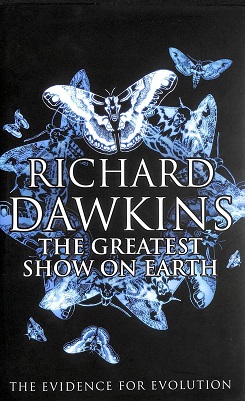
The title is from a T-shirt given to Dawkins by "an anonymous well-wisher". It bears the words "Evolution: The Greatest Show on Earth, the Only Game in Town".[7] He wore it occasionally while lecturing,[11] and realised it was an ideal title. However, his editor said it was too long[12] so they shortened it. On three occasions, Dawkins wanted to include new scientific findings that emerged late in the publishing process; despite the disruption, the publisher accommodated them.[7]
Dawkins dedicated the book to Josh Timonen, an architect of RichardDawkins.net. He writes: "Josh's creative talent runs deep, but the image of the iceberg captures neither the versatile breadth of his contributions to our joint endeavour, nor the warm good humour with which he makes them." He also thanks his wife Lalla's "unfailing encouragement, helpful stylistic criticisms and characteristically stylish suggestions", and his friend Charles Simonyi as he signs off after fourteen years and seven books.[7]
"Only a theory?" examines evolution as theory and fact. He cites the Oxford English Dictionary's definition of "theory": “A scheme or system of ideas or statements held as an explanation or account of a group of facts or phenomena; a hypothesis that has been confirmed or established by observation or experiment, and is propounded or accepted as accounting for the known facts; a statement of what are held to be the general laws, principles, or causes of something known or observed.”[14]
"Silence and slow time" examines the age of the Earth and geologic time. Dawkins describes various means of dating the earth, notably dendrochronology and uranium-lead dating. Before our very eyes: the evolution of bacteria in the Lenski experiment
"Before our very eyes" examines examples of evolution in the field and in the lab. In 1971, a population of Podarcis sicula from the island of Pod Kopiste was transported to the island of Pod Mrcaru. In 2008, a group of scientists led by Anthony Herrel found that the lizards had evolved stronger jaws to adapt to a vegetarian diet, and have started to evolve a cecum.[16] Dawkins describes Richard Lenski's E. coli long-term evolution experiment, in which 12 strains of E. coli were grown in flasks with glucose as a limiting factor. “In these conditions, the Darwinian expectation was that, if any mutation arose that assisted an individual bacterium to exploit glucose more efficiently, natural selection would favour it, and it would spread throughout through the flask as mutant individuals out-reproduced non-mutant individuals.” That is what happened: “As the ‘flask generations’ went by, all twelve lines improved over their ancestors: got better at exploiting glucose as a food source. But, fascinatingly, they got better in different ways – that is, different tribes developed different sets of mutations.”[3]:121[17] Lenski's student Zachary Blount found that one strain evolved the ability to digest citrate.[18] A tragic corollary is antimicrobial resistance; bacteria have evolved resistance "to antibiotics in spectacularly short periods. After all, the first antibiotic, penicillin, was developed, heroically, by Florey and Chain as recently as the Second World War. New antibiotics have been coming out at frequent intervals since then, and bacteria have evolved resistance to just about every one of them.”[3]:132 He describes John Endler’s studies of the competing pressures of natural and sexual selection. Endler found that in streams without strong predation, male guppies evolved colorful spots to attract females. In streams with strong predation, they evolved camouflage to escape detection. Endler wanted to see if he could recreate this in the lab. He raised guppies in ponds with strong, weak and intermediate predation. After introducing a strong predator, the number of spots plummeted. The sizes of rocks in the ponds also influenced the sizes of spots the guppies evolved.[19][20]
"You did it yourself in nine months" discusses developmental biology, especially the work of Lewis Wolpert. Haldane was asked how, in evolution, a single cell could give rise to something as complex as a human. His response is the chapter title.
"The tree of cousinship" examines the tree of life. Dawkins discusses homology. He discusses Motoo Kimura's neutral theory of molecular evolution. Silent mutations are invisible to natural selection but not to biologists, who use them as molecular clocks to see when species split. Dawkins discusses pseudogenes, vestiges of functional genes: "The very existence of pseudogenes - useless, untranscribed genes that bear a marked resemblance to useful genes - is a perfect example of the way animals and plants have their history written all over them."[3]:336
"Arms races and 'evolutionary theodicy'" examines evolutionary arms races between predator and prey and host and parasite. “Over evolutionary time, predators get better at catching prey, which prompts prey animals to get better at evading capture.”[3]:387 He examines cruelty in nature, such as Ichneumonidae, wasps that lay their larva in live caterpillars, which they consume from the inside out. Dawkins argues that such things do not reflect a loving creator, but rather evolution by natural selection.
"There is grandeur in this view of life" is a close reading of the final passage of On the Origin of Species. He writes that understanding evolution ennobles us: "We are surrounded by endless forms, most beautiful and most wonderful, and it is no accident, but the direct consequence of evolution by non-random selection, the only game in town, the greatest show on earth."[3]:426
Critical reception
The book received mixed to positive critical reception on its release. Writing in The Times, Anjana Ahuja described Dawkins's account of the evidence for evolution as "fine, lucid and convincing". Though she criticised him for aggrandising the role of Islam in the spread of creationism and suggested that his writing style is unlikely to persuade disbelievers, Ahuja described these as merely "quibbles" and recommended the book to all readers.[22]The Economist also featured a favourable review, praising Dawkins's writing style as "persuasive" and lauding its educational value.[23] Mark Fisher in The List called Dawkins a "compelling communicator", adding that the book was "illuminating" and praising the use of humorous anecdotes throughout.[24]The Sunday Telegraph awarded it "Book of the Week", with reviewer Simon Ings describing Dawkins as a "master of scientific clarity and wit". Although Ings felt that anger had interfered with Dawkins's creativity to an extent, he also praised sections of the book as "magical" and "visceral", concluding that there was a "timeless merit" to the overall theme.[25][26][27][28]
The New York Times reviewer Nicholas Wade, while praising the work overall, criticised Dawkins's assertion that evolution can be treated as an undeniable fact and asserted that Dawkins's insistence that it is a fact makes him as dogmatic as his opponents. Moreover, characterising his opponents as "history-deniers", "worse than ignorant" and "deluded to the point of perversity" Wade asserts, "is not the language of science, or civility." Wade sees both Dawkins and his creationist opponents as wrong.[29] Wade's review was subsequently criticised in numerous letters to The New York Times. In one, Daniel Dennett asserted that creationism deserves as much respect as believing that the world is flat. Another letter, from Philip Kitcher, Professor of Philosophy at Columbia University, asserted that evolution and other scientific findings "are so well supported that they count as facts".[30][31]
The Greatest Show on Earth at RichardDawkins.net (includes a video and links to abstracts from the first two chapters as well as extensive links to book reviews and media coverage)
This page is based on this Wikipedia article Text is available under the CC BY-SA 4.0 license; additional terms may apply. Images, videos and audio are available under their respective licenses.