
Tibouchina is a neotropical flowering plant genus in the family Melastomataceae. Species of this genus are subshrubs, shrubs or small trees and typically have purple flowers. They are native to Mexico, the Caribbean, and South America where they are found as far south as northern Argentina. Members of this genus are known as glory bushes, glory trees or princess flowers. The name Tibouchina is adapted from a Guianan indigenous name for a member of this genus. A systematic study in 2013 showed that as then circumscribed the genus was paraphyletic, and in 2019 the genus was split into a more narrowly circumscribed Tibouchina, two re-established genera Pleroma and Chaetogastra, and a new genus, Andesanthus.

Chaetogastra grossa, synonym Tibouchina grossa, is a species in the Melastomataceae family that is native to Colombia, Ecuador and Venezuela. It is found between 2400 and 3800 meters in elevation. Also called "red princess flower" or "carmine princess flower" to differentiate it from "princess flower" which has purple blooms.

Chaetogastra is a genus of flowering plants belonging to the family Melastomataceae. Its native range is South America and North America. It contains around 115 species.

Pleroma is a genus of flowering plant in the family Melastomataceae, native from Puerto Rico and the Leeward Islands to tropical South America.
Tibouchina albescens is a species of flowering plant in the family Melastomataceae, native to Bolivia and Brazil. It was first formally described in 2015.
Tibouchina verticillaris is a species of flowering plant in the family Melastomataceae, native to Brazil. It was first described by Alfred Cogniaux in 1885.
Tibouchina araguaiensis is a species of flowering plant in the family Melastomataceae, native to north Brazil. It was first described by Paulo J.F. Guimarães in 2014.

Tibouchina aspera is a species of flowering plant in the family Melastomataceae, native to Central America and tropical South America. It was first described by Jean Fusée Aublet in 1775. In the original description of the species, it was suggested that the plant was inhaled to treat chest pain and dry coughs.

Andesanthus is a genus of flowering plant in the family Melastomataceae, native to Colombia, Costa Rica, Ecuador, Panama, Peru and Venezuela. The genus was established in 2019 for some species formerly placed in Tibouchina. Some species are cultivated as ornamental shrubs or trees.
Tibouchina bipenicillata is a species of flowering plant in the family Melastomataceae, native to Colombia, Costa Rica, Panama and Venezuela. The type specimen is kept in the herbarium at Conservatoire et Jardin botaniques de la Ville de Genève in Switzerland.
Tibouchina johnwurdackiana is a species of flowering plant in the family Melastomataceae, native to west central Brazil. It was first described in 1997. The type specimen is kept in the herbarium at Missouri Botanical Garden.
Tibouchina karstenii is a species of flowering plant in the family Melastomataceae, native to Colombia. It was first described by Alfred Cogniaux in 1885. The type specimen is kept at the Naturhistorisches Museum Wien in Austria.

Tibouchina mathaei is a species of flowering plant in the family Melastomataceae, native to Peru. It was first described by Alfred Cogniaux in 1885. The type specimen is kept at the Muséum National d'Histoire Naturelle in Paris.
Tibouchina melastomoides is a species of flowering plant in the family Melastomataceae, native to Brazil. It was first described in 1850, as Lasiandra melastomoides, by Charles Victor Naudin. The type specimen is kept in Naturhistorisches Museum Wien in Austria.
Tibouchina bruniana is a species of flowering plant in the family Melastomataceae, native to Brazil. It was first described in 2014. Distinguishing characteristics of Tibouchina bruniana are the solitary flowers and the small leaves. The anthers have long, simple trichomes which led to this species being placed in the section Barbigerae. This shrub is found in cerrado vegetation, growing in compacted soil and in swampy areas at around 1,100 metres. The species is only known from one population growing close to a nickel mine in the Brazilian state of Goiás.
Tibouchina fraterna is a species of flowering plant in the family Melastomataceae, native to Guyana and south Venezuela. It was first described by Nicholas Edward Brown in 1901. The type specimen is kept in the herbarium at the Berlin Botanical Garden and Botanical Museum. One chromosome count has been done for this species with a gametophytic count of 9.
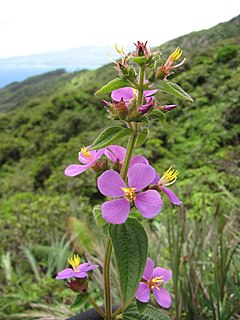
Chaetogastra herbacea, synonym Tibouchina herbacea, is a species of flowering plant in the family Melastomataceae, native to southern Brazil and north-eastern Argentina. It has been introduced to Hawaii. It was first described, as Arthrostemma herbaceum, by Augustin de Candolle in 1828.

Pleroma francavillanum is a species of flowering plant in the family Melastomataceae, native to Brazil. It was first described by Alfred Cogniaux in 1885 as Tibouchina francavillana.
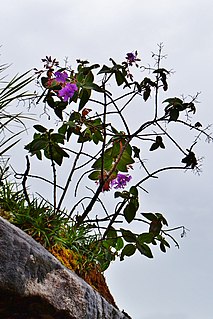
Pleroma pereirae is a species of flowering plant in the family Melastomataceae, native to Brazil. It was first described in 1961 as Tibouchina pereirae.

Chaetogastra versicolor is a species of flowering plant in the family Melastomataceae, native to Brazil. It was first described by John Lindley in 1827 as Rhexia versicolor. One of its synonyms is Tibouchina versicolor.
