Sclerophyll is a type of vegetation that has hard leaves, short internodes and leaf orientation parallel or oblique to direct sunlight. The word comes from the Greek sklēros (hard) and phyllon (leaf).
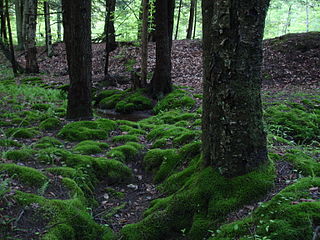
Mosses, or the taxonomic division Bryophyta, are small, non-vascular flowerless plants that typically form dense green clumps or mats, often in damp or shady locations. The individual plants are usually composed of simple leaves that are generally only one cell thick, attached to a stem that may be branched or unbranched and has only a limited role in conducting water and nutrients. Although some species have conducting tissues, these are generally poorly developed and structurally different from similar tissue found in vascular plants. Mosses do not have seeds and after fertilisation develop sporophytes with unbranched stalks topped with single capsules containing spores. They are typically 0.2–10 cm (0.1–3.9 in) tall, though some species are much larger. Dawsonia, the tallest moss in the world, can grow to 50 cm (20 in) in height.

Sphagnum is a genus of approximately 380 accepted species of mosses, commonly known as "peat moss" though they are different as peat moss has a higher acidic pH level. Accumulations of Sphagnum can store water, since both living and dead plants can hold large quantities of water inside their cells; plants may hold 16 to 26 times as much water as their dry weight, depending on the species. The empty cells help retain water in drier conditions.
Xerosere is a plant succession that is limited by water availability. It includes the different stages in a xerarch succession. Xerarch succession of ecological communities originated in extremely dry situation such as sand deserts, sand dunes, salt deserts, rock deserts etc. A xerosere may include lithoseres and psammoseres.

Spiranthes spiralis, commonly known as autumn lady's-tresses, is an orchid that grows in Europe and adjacent North Africa and Asia. It is a small grey-green plant. It forms a rosette of four to five pointed, sessile, ovate leaves about 3 cm (1.2 in) in length. In late summer an unbranched stem of about 10–15 cm (3.9–5.9 in) tall is produced with approximately four sheath-shaped leaves. The white flowers are about 5 mm (0.20 in) long and have a green spot on the lower lip. They are arranged in a helix around the upper half of the stalk. The species is listed in Appendix II of CITES as a species that is not currently threatened with extinction but that may become so. Autumn lady's-tresses are legally protected in Belgium and the Netherlands.

Meesia uliginosa, the broad-nerved hump-moss, is a rare moss of the Western U.S. It occurs all around the northern hemisphere in higher latitudes, and in some places is not as rare as in the Western U.S.

Pseudoroegneria spicata is a species of grass known by the common name bluebunch wheatgrass. This native western North American perennial bunchgrass is known by the scientific synonyms Elymus spicatus and Agropyron spicatum. The grass can be found in the United States, Canada, and Mexico from Alaska and Yukon south as far as Sonora and Nuevo León.

Ceratodon purpureus is a dioicous moss with a color ranging from yellow-green to red. The height amounts to 3 centimeters. It is found worldwide, mainly in urban areas and next to roads on dry sand soils. It can grow in a very wide variety of habitats, from polluted highway shoulders and mine tailings to areas recently denuded by wildfire to the bright slopes of Antarctica. Its common names include redshank, purple forkmoss, ceratodon moss, fire moss, and purple horn toothed moss.

Aulacomnium palustre, the bog groove-moss or ribbed bog moss, is a moss that is nearly cosmopolitan in distribution. It occurs in North America, Hispaniola, Venezuela, Eurasia, and New Zealand. In North America, it occurs across southern arctic, subboreal, and boreal regions from Alaska and British Columbia to Greenland and Quebec. Documentation of ribbed bog moss's distribution in the contiguous United States is probably incomplete. It is reported sporadically south to Washington, Wyoming, Georgia, and Virginia.

Selaginella densa is a species of spikemoss known by the common names lesser spikemoss, prairie spikemoss, and Rocky Mountains spikemoss. It is native to western North America, where it can be found from Alaska to Ontario, the Dakotas, Texas and far northern California.

Polytrichum juniperinum, commonly known as juniper haircap or juniper polytrichum moss, is an evergreen and perennial species of moss that is widely distributed, growing on every continent including Antarctica.

Lysimachia asperulifolia is a rare species of flowering plant in the Primulaceae known by the common name rough-leaved loosestrife and roughleaf yellow loosestrife. It is endemic to the Atlantic coastal plain in North Carolina and northern South Carolina in the United States, where there are 64 known populations. It is a federally listed endangered species of the United States.

Achnatherum nelsonii is a species of grass known by the common names Columbia needlegrass, subalpine needlegrass, and western needlegrass. It is native to western North America, from Yukon and British Columbia to California to Texas.

Calamovilfa longifolia is a species of grass known by the common names prairie sandreed and sand reedgrass. It is native to North America, where it occurs from the Northwest Territories to Ontario in Canada and as far south as New Mexico and Kansas in the United States. There are two varieties, var. longifolia being widespread in the species' range and var. magna being native to the Great Lakes region.
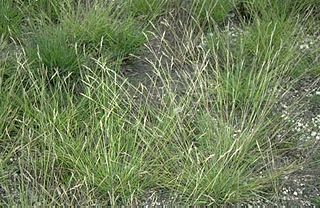
Danthonia spicata is a species of grass known by the common name poverty oatgrass, or simply poverty grass. It is native to North America, where it is widespread and common in many areas. The species is distributed across much of Canada and the United States, and its distribution extends into northern Mexico.

Vaccinium myrsinites is a species of flowering plant in the heath family known by the common name shiny blueberry. It is native to the southeastern United States from Alabama, Georgia, South Carolina and Florida. It may occur as far west as Louisiana.

Eucephalus vialis is a rare North American species of flowering plant in the aster family known by the common name wayside aster. It is native to southwestern Oregon and northwestern California in the United States.

Aquilegia brevistyla is a species of flowering plant in the buttercup family known by the common name smallflower columbine. It is native to northern North America, where it has a disjunct distribution. Most of its range extends from Alaska through much of Canada, and it also occurs in a few areas in the contiguous United States, such as the Black Hills of South Dakota and central Montana. It is most common in eastern Alaska, Yukon, the southern Northwest Territories, and northern parts of Alberta, Manitoba, and Saskatchewan.
Forest conservation is the practice of planning and maintaining forested areas for the benefit and sustainability of future generations. Forest conservation involves the upkeep of the natural resources within a forest that are beneficial for both humans and the ecosystem. Forest conservation acts to maintain, plan, and improve forested areas. Forests provide wildlife with a suitable habitat for living along with filtering groundwater and preventing runoff.

Climacium dendroides, also known as tree climacium moss, belongs in the order Hypnales and family Climaciaceae, in class Bryopsida and subclass Bryidae. It is identified as a "tree moss" due to its distinctive morphological features, and has four species identified across the Northern Hemisphere. The species name "dendroides" describes the tree-like morphology of the plant, and its genus name came from the structure of the perforations of peristome teeth. This plant was identified by Weber and Mohr in 1804. They often have stems that are around 2-10 cm tall and growing in the form of patches, looking like small palm-trees. They have yellow-green branches at the tip of stems. The leaves are around 2.5-3 mm long, with rounder stem leaves and pointier branch leaves. Their sporophytes are only abundant in late winter and early spring, and appears as a red-brown shoot with long stalk and cylindrical capsules.