
Tropaeolum, commonly known as nasturtium or nasturtian , is a genus of roughly 80 species of annual and perennial herbaceous flowering plants. It was named by Carl Linnaeus in his book Species Plantarum, and is the only genus in the family Tropaeolaceae. The nasturtiums received their common name because they produce an oil similar to that of watercress.
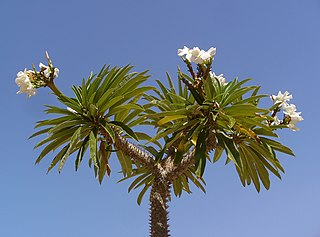
Pachypodium lamerei is a species of flowering plant in the family Apocynaceae. It is a stem succulent, photosynthesizing mainly through its trunk, and comes from the island of Madagascar, off the east coast of Africa. It has large thorns and leaves mostly just at the top of the plant, and large, fragrant flowers. The species has become one of the best known pachypodiums in cultivation, being relatively easy to propagate and grow. In cultivation it is often marketed as the Madagascar palm, despite its not being a palm at all. A variety called "Ramosum" has been described. It is distinguished mostly by a dwarf growth habit.

Alstroemeria, commonly called the Peruvian lily or lily of the Incas, is a genus of flowering plants in the family Alstroemeriaceae. They are all native to South America although some have become naturalized in the United States, Mexico, Australia, New Zealand, Madeira and the Canary Islands. Almost all of the species are restricted to one of two distinct centers of diversity, one in central Chile, the other in eastern Brazil. Species of Alstroemeria from Chile are winter-growing plants while those of Brazil are summer-growing. All are long-lived perennials except A. graminea, a diminutive annual from the Atacama Desert of Chile.

Tropaeolum tuberosum is a species of flowering plant in the family Tropaeolaceae, grown in the Andes, particularly in Peru and Bolivia, and to a lesser extent in Ecuador as well as in some areas of Colombia, for its edible tubers, which are eaten cooked or roasted as a vegetable. It is a minor food source, especially to native Amerindian populations. Mashua is a herbaceous perennial climber growing to 2–4 m (7–13 ft) in height. It is related to garden nasturtiums, and is occasionally cultivated as an ornamental for its brightly coloured tubular flowers.

Strelitzia reginae, commonly known as the crane flower or bird of paradise, is a species of flowering plant indigenous to South Africa. An evergreen perennial, it is widely cultivated for its dramatic flowers. In temperate areas it is a popular houseplant.

Hoya carnosa, the porcelainflower or wax plant, is an asclepiad species of flowering plant in the dogbane family Apocynaceae. It is one of the many species of Hoya that are native to Eastern Asia and Australia. It is a common house plant grown for its attractive waxy foliage, and sweetly scented flowers. It is grown well in pots and hanging baskets.

Ceropegia woodii is a flowering plant in the genus Ceropegia (Apocynaceae), native to South Africa, Swaziland, and Zimbabwe. It is sometimes treated as a subspecies of the related Ceropegia linearis, as C. linearis subsp. woodii. Common names include chain of hearts, collar of hearts, string of hearts, rosary vine, hearts-on-a-string, and sweetheart vine.

Tropaeolum majus is a species of flowering plant in the family Tropaeolaceae, originating in the Andes from Bolivia north to Colombia. An easily-grown annual with disc-shaped leaves and brilliant orange or red flowers, it is of cultivated, probably hybrid origin. It is not closely related to the genus Nasturtium.

Cautleya is a small genus of perennial plants of the family Zingiberaceae, found in the eastern Himalayas through to China and Vietnam. It consists of two species of high-altitude tropical and temperate exotic jungle gingers, native to cool forest areas – an unusual habitat for members of the Zingiberaceae. They are grown as ornamental flowering plants.
Townsonia, commonly called myrtle beech orchids is a genus of two species of flowering plants from the orchid family, Orchidaceae. They form small clusters of plants with their tubers connected, each tuber with one or two leaves. The flowers are inconspicuous.

Nymphaea thermarum is the world's smallest water lily. The pads (leaves) of N. thermarum can measure only 1 cm (0.39 in) across, less than 10% the width of the next smallest species in the genus Nymphaea. By comparison, the largest water lily has pads that can reach 3 m (9.8 ft). All wild plants were lost due to destruction of its native habitat, but it was saved from extinction when it was grown from seed at the Royal Botanic Gardens, Kew in 2009. In January 2014, a surviving water lily was stolen from the Royal Botanic Gardens.

Anemonoides blanda, syn. Anemone blanda, the Balkan anemone, Grecian windflower, or winter windflower, is a species of flowering plant in the family Ranunculaceae, native to southeastern Europe, Turkey, Lebanon, and Syria. The specific epithet blanda means "mild" or "charming". The genus name is derived from the Greek word anemos, or wind.

Cyclamen cilicium is a species of flowering perennial plant in the family Primulaceae. It is native to coniferous woodland at 700–2,000 m (2,300–6,600 ft) elevation in the Taurus Mountains of southern Turkey.
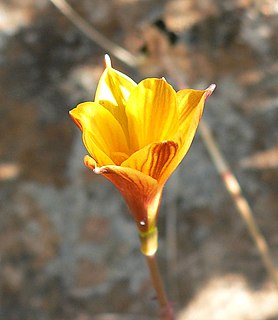
Habranthus tubispathus, the Rio Grande copperlily or Barbados snowdrop, is a species of flowering plant in the family Amaryllidaceae. It is a perennial bulb native to southern South America. It is widely cultivated as an ornamental and reportedly naturalized in the southeastern United States, much of the West Indies as well as Bermuda, eastern Mexico, India, Easter Island, and central Chile.
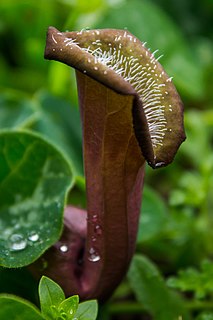
Aristolochia chilensis, known locally as orejas de zorro, is a herbaceous perennial plant native to Chile.

Tropaeolum speciosum, the flame flower or flame nasturtium, is a species of flowering plant in the family Tropaeolaceae native to Chile, where it is known locally as coralito, quintralito, or voqui.

Tropaeolum polyphyllum is a species of flowering plant in the nasturtium family Tropaeolaceae. It is endemic to mountainous regions of Chile and Argentina where it is called in Spanish soldadito grande de la cordillera.

Rubus tricolor is an evergreen prostrate shrub, native to southwestern China. Leaves are dark green above, pale green below, and stems have red bristles. It has white flowers in summer, and edible red fruit. It grows approximately 0.3 m (1 ft) high and usually forming a vigorously spreading, dense mat. In cultivation it is mainly used as groundcover. Common names include Chinese bramble, groundcover bramble, creeping bramble, Korean raspberry, Himalayan bramble, Groundcover Raspberry. In Chinese it is called 三色莓.
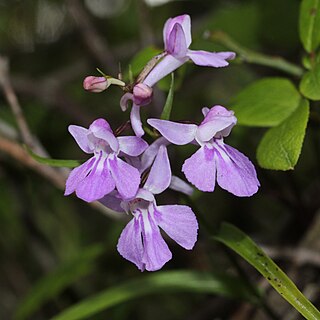
Ponerorchis graminifolia is a species of flowering plant in the family Orchidaceae, native to southern Korea and Japan. They are short herbaceous perennials, growing from a tuber, with small flowers in shades of pink to purple. Many varieties and cultivars are grown in Japan as ornamental plants. The Japanese name for the species is transcribed as uchou-ran or utyouran.
Tropaeolum beuthii is a species of flowering plant in the family Tropaeolaceae, native to Northern Chile. Growing to 1 m (3.3 ft) in height, it is a tuberous summer-dormant climber. It belongs to the same genus as the more familiar annual nasturtium of gardens, Tropaeolum majus.


