Amphiesma monticola, also known as the Wynad keelback, is a harmless colubrid snake species endemic to the Western Ghats of India, where it has been recorded in the Kodagu and Wayanad regions.

The banded racer or banded wolf snake, is a species of colubrid snake.
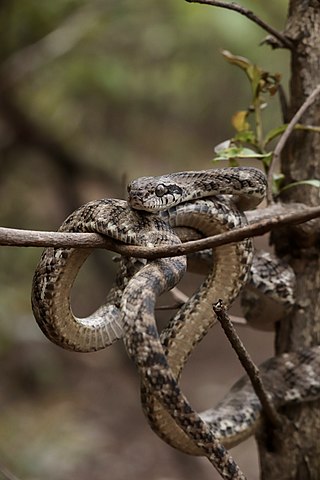
Boiga forsteni, also known commonly as Forsten's cat snake, is a species of mildly venomous rear-fanged snake in the family Colubridae. The species is endemic to South Asia.

The white-banded wolf snake, also known as the northern large-toothed snake, is a species of colubrid snake found in Asia.

Lycodon aulicus, commonly known as the Indian wolf snake or common wolf snake, is a species of nonvenomous snake found in South Asia and Southeast Asia. Early naturalists have suggested its resemblance to the venomous common krait as an instance of Batesian mimicry.

Lycodon jara, commonly known as the twin-spotted wolf snake, is a species of colubrid snake. It is endemic to Asia.

Rhabdophis plumbicolor, known as the green keelback or lead keelback, is a species of nonvenomous snake in the family Colubridae native to parts of the Indian subcontinent.

The arani kukri snake, is a species of nonvenomous colubrid found mainly in South Asia.

The painted keelback is a species of colubrid snake found in Pakistan, Nepal, Bangladesh, and India. This snake is also called the dark-bellied marsh snake.

Sibynophis subpunctatus, commonly known as Duméril's black-headed snake or Jerdon's many-toothed snake, is a species of nonvenomous colubrid snake endemic to Bangladesh, India, Sri Lanka, and Nepal.

Hydrophis melanocephalus, commonly known as the slender-necked sea snake, is a species of venomous sea snake in the family Elapidae.

Günther's black snake is a species of poorly known lamprophiid snake endemic to central Africa. It is the only member of the genus, Bothrolycus. This snake is notable as one of the few snakes with notable sexual dimorphism, as well as possessing a small pit anterior to the eye. While superficially similar to the thermal pits of vipers, its function remains unknown.

Coelognathus helena monticollaris is subspecies of nonvenomous constricting snake in the family Colubridae. The subspecies is native to the Western ghats of India.
Brachyophis is a monotypic genus created for the rear-fanged venomous snake species, Brachyophis revoili, commonly known as Revoil's short snake, which is endemic to Eastern Africa. Three subspecies are recognized as being valid.
Hypoptophis is a monotypic genus created for the rear-fanged (opisthoglyphous) venomous snake species, Hypoptophis wilsonii. The species, which is endemic to Africa, is in the subfamily Aparallactinae of the family Atractaspididae. There are no subspecies that are recognized as being valid.

Macrelaps is a monotypic genus created for the rear-fanged (opisthoglyphous) venomous snake species, M. microlepidotus, endemic to South Africa. No subspecies are currently recognized.
The Cameroon racer, Poecilopholis cameronensis, is a species of rear-fanged venomous snake endemic to Africa. Poecilopholis is a monotypic genus created for this species.
Micrelaps boettgeri, commonly known as Boettger's two-headed snake, is a species of venomous rear-fanged snake in the family Atractaspididae. The species is endemic to Africa.

Aparallactus modestus, or the western forest centipede-eater, is a species of venomous rear-fanged snake in the Atractaspididae family.

Uropeltis shorttii, also known commonly as the Shevaroy Hills earth snake and Shortt's shieldtail snake, is a species of non-venomous snake in the family Uropeltidae. The species is endemic to the southern Eastern Ghats of India. This species was first described as Silybura shorttii by British naturalist Richard Henry Beddome in 1863. It is found only in the Shevaroy Hills of Salem district in Tamil Nadu state in South India. For a long time, this species was misclassified into Uropeltis ceylanica, a snake endemic to the Western Ghats, till a recent taxonomic study proved it to be a distinct species with a very narrow geographic range. It is a burrowing snake, presumed to be nocturnal, feeding on soft-bodied worms. It becomes active during the rains. U. shorttii has most recently been assessed for The IUCN Red List of Threatened Species in 2019, and is listed as "Critically Endangered" under criteria B1ab(iii).