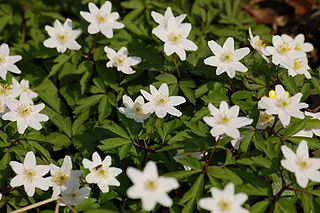
Anemonoides nemorosa, the wood anemone, is an early-spring flowering plant in the buttercup family Ranunculaceae, native to Europe. Other common names include windflower, European thimbleweed, and smell fox, an allusion to the musky smell of the leaves. It is a perennial herbaceous plant growing 5–15 cm (2–6 in) tall.

Aloysia citrodora, lemon verbena, is a species of flowering plant in the verbena family Verbenaceae, native to South America. Other common names include lemon beebrush. It was brought to Europe by the Spanish and the Portuguese in the 17th century and cultivated for its oil.
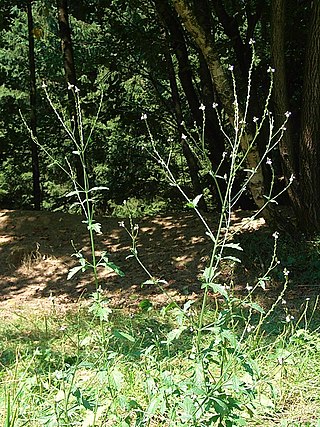
Verbena, also known as vervain or verveine, is a genus in the family Verbenaceae. It contains about 150 species of annual and perennial herbaceous or semi-woody flowering plants. The majority of the species are native to the Americas and Asia; however, Verbena officinalis, the common vervain or common verbena, is the type species and native to Europe.
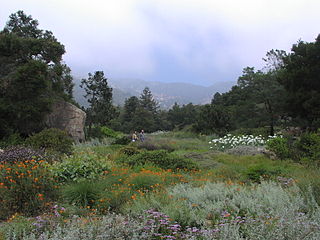
The Santa Barbara Botanic Garden is a 78-acre botanical garden (32 ha), containing over 1,000 species of rare and indigenous plants. It is located in Mission Canyon, Santa Barbara, California, United States.

Ceanothus arboreus is a species of perennial shrub to small tree in the family Rhamnaceae, commonly known as the feltleaf ceanothus, island ceanothus, and island mountain lilac. It is the largest member of the California lilacs, and is characterized with glossy, dark green foliage that is adorned by pale blue to white flowers in bloom. It is endemic to the Channel Islands of California and Guadalupe Island in Mexico, only being re-discovered on Guadalupe Island after the elimination of feral goats.

Verbena bonariensis, the purpletop vervain, clustertop vervain, Argentinian vervain, tall verbena or pretty verbena, is a member of the verbena family cultivated as a flowering annual or herbaceous perennial plant. In USA horticulture, it is also known by the ambiguous names purpletop and South American vervain. For the misapplication "Brazilian verbena" see below.

Verbena hastata, commonly known as American vervain, blue vervain, simpler's joy, or swamp verbena, is a perennial flowering plant in the vervain family Verbenaceae. It grows throughout the continental United States and in much of southern Canada.

Symphyotrichum sericeum is a species of flowering plant in the family Asteraceae native to central North America. Commonly known as western silver aster, western silvery aster, and silky aster, it is a perennial, herbaceous plant that may reach 70 centimeters tall. Its flowers have purple ray florets and pink then purple disk florets, and its leaves are firm and silvery-green.

Salvia cedrosensis, commonly known as the Cedros Sage or Cedros Island Sage is an evergreen fruticose perennial plant that is endemic to the western (Pacific) coast of Baja California in Mexico, native to the Vizcaino peninsula and Cedros Island.
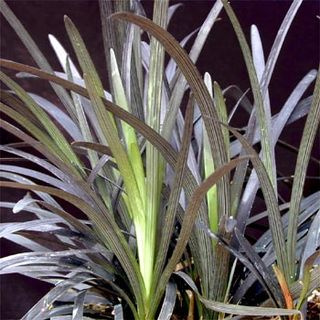
Ophiopogon planiscapus is a species of flowering plant in the family Asparagaceae. It is a small evergreen perennial growing to 20 cm (8 in) tall by 30 cm (12 in)wide. It grows from short rhizomes, and bears tufts of grasslike leaves, from which purple or white flowers emerge in racemes held on short stems above the leaves. It is native to Japan, where it grows on open and forested slopes.

Verbena tenera, commonly known as South American mock vervain, is a species of flowering plant in the verbena family. It is native to Brazil, Argentina, and Uruguay, and it is present elsewhere as an introduced species and roadside weed. It is an annual or perennial herb producing one or more stems growing decumbent to erect in form and hairy to hairless in texture. The rough-haired leaves are divided deeply into lobes. The inflorescence is a dense, headlike spike of many flowers up to 1.5 centimeters wide. Each flower corolla is up to 1.4 centimeters wide and white to purple in color.

Verbena rigida, known as slender vervain or tuberous vervain, is a flowering herbaceous perennial plant in the family Verbenaceae. It is native to Brazil and Argentina, and is not fully hardy in temperate climates, where consequently it is grown from seed as an annual.

Stachytarpheta cayennensis is a species of flowering plant in the verbena family known by many English language common names, including blue snakeweed, Cayenne snakeweed, dark-blue snakeweed, bluetop, nettle-leaf porterweed, rattail, rough-leaf false vervain, blue rat's tail, Brazilian tea, Cayenne vervain, false verbena, joee, nettleleaf velvetberry, and Cayenne porterweed. Names in other languages include honagasō (Japanese), gervão-urticante, piche de gato, rabo de zorro (Spanish), herbe á chenille, herbe bleue, queue de rat (French), ōi or ōwī (Hawaiian), sakura or ouchung (Chuukese), and tiāki (Māori). It is native to the Americas, from Mexico south through Central and South America to Argentina, as well as many islands of the Caribbean. It is known in many other parts of the world as an introduced species, including regions in Africa, India, Indonesia, Australia, Florida in the United States, and many Pacific Islands. Its distribution is now considered pantropical. In many places, such as New Caledonia, it has become an invasive species.
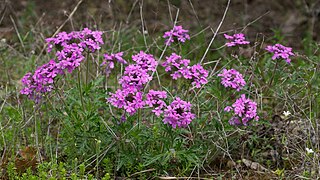
Verbena canadensis, commonly known as rose mock vervain, rose verbena, clump verbena or rose vervain is a perennial herbaceous flowering plant in the verbena family (Verbenaceae) with showy pink to purple flowers.. It is native to the eastern and south-central areas of the United States. This species is widely cultivated as an ornamental, and naturalized populations have been established outside its native range, such as in the northeastern U.S.
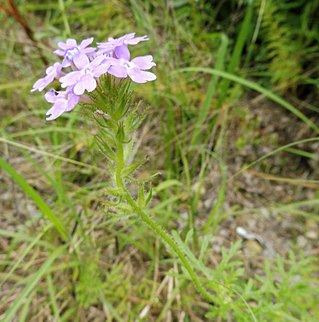
Verbena bipinnatifida, commonly called Dakota mock vervain, prairie verbena, and Moradilla, among others, is a species of flowering plant in the verbena family Verbenaceae.

Aloysia virgata, known as sweet almond verbena and sweet almond bush, is a perennial plant in the family Verbenaceae native to Argentina. It grows from Central Argentina up to Brazil and Peru, with multiple instances in Yucatán, Southeastern United States, and Texas.

Dudleya pachyphytum is an insular succulent plant known by the common name Cedros Island liveforever. It is a member of the genus Dudleya, in the family Crassulaceae. Characterized by thick, blunt leaves covered in a white, powdery wax and adorned by white flowers in bloom, it is regarded as one of the most attractive and charismatic members of its genus. It is endemic to the foggy northern end of Mexico's Cedros Island, occupying an ecological niche shared with the Cedros Island Pine.

Verbena aristigera, variously called the moss verbena, desert verbena, fine leafed verbena, wild verbena, tuber vervain, South American mock vervain, Mayne's curse and Mayne's pest, is a species of flowering plant in the family Verbenaceae. It is native to Bolivia, southern Brazil, northern Argentina, Paraguay and Uruguay. It has been widely introduced to the rest of the world's drier tropics and subtropics, including California, Guatemala, Honduras, Nicaragua, Venezuela, Greece, Nigeria, eastern and southern Africa, India, and all of Australia except Tasmania.

Nierembergia scoparia is a species of plant in the family Solanaceae.
Verbena chiricahensis, commonly named Chiricahua Mountain mock vervain or Chiricahua vervain, is a species of flowering plant in the family Verbenaceae. The specific name is sometimes misspelled as "chiricahuensis".


