Xylosma hurlimannii is a shrub or tree reaching up to a reported 2m (6ft 7in) in height, characterized by a spreading habit with long brown branches that are rugose , densely lenticellate, and minutely puberulous . The leaves are almost discoid , measuring up to 7cm (2.8in) long and 6cm (2.4in) wide; the apex is obtuse or rounded, the base is rounded or slightly cordate, and the margins are subdentate. The veins come in pairs that form a reticulate pattern; the petiole is short and minutely puberulous, measuring 5mm (0.20in) long.
The range of Xylosma hurlimannii is restricted to New Caledonia, and is only documented from a small extent in southern Grande Terre, occupying the communes of Dumbéa and Païta. It is exclusively recorded from the Couvélée Mountains and the areas surrounding it.
Xylosma hurlimannii is a tropical species reported from a narrow range of habitats at elevations of up to 800m (2,600ft). Being found in montane and submontane environments, it occurs in valleys and along ridges. Additionally, it is noted to be in loose upland forest on serpentine substrates covered in scree.[2][3][4][7]
Taxonomy
Xylosma hurlimannii was first described by André Guillaumin in 1953 uunder the same name it has today; although later switched to Xylosma hürlimannii, it was a redundant change. In 1974, the taxon was reassigned to Lasiochlamys by Hermann Otto Sleumer, still in Flacourtiaceae; the epithet given to it was hürlimannii, later corrected to hurlimannii, and alternative spelled huerlimannii.[2][3][4][7] This system was brief however, as Sleumer would hastily refute the accuracy of the family in 1975. As a result, Lasiochlamys hurlimannii, along with its genus, were changed to be in Salicaceae.[2][8]
An ecological study in 1980 by Tanguy Jaffré noted that Lasiochlamys could be differentiated from Xylosma for lacking the property of accumulating nickel, but this would later prove ineffective as a distinguishing trait.[9] In 2005, Mac Haverson Alford published a thesis in which Lasiochlamys was suggested to be nested in Xylosma based on molecular phylogenetic analysis.[10] It was not until 2023 however, when Lasiochlamys was ultimately synonymized with Xylosma by Yohan Pillon, resulting in the transfer of all of its species to the new classification. This revision resulted in the renaming of Lasiochlamys hurlimannii to its now recognized name; Xylosma hurlimannii, which cites Guillaumin as the author once more.[2][5] Decades earlier, Xylosma underwent a gender agreement whose purpose was to match the specific epithets with the female generic name; it was likely initiated by William T. Stearn in 1992 when he commented on the gender inaccuracy, and finalized by Dan Henry Nicolson in 1994. Despite this, Xylosma hurlimannii would not have been subject to it because its epithet is a genitive noun, which remains unchanged regardless of gender; another reason would be that it was in Lasiochlamys at the time, which has a female generic name.[3][11][12][13]
Etymology
The generic name Xylosma derives from xylon (Ancient Greek: ξύλον), meaning "wood" or "tree", and osmé (Ancient Greek: ὀσμή), meaning "smell", overall referring to the aromatic wood found in some species.[14] The specific epithet, hurlimannii, is in honor of Hans Hürlimann, a Swiss botanist who collected its type specimen.[7] As for the defunct genus Lasiochlamys, it stems from lasio- (Ancient Greek: λάσιος), meaning "hairy", and chlamys (Ancient Greek: χλαμύς), meaning "cloak".[13]
Conservation status
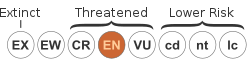
Xylosma hurlimannii was classified as endangered by the IUCN Red List under its old name in 1998; the assessment itself has many missing elements and needs updating due to its age.[1] It is listed as a protected species by the National Natural Heritage Inventory also under its previous name, though further information on its status is absent.[6]
This page is based on this Wikipedia article Text is available under the CC BY-SA 4.0 license; additional terms may apply. Images, videos and audio are available under their respective licenses.