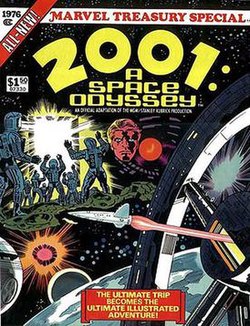
Treasury edition
In the 70s, Marvel Comics made investments on licensed comics based on sci-fi works, adapting movies and novels such as Star Wars , Godzilla , Planet of the Apes , and Logan’s Run . [1] According to Mark Evanier, Marvel had acqucired the rights to 2001: A Space Odyssey from Metro-Goldwyn-Mayer in the mid-70s and there was a general agreement inside of the company that Jack Kirby, who was working for the rival company DC Comics at the time, should be the one to adapt the film. Kirby accepted, but he was unhappy to work on an adaptation and decided to narrate the story from his viewpoint. He has taken "three or four weeks" to finalize the story, and later declared that it was "an honor, but not a lot of fun". [2]
The story is a close adaptation of the events of the film, but differs in the fact that Kirby incorporated additional dialog from two other sources: the novel [3] and a copy of an earlier draft script of the film that included the more colloquial-sounding version of HAL 9000, as originally voiced by actor Martin Balsam before he was replaced by Douglas Rain. [4] In addition, the comic narrative chooses to use more dialog than visual effects when compared to the movie. The captions describe the characters' thoughts and feelings, a significantly different approach from that taken by the film. Kirby has also chosen to portray the characters as more beefy and emotional than their counterparts from the film. [2] Kirby has also implemented his own art style, diminishing the realism presented in the movie. He often depicted the space and planets with pink, purple, blue and other strong colors, with the presence of "Kirby Krackles" in several pannels. Sometimes, he had also used photo-collage panels. [4] Marvel published the adaptation in its then-common treasury edition format featuring tabloid-sized pages of roughly twice the size of a standard American comic book. [5] [6] It also contained a 10-page article entitled "2001: A Space Legacy" written by David Anthony Kraft.
Monthly series
Shortly after the publication of the treasury edition, Marvel asked Kirby to explore the concepts of 2001 in a monthly comic book series of the same name. According to Evanier, Kirby thought that adapting the movie into a series was a bad idea, but he accepted the project anyways. There was some doubt if original characters would be considered a trademark from Marvel or MGM, so Kirby was dissuaded from creating new, recurring characters. [2]
Up until issue #6, Kirby retold the tale of the monolith, creating new characters that are transformed into New Seed. [7] Here, Kirby followed the pattern established in the film, replaying the same idea with different characters in different situations, both ancient and futuristic. [8]
The first issue was cover dated December 1976. [9] Once again the reader encounters a prehistoric man ("Beast-Killer") who lives in what is going to become New Orleans. He gains new insight upon encountering a Monolith as did Moon-Watcher in the film, and learns how to create and use weapons. The scene then shifts, where Woodrow Decker, a descendant of Beast-Killer, and his companion Maston are in a mission to locate alien life. They crash in an asteroid between Mars and Jupiter, where they find ruins of an ancient civilization. Maston's life support is crashed by an alien and the ruins start to collapse. Decker runs for his life and encounters the Monolith. It then transforms him into a Star Child, called in the comic a "New Seed". [8] [10] [11]
Issue #2 introduces the story of "Vira, the She-Demon". It starts with a starving prehistoric woman called Vira accidentally entering a ritual cave full of skulls while looking for food in the volcanic region that will eventually be Italy. She is caught by other prehistoric men, but she scapes by setting a skull on fire and thus making them believe it came back to life. She overhears them talking about a stone spirit and finds the monolith, that teaches her how to use religion for her survival. She then covers herself with bones and declares to be an emissary of the stone spirit. The prehistoric men venerate her out of fear, and the tribe prospers. One of Vira's descendants, Vera Gentry, is sent by NASA to the Jovian moon Ganymede to look for UFOs. She finds it, but the aliens are hostile and destroy her life support. Vera finds the monolith while trying to survive the attack and is transformed into a New Seed. [7] [12] [13] Sequart Organization has pointed that Vira is probably based on Shanna the She-Devil, that had her debut five years prior. [12]
In issues #5–6, Kirby introduces the two-part story named "Norton of New York 2040 A.D." It starts with "The White Zero" fighting a monster in a simulation at the "Comicsville" amusement park. He thus proceeds to enlist for space exploration and ends up battling an army of aliens and rescuing a princess. He then finds the monolith and becomes a New Seed. [1] Wired has classified the story as "a cross between Marvel's Inhumans and DC's New Gods ". [2]
In issue #7 (June 1977), the comic starts with a story called "The New Seed". [1] It opens with the birth of a New Seed who then travels the galaxy witnessing the suffering that men cause each other. While the New Seed is unable or unwilling to prevent this devastation, he takes the essence of two doomed lovers and uses it to seed another planet with the potential for human life. [8] According to Cracked.com , Kirby combined several of his sci-fi heroes, including Silver Surfer, Human Torch and Uatu the Watcher, to create New Seed's personality and powers. [1]
In issue #8 (July 1977), Kirby introduces Mister Machine, [14] an advanced robot designated X-51. All the other robots in the X series go on a rampage as they achieve sentience and are destroyed. X-51, supported by both the love of his creator Dr. Abel Stack and an encounter with a Monolith, transcends the malfunction that destroyed his siblings. After the death of Dr. Stack, X-51 takes the name Aaron Stack and begins to blend into humanity. [15] Issues #9 and 10, the final issues of the series, continue the story of X-51 as he flees destruction at the hands of the Army. [8] On the final panels of the comic, Mister Machine abandons his sidekick Jerry and his family, and his solo magazine, Machine Man (1978), is announced. [1]
Legacy
The story was obfuscated by others of Kirby's comic books, such as X-Men , Black Panther and Thor , and turned out to be one of his most forgotten creations. According to Kubrick scholar James Fenwick, there was no trace of the comics on the Kubrick Archive and he was unsure if Stanley Kubrick was even aware of its existence. Nevertheless, one of Kirby's original characters, Mister Machine, was renamed as Machine Man and got his own series, thus being officially incorporated into the Marvel Universe. [2]
A reprint was never released due to copyright issues. Marvel owns part of the trademark, but even though the original deal was made with MGM, Warner Bros. later became the owner of the franchise. Kubrik's family also holds the rights of the franchise. [2]