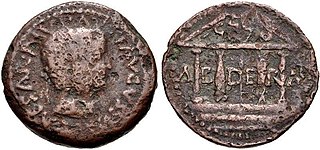
Abdera was an ancient Carthaginian and Roman port on a hill above the modern Adra on the southeastern Mediterranean coast of Spain. It was located between Malaca and Carthago Nova in the district inhabited by the Bastuli.
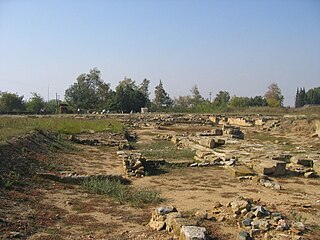
Abdera is a municipality in the Xanthi regional unit of Thrace, Greece. In classical antiquity, it was a major Greek polis on the Thracian coast.
In Greek mythology, Abderus or Abderos was a divine hero, reputed by some to be one of Heracles' lovers (eromenoi), and reputedly a son of Hermes by some accounts, and eponym of Abdera, Thrace.
Hecataeus of Abdera or of Teos, was a Greek historian who flourished in the 4th century BC. Though none of his works survive, his writings are attested by later authors in various fragments, in particular his Aegyptica, a work on the society and culture of the Egyptians, and his On the Hyperboreans. He is one of the authors whose fragments were collected in Felix Jacoby's Fragmente der griechischen Historiker.

Xanthi is one of the regional units of Greece. It is part of the Region of East Macedonia and Thrace. The capital is Xanthi. Together with the regional units Rhodope and Evros, it forms the geographical region of Western Thrace.

Adra, the classical Abdera, is a municipality of Almería province, Spain.
Myrodato is a settlement in the Abdera municipal unit, Xanthi regional unit of Greece. It is located 2 kilometres (1.2 mi) west of Abdera. Its population was 402 at the 2021 census. In 1981, the settlement had a population of around 668, and in 1991 about 671.
Bion of Abdera was a Greek mathematician and astronomer of Abdera, Thrace, and a pupil of Democritus. Strabo refers to him as an astrologer. He wrote both in the Ionic and Attic dialects, and was the first who said that there were some parts of the Earth in which it was night for six months, while the remaining six months were one uninterrupted day. He also engaged in correlating the direction of winds with climate and is believed to have traveled to distant regions.
Darrhon or Darron was a Paeonian god of healing, whose cult was adopted by the ancient Macedonians, as mentioned by Hesychius as a Macedonian Daemon and attested hapax in one inscription of Pella c. 200 – 150 BC.
Ἀμφίπολις Δάρρωνι εὐξαμένη ἐπηκόωι. Amphipolis Darrhoni euxamene epekooi. Amphipolis who prayed to benevolent Darrhon.
The Archaeological Museum of Abdera is a museum in Abdera, Greece. The museum houses archaeological artefacts found in the city which date from around 7th century BC to 13th century AD.

Acraea cepheus, the Cepheus acraea, is a butterfly of the family Nymphalidae. It is found in Africa, from Nigeria and Angola to Uganda, western Tanzania and Zambia.
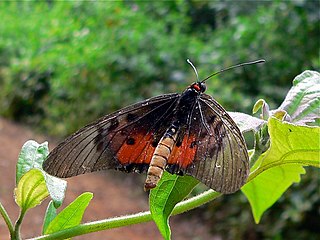
Acraea abdera, the Abdera acraea, is a butterfly in the family Nymphalidae. It is found in Sierra Leone, Liberia, Ivory Coast, Ghana, Togo, Nigeria, Cameroon, Equatorial Guinea, Sudan, Uganda and the Republic of the Congo.
Abderites or Abderite may refer to:

Metarbela triguttata is a moth in the family Cossidae. It is found in Cameroon.

Abdera flexuosa is a species of false darkling beetle (Melandryidae). (Paykull, 1799)
Abdera is a genus of false darkling beetles, in the family Melandryidae. It contains three species, two of which are extinct and were discovered in 2014.
Die Geschichte der Abderiten, subtitled Eine sehr wahrscheinliche Geschichte, is a satirical novel by the German poet and writer Christoph Martin Wieland. Written between 1773 and 1779, it was published in part in the periodical Der teutsche Merkur in 1774 and was first issued as a collection in book form in 1780. It satirises the pettiness of the inhabitants of small-town Germany, using the ancient Greek town of Abdera as a stand-in for the contemporary German towns which Wieland was critiquing. Abderit is a name for a 'Schildbürger', a naive and simple but also conceded person. The term likely targeted the often hypocritical citizens of Wieland's home town of Biberach.

