
Dieffenbachia, commonly known as dumb caneorleopard lily, is a genus of tropical flowering plants in the family Araceae. It is native to the New World Tropics from Mexico and the West Indies south to Argentina. Some species are widely cultivated as ornamental plants, especially as houseplants, and have become naturalized on a few tropical islands.

The Nymphalidae are the largest family of butterflies, with more than 6,000 species distributed throughout most of the world. Belonging to the superfamily Papilionoidea, they are usually medium-sized to large butterflies. Most species have a reduced pair of forelegs and many hold their colourful wings flat when resting. They are also called brush-footed butterflies or four-footed butterflies, because they are known to stand on only four legs while the other two are curled up; in some species, these forelegs have a brush-like set of hairs, which gives this family its other common name. Many species are brightly coloured and include popular species such as the emperors, monarch butterfly, admirals, tortoiseshells, and fritillaries. However, the under wings are, in contrast, often dull and in some species look remarkably like dead leaves, or are much paler, producing a cryptic effect that helps the butterflies blend into their surroundings.

Violaceae is a family of flowering plants established in 1802, consisting of about 1000 species in about 25 genera. It takes its name from the genus Viola, the violets and pansies.

Philodendron is a large genus of flowering plants in the family Araceae. As of September 2015, the World Checklist of Selected Plant Families accepted 489 species; other sources accept different numbers. Regardless of number of species, the genus is the second-largest member of the family Araceae, after genus Anthurium. Taxonomically, the genus Philodendron is still poorly known, with many undescribed species. Many are grown as ornamental and indoor plants. The name derives from the Greek words philo- 'love, affection' and dendron 'tree'. The generic name, Philodendron, is often used as the English name.

The Marantaceae are a family, the arrowroot family, of flowering plants consisting of 31 genera and around 530 species, defining it as one of the most species-rich families in its order. Species of this family are found in lowland tropical forests of Africa, Asia, and the Americas. The majority (80%) of the species are found in the American tropics, followed by Asian (11%) and African (9%) tropics. They are commonly called the prayer-plant family and are also known for their unique secondary pollination presentation.

Rhynchospora is a genus of about 400 species of sedges with a cosmopolitan distribution. The genus includes both annual and perennial species, mostly with erect 3-sided stems and 3-ranked leaves. The achenes bear a beak-like tubercule and are sometimes subtended by bristles. Many of the species are similar in vegetative appearance, and mature fruits are needed to make a positive identification.

Schefflera is a genus of flowering plants in the family Araliaceae with 13 species native to New Zealand and some Pacific islands.

Rhabdodendron is a genus of flowering plant in the family Rhabdodendraceae. It comprises three species of tropical South American trees.
Baursia is a section within the genus Philodendron that consists of 33 different species of plants. Philodendron species that are members of this section are typically described as having very prominent lateral veins. They also have elongated oblong leaves with a few species that are exceptions to this rule. Members of this section are usually found within southeastern South America and the upper amazon basin. The type species for this section is Philodendron crassinervium. Additionally, philodendron within this section have plurilocular ovaries.

Thaumatophyllum bipinnatifidum is a plant in the genus Thaumatophyllum, in the family Araceae. Previously it was classified in the genus Philodendron within subgenus Meconostigma. The commonly used names Philodendron bipinnatifidum and Philodendron selloanum are synonyms. This plant is native to South America, namely to Brazil, Bolivia, Argentina, and Paraguay, but is also cultivated as a landscape plant in tropical, subtropical and warm temperate climates.
Alan W. Meerow is an American botanist, born in New York City in 1952. He specializes in the taxonomy of the family Amaryllidaceae and the horticulture of palms and tropical ornamental plants. He also works on the population genetics and molecular systematics of cycads and palms.

Prothysana is a genus of moths of the family Apatelodidae. It contains two species, whose larvae are known as shag-carpet caterpillars. They are found from Mexico, south to Panama and into South America, at least to Ecuador.

Adelonema is a genus of plants in the family Araceae.

Thaumatophyllum is a genus of flowering plants in the arum family, Araceae. Its species are native to northern (tropical) South America.
Thaumatophyllum xanadu is a perennial plant belonging to the arum family Araceae and the genus Thaumatophyllum, formerly classified under the Meconostigma subgenus of Philodendron. This plant is native to Brazil, but is widely cultivated as a landscape plant in tropical, subtropical and warm temperate climates.

The Solanaceae, or the nightshades, are a family of flowering plants that ranges from annual and perennial herbs to vines, lianas, epiphytes, shrubs, and trees, and includes a number of agricultural crops, medicinal plants, spices, weeds, and ornamentals. Many members of the family contain potent alkaloids, and some are highly toxic, but many—including tomatoes, potatoes, eggplant, bell and chili peppers—are used as food. The family belongs to the order Solanales, in the asterid group and class Magnoliopsida (dicotyledons). The Solanaceae consists of about 98 genera and some 2,700 species, with a great diversity of habitats, morphology and ecology.

Philodendron billietiae [(bi·lli·et·i·ae) pronounced “bili ətiā”)] is a hemi-epiphytic species of plant in the genus Philodendron native to Brazil, Guyana, and French Guiana. A relatively recent discovery in 1995, P. billietiae is known especially for its distinctive orange-yellow petioles and wavy, ridged leaf edges. Philodendron billietiae is commonly mistaken for Philodendron burle-marxii due to their similar structure and coloration.
Oerstedina is a genus of epiphytic flowering plants in the family Gesneriaceae, native to Mexico, Costa Rica and Panama. The relationship of Oerstedina to the genus Rufodorsia is uncertain, as of April 2021.

Philodendron patriciae is a plant in the genus Philodendron native to the Chocó region of Colombia. It was scientifically described in 2010 by Thomas Croat, who named it after his wife Patricia and called it "one of the most spectacular species of Philodendron that he had ever seen". An epiphyte, as it climbs the long, ovate-lanceolate leaves hang down and develop ruffles. The ovules of the plant are set up axially and number up to at least 10 per locule. It is also characterized by its short stems and pendent narrow blades, which are matte and become undulated in age.
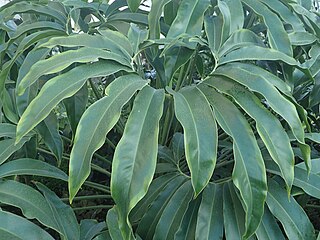
Thaumatophyllum spruceanum is a neotropical hemiepiphytic or scrambling plant in the genus Thaumatophyllum, in the family Araceae. It is native to northern South America.


