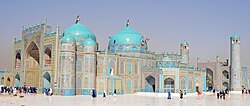
Afghans[a] are the citizens and nationals of Afghanistan. They are composed of various ethnic groups, of which Pashtuns, Tajiks, Hazaras, and Uzbeks are the largest.
The earliest mention of the name Afghan (Abgân) is by Shapur I of the Sassanid Empire during the 3rd century CE,[47][48][49] In the 4th century, the word "Afghans/Afghana" (αβγανανο) as reference to the Pashtun people is mentioned in the Bactrian documents found in Northern Afghanistan.[50][51] The word 'Afghan' is of Persian origin and refers to the Pashtun people.[52] Some scholars suggest that the word "Afghan" is derived from the words awajan/apajan in Avestan and ava-Han/apa-Han in Sanskrit, which means "killing, striking, throwing and resisting, or defending." Under the Sasanians, and possibly the Parthian Empire, the word was used to refer to men of a certain Persian sect.[53] In the past, several scholars sought a connection with "horse", Skt.aśva-, Av.aspa-, i.e. the Aśvaka or Aśvakayana, the name of the Aśvakan or Assakan, the ancient inhabitants of the Hindu Kush region. Some have theorized that the name of the Aśvakan or Assakan has been preserved in that of the modern Pashtun, with the name Afghan being derived from Asvakan.[54][55][56][57][58][59][60][61]
As an adjective, the word Afghan also means "of or relating to Afghanistan or its people, language or culture". According to the 1964 Constitution of Afghanistan, all Afghans citizens are equal in rights and obligations before the law.[62] The fourth article of the Constitution of the Islamic Republic of Afghanistan, which was valid until 2021, states that citizens of Afghanistan consist of Pashtun, Tajik, Uzbek, Turkmen, Baloch, Pashayi, Nuristani, Aimaq, Arab, Kyrgyz, Qizilbash, Gurjar, Brahui, and members of other ethnicities.[63] There are political disputes regarding this: there are members of the non-Pashtun ethnicities of Afghanistan that reject the term Afghan being applied to them, and there are Pashtuns in Pakistan that wish to have the term Afghan applied to them.[64][65][66][67][68]
Usage as an ethnonym
The pre-nation state, historical ethnonym Afghan was used to refer to a member of the Pashtun ethnic group. Due to the changing political nature of the state, the meaning has changed, and the term has shifted to refer to the national identity of people from Afghanistan of all ethnicities.[69][70][71]
From a more limited, ethnological point of view, "Afḡhān" is the term by which the Persian-speakers of Afghanistan (and the non-Pashtō-speaking ethnic groups generally) designate the Pashtūn. The equation Afghans = Pashtūn has been propagated all the more, both in and beyond Afghanistan, because the Pashtūn tribal confederation has maintained its hegemony in the country, numerically and politically.[72]
Variations
The term Afghani refers to the unit of Afghan currency. The term is also often used in the English language (and appears in some dictionaries) for a person or thing related to Afghanistan, although some have expressed the opinion that this usage is incorrect.[73] The reason for this usage might be because the term "Afghani" (افغانی) is in fact a valid demonym for Afghans in the overall Persian language, whereas "Afghan" is derived from Pashto. Thus, "Afghan" is the anglicized form of "Afghani" when translating from Dari Persian, but not from Pashto.[74] Another variant is Afghanistani[75][76] and Afghanese, which has been seldom used in place of Afghan.[77][78][79]
Ethnicities
Ethnolinguistic groups in Afghanistan and its surroundings (1982).
Afghans come from various ethnic backgrounds. The largest ethnic groups are Pashtuns. Historian Clifford Edmund Bosworth defines "Afghan" primarily as a historical ethnonym for the Pashtun people. In his scholarly analysis of medieval Islamic sources, such as the 10th-century geography Hudūd al-ʿĀlam, Bosworth notes that the term was originally restricted to specific Pashtun tribes residing in the frontier regions between the Hindu Kush and the Indus River. He maintains a clear distinction between these "Afghans" and other ethnic groups residing in the region, such as the Tajiks (sedentary Persian-speakers), Uzbeks, and Hazaras, whom he identifies as having separate linguistic and historical origins. [80][81][82]
While Bosworth acknowledges that the 1964 Constitution of Afghanistan formally standardised "Afghan" as a national demonym for all citizens regardless of their ethnicity, his work emphasizes that for most of the region's history, the term remained synonymous with Pashtun identity. [83]Tajiks, Hazaras, and Uzbeks, who make up approximately 60–70% of the population of Afghanistan have diverse origins including of Iranic, Turkic or Mongolic ethnolinguistic roots.[84]
Historically, Afghan culture is centered on Pashtunwali, an ancient, pre-Islamic code of conduct based on core tenets such as hospitality (melmastia), personal and tribal honour (nang), and retributive justice (badal). While oral tradition served as the primary vessel for this culture for centuries, the oldest direct written literary records of Pashtun culture and social values are found in Pashto poetry and prose, such as the 16th-century and later 19th-century works.
Broader Afghan culture, encompassing the diverse ethnic groups within the modern borders, is historically and linguistically linked to the Persian world.
↑"Article Sixteen of the 2004 Constitution of Afghanistan". 2004. Archived from the original on 28 October 2013. Retrieved 13 June 2012. Dari and Pashto are the official languages of the state. Uzbek, Turkmen, Baluchi, Pashai, Nuristani, and Pamiri are—in addition to Pashto—the second official language in areas where the majority speaks them.
↑Garner, Bryan (2009). Garner's Modern American Usage (thirded.). New York: Oxford University Press. p.27. ISBN978-0-19-538275-4.
↑Siegal, Allan M.; Connolly, William (2015). The New York Times Manual of Style and Usage (fifthed.). New York: Crown Publishing Group. p.18. ISBN978-1-336-02484-7.
↑Noelle-Karimi, Christine; Conrad J. Schetter; Reinhard Schlagintweit (2002). Afghanistan -a country without a state?. University of Michigan, United States: IKO. p.18. ISBN3-88939-628-3. Retrieved 24 September 2010. The earliest mention of the name 'Afghan' (Abgan) is to be found in a Sasanid inscription from the 3rd century, and it appears in India in the form of 'Avagana'...
↑Sims-Williams, Nicholas (2000). Bactrian documents from northern Afghanistan. Oxford: The Nour Foundation in association with Azimuth Editions and Oxford University Press. ISBN1-874780-92-7.
↑"The name Afghan has evidently been derived from Asvakan, the Assakenoi of Arrian... " (Megasthenes and Arrian, p 180. See also: Alexander's Invasion of India, p 38; J.W. McCrindle).
↑Indische Alterthumskunde, Vol I, fn 6; also Vol II, p 129, et al.
↑Etude Sur la Geog Grecque & c, pp 39–47, M. V. de Saint Martin.
↑The Earth and Its Inhabitants, 1891, p 83, Élisée Reclus – Geography.
↑"Even the name Afghan is Aryan being derived from Asvakayana, an important clan of the Asvakas or horsemen who must have derived this title from their handling of celebrated breeds of horses" (See: Imprints of Indian Thought and Culture abroad, p 124, Vivekananda Kendra Prakashan).
↑cf: "Their name (Afghan) means "cavalier" being derived from the Sanskrit, Asva, or Asvaka, a horse, and shows that their country must have been noted in ancient times, as it is at the present day, for its superior breed of horses. Asvaka was an important tribe settled north to Kabul river, which offered a gallant resistance but ineffectual resistance to the arms of Alexander "(Ref: Scottish Geographical Magazine, 1999, p 275, Royal Scottish Geographical Society).
↑"Afghans are Assakani of the Greeks; this word being the SanskritAshvaka meaning 'horsemen' " (Ref: Sva, 1915, p 113, Christopher Molesworth Birdwood).
↑Cf: "The name represents Sanskrit Asvaka in the sense of a cavalier, and this reappears scarcely modified in the Assakani or Assakeni of the historians of the expedition of Alexander" (Hobson-Jobson: A Glossary of Colloquial Anglo-Indian words and phrases, and of kindred terms, etymological..by Henry Yule, AD Burnell).
↑"Constitution of Afghanistan". 2004. Archived from the original on 4 August 2016. Retrieved 16 February 2013. National sovereignty in Afghanistan shall belong to the nation, manifested directly and through its elected representatives. The nation of Afghanistan is composed of all individuals who possess the citizenship of Afghanistan. The nation of Afghanistan shall be comprised of Pashtun, Tajik, Hazara, Uzbek, Turkman, Baluch, Pachaie, Nuristani, Aymaq, Arab, Qirghiz, Qizilbash, Gujur, Brahwui and other tribes. The word Afghan shall apply to every citizen of Afghanistan. No individual of the nation of Afghanistan shall be deprived of citizenship. The citizenship and asylum related matters shall be regulated by law.
↑Kieffer, Ch. M. "Afghan". Encyclopædia Iranica. Archived from the original on 16 November 2013. From a more limited, ethnological point of view, "Afḡān" is the term by which the Persian-speakers of Afghanistan (and the non-Paṧtō-speaking ethnic groups generally) designate the Paṧtūn. The equation Afghans = Paṧtūn has been propagated all the more, both in and beyond Afghanistan, because the Paṧtūn tribal confederation is by far the most important in the country, numerically and politically.
This page is based on this Wikipedia article Text is available under the CC BY-SA 4.0 license; additional terms may apply. Images, videos and audio are available under their respective licenses.

 Iran
Iran Pakistan
 Germany
 United States
 UAE
UAE Russia
 Turkey
 Canada
 France
 Sweden
 United Kingdom
 Australia
 The Netherlands
 Denmark
 Greece
 Ukraine
 India
India Austria
 Switzerland
 Finland
 Italy
Italy Norway
 Uzbekistan
 Israel
 Tajikistan
 Brazil
 Qatar
Qatar Japan
Japan New Zealand
 Malaysia
 Kazakhstan
 Romania
 Kyrgyzstan
 Ireland
 Spain
Spain Portugal