
Vicia lutea is a plant species of the genus Vicia. It is native to Europe, western Asia, and North Africa, and it is known on other continents as an introduced species. It is an annual herb. It has leaves made up of several pairs of oblong or linear leaflets each 1 to 2 centimeters long. It produces solitary flowers or clusters of up to 3 flowers with yellow or purple-tinged corollas up to 3 centimeters in length.
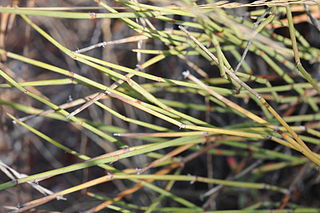
Ephedra trifurca is a species of Ephedra known by the common names longleaf jointfir and Mexican tea.
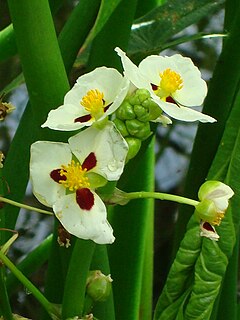
Sagittaria montevidensis is a species of flowering plant in the water-plantain family Alismataceae. Common names include giant arrowhead and California arrowhead.

Angelica genuflexa is a species of angelica known as kneeling angelica. It is native to northwestern North America from Alaska to northern California, where it grows in moist areas in coniferous forests such as streambanks. This is a taprooted perennial herb producing an erect, hollow stem to heights between 1 and 2 meters. The leaves are up to 80 centimeters long and are made up of many dissected, toothed leaflets, each up to 10 centimeters long. The inflorescence is a compound umbel of up to 50 rays bearing clusters of small flowers.

Angelica hendersonii is a species of angelica known as Henderson's angelica. It is native to the west coast of the United States from Washington to central California, where it grows in the coastal sage scrub and other habitat on the immediate coastline. This is a taprooted perennial herb producing a branching erect stem to heights between about 1 and 2 meters. The basal leaves are made up of oval-shaped leaflets each up to 10 centimeters long, with toothed edges and white woolly undersides. The woolly inflorescences are compound umbels of up to 60 rays holding clusters of fuzzy flowers. The flowers yield fruits which are paired bodies nearly a centimeter long each containing a seed.
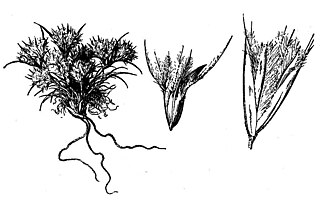
Blepharidachne kingii is a species of grass known by the common name King's eyelashgrass. It is native to the Great Basin in the United States, where it grows in habitat such as pinyon-juniper woodland. It is rare in California and Idaho, but it is one of the most common grasses of the northeastern deserts of Nevada.

Lathyrus sphaericus is a species of wild pea known by the common names grass pea and round-seeded vetchling. It is native to Eurasia and much of Africa, and it is known on other continents as an introduced species. It can grow in many types of habitat, including disturbed areas. This is an annual herb producing a slender stem and bearing leaves each made up of two long, narrow, grasslike leaflets up to 6 centimeters long and a coiling, climbing tendril. The inflorescence is made up of one pea flower on a stalk one or two centimeters long ending a in a bristle. The flower is roughly a centimeter long and deep orange-red or dull red in color. The fruit is a hairless legume pod marked with longitudinal stripes.
Perideridia lemmonii is a species of flowering plant in the family Apiaceae known by the common names Lemmon's yampah and tuni. It is native to the western United States, where it is known from southeastern Oregon, western Nevada, and the mountains of eastern California. It grows in meadows, forests, and other habitat. It is a perennial herb approaching one meter in maximum height, its slender, erect stem growing from usually a single small tuber about 1.5 centimeters long. Leaves near the base of the plant have blades up to 30 centimeters long divided into one or two pairs of leaflets, each of which may be subdivided. The inflorescence is a compound umbel of many spherical clusters of small white flowers. These yield ribbed, round or oblong-shaped fruits each under half a centimeter long.
Plagiobothrys kingii is a species of flowering plant in the borage family known by the common name Great Basin popcornflower. It is native to the Great Basin and Mojave Desert of the United States, where it grows in desert and plateau scrub habitat, among saltbush and on rocky slopes and flats.

Grindelia ciliata is a species of flowering plant in the daisy family known by the common names Spanish gold, goldenweed, and waxed goldenweed.
Ptilagrostis kingii is a species of grass known by the common names Sierra false needlegrass and King's ricegrass. It is endemic to the high mountains of the Sierra Nevada of California, where it grows in meadows and near streams in subalpine and alpine climates.

Senna didymobotrya is a species of flowering plant in the legume family known by the common names African senna, popcorn senna, candelabra tree, and peanut butter cassia. It is native to Africa, where it can be found across the continent in several types of habitat.

Senna multiglandulosa is a species of flowering plant in the legume family known by several common names, including glandular senna, downy senna, and buttercup bush. It is native to Mexico, Guatemala, and western parts of South America, but it is widely cultivated as an ornamental plant and in some areas of the world has become naturalized in the wild. In some places it is considered a weed, for example, in New Zealand and New South Wales.

Sisymbrium orientale is a species of flowering plant in the family Brassicaceae known by the common names Indian hedgemustard and eastern rocket. It is native to Europe, Asia, and North Africa, and it can be found throughout much of the temperate world as an introduced species and in some areas a common roadside weed. It is an annual herb producing a hairy, branching stem up to about 30 centimeters tall. The basal leaves are divided into deep lobes or toothed leaflets. Leaves higher on the stem have lance-shaped blades with small separate lobes near the base. The top of the stem is occupied by a raceme of flowers with light yellow petals each measuring up to a centimeter long. The fruit is a silique which can be up to 10 centimeters long.

Vicia pannonica is a species of vetch known by the common name Hungarian vetch. It is native to southern, central Europe and western Asia, and it is sometimes cultivated as an agricultural crop for use as hay and fodder. It may escape cultivation and grow as a casual roadside weed. This is an annual herb producing a hairy, climbing stem supported by the tendrils on its leaf-tips. The leaves are each made up of 10 to 20 oval or oblong leaflets measuring up to 2.5 centimeters in length. The inflorescence bears two to four pealike flowers each up to 2 centimeters long. The flower corolla is yellow or purple-marked and the back of the banner is coated in soft hairs. The fruit is a hairy legume pod 2 to 3 centimeters long.
Cymopterus goodrichii is a rare species of flowering plant in the carrot family known by the common name Toiyabe springparsley. It is endemic to Nevada in the United States, where it occurs in the Toiyabe and West Humboldt Ranges.
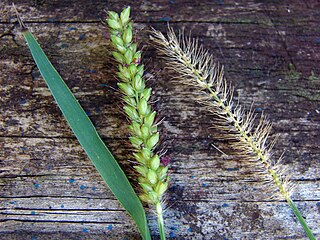
Setaria parviflora is a species of grass known by the common names marsh bristlegrass, knotroot bristle-grass, bristly foxtail and yellow bristlegrass. It is native to North America, including Mexico and the United States from California to the East Coast, Central America and the West Indies, and South America.
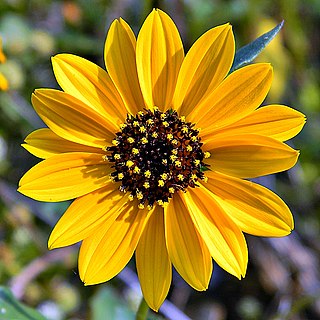
Helianthus debilis is a species of sunflower known by the common names cucumberleaf sunflower, beach sunflower, weak sunflower, and East Coast dune sunflower. It is native to the United States, where it can be found along the Atlantic and Gulf Coasts. It is known elsewhere as an introduced species, such as South Africa, Australia, Taiwan, Slovakia, and Cuba.

Physaria kingii is a species of flowering plant in the family Brassicaceae known by the common name King bladderpod. It is native to western North America from Utah to Baja California, where it grows in dry and rocky habitat, such as deserts and adjacent mountain slopes. This is a perennial herb growing a small, hairy stem from a caudex. The leaves form a patch or rosette around the caudex, each up to 6 centimeters long and round, oval, diamond, or spoonlike in shape. The inflorescence is an erect or mostly upright raceme of bright yellow mustardlike flowers. The fruit is a hairy capsule under a centimeter long suspended on a short, often curvy pedicel.

Herrickia kingii is a North American species of flowering plants in the aster family, called the King's serpentweed or King's aster. It has been found only in the State of Utah in the western United States.


