
Eremaea acutifolia, commonly known as rusty eremaea, is a plant in the myrtle family, Myrtaceae and is endemic to the south-west of Western Australia. It is a small shrub with needle-like leaves and which bears orange-coloured flowers on short side branches and fruits with a surface that is rough to the touch.

Beaufortia puberula, commonly known as hairy-leaved beaufortia, is a plant in the myrtle family, Myrtaceae and is endemic to the southwest of Western Australia. It is a shrub growing to a height of about 2 m (7 ft) with hairy young leaves and heads of hairy, pink or red flowers during most of the year.
Baeckea elderiana is a species of flowering plant in the family Myrtaceae and is endemic to central Western Australia.
Baeckea pentagonantha is a species of flowering plant in the family Myrtaceae and is endemic to near-coastal areas in the west of Western Australia. It is an erect, spreading shrub that typically grows to a height of 0.25 to 2 metres and blooms between July and October producing white flowers. It is found on sand plains and river flats in the coastal parts of the Mid West region of Western Australia centred around Geraldton where it grows in sandy soils.
Baeckea robusta is a species of flowering plant in the family Myrtaceae and is endemic to an area along the west coast Western Australia. It is an erect and slender shrub that typically grows to a height of 0.9 to 2.6 metres and blooms between June and December producing white to white-pink flowers. It is found on sand plains and around limestone outcrops in the coastal parts of the Mid West and extending south into the north west of the Wheatbelt region of Western Australia where it grows in sandy soils over laterite or limestone.
Thryptomene johnsonii is a species of flowering plant in the family Myrtaceae and is endemic to a restricted area of Western Australia. It is a bushy shrub with rigid branches, egg-shaped leaves with the narrower end towards the base and pink flowers with five petals and usually eight stamens.
Enekbatus cryptandroides is a shrub endemic to Western Australia.

Cyanothamnus baeckeaceus is a plant in the citrus family, Rutaceae and is endemic to eastern Australia. It is a slender or straggling shrub with simple or trifoliate leaves and pink and white four-petalled flowers. It is endemic to the south-west of Western Australia.

Styphelia crassifolia is a species of flowering plant in the family Ericaceae and is endemic to [the south-west of Western Australia. It is an erect, bushy shrub that typically grows to a height of 60 cm (24 in). Its leaves are oblong, 4–9 mm (0.16–0.35 in) long on a short petiole, with 3 prominent ribs on the lower surface. One or two flowers are borne in leaf axils on a short peduncle with tiny bracts and bracteoles about half the length of the sepals. The sepals are about 1.6 mm (0.063 in) long and the petals are about 3.2 mm (0.13 in) long and joined at the base, the lobes about as long as the tube.
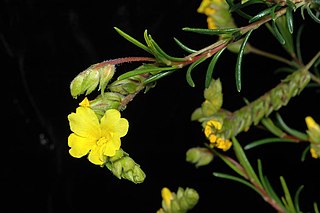
Hibbertia spicata is a species of flowering plant in the family Dilleniaceae and is endemic to the west of Western Australia. It is a low, erect to spreading shrub with scattered linear leaves with the edges rolled under and yellow flowers with six or seven stamens on one side of two softly-hairy carpels, and a larger number of staminodes.
Pomaderris grandis, commonly known as large pomaderris, is a species of flowering plant in the family Rhamnaceae and is endemic to a restricted part of the south-west of Western Australia. It is an erect shrub that typically grows to a height of 30–75 cm (12–30 in) and produces white flowers from July to October. It grows in rocky gullies on the slopes of Mount Manypeaks in the Esperance Plains biogeographic region of south-western Western Australia. The species was first formally described in 1862 by Ferdinand von Mueller in his Fragmenta Phytographiae Australiae. It is listed as "Priority Four" by the Government of Western Australia Department of Biodiversity, Conservation and Attractions, meaning that it is rare or near threatened.

Lasiopetalum oldfieldii is a species of flowering plant in the family Malvaceae and is endemic to the south-west of Western Australia. It is a low, spreading shrub with rusty-hairy young stems, egg-shaped to narrowly egg-shaped leaves and pink and dark red flowers.

Lasiopetalum oppositifolium is a species of flowering plant in the family Malvaceae and is endemic to the south-west of Western Australia. It is an open, erect shrub with rusty-hairy young stems, linear, narrowly elliptic or narrowly egg-shaped leaves and white, pink and dark red flowers.
Pomaderris rotundifolia is a species of flowering plant in the family Rhamnaceae and is endemic to Western Australia. It is an upright, spreading shrub that typically grows to a height of 0.1–1.5 m, its branchlets covered with star-shaped hairs. The leaves are more or less round leaves and the flowers are white to pink. In most respects it is similar to other species of Pomaderris occurring in Western Australia but has more prominent bracts, shorter pedicels and well-developed petals. Flowering occurs from June to October.
Pimelea concreta is a species of flowering plant in the family Thymelaeaceae and is native to northern Australia and parts of Indonesia. It is an annual herb with narrowly egg-shaped leaves and head-like clusters of white or pink, tube-shaped flowers surrounded by egg-shaped green involucral bracts.
Pimelea eyrei is a species of flowering plant in the family Thymelaeaceae and is endemic to the southwest of Western Australia. It is an erect shrub with hairy, narrowly elliptic leaves and clusters of densely hairy, white or cream-coloured flowers.
Pimelea forrestiana is a species of flowering plant in the family Thymelaeaceae and is endemic to Western Australia. It is a shrub with linear to narrowly elliptic leaves arranged in opposite pairs, and head-like clusters of yellow, tube-shaped flowers.
Stenanthemum complicatum is a species of flowering plant in the family Rhamnaceae and is endemic to the southwest of Western Australia. It is a woody, erect or straggling shrub with densely hairy young stems, broadly egg-shaped leaves and densely woolly-hairy heads of tube-shaped flowers.
Pimelea holroydii is a species of flowering plant in the family Thymelaeaceae and is endemic to the north of Western Australia. It is an erect shrub with egg-shaped leaves arranged more or less in opposite pairs, and head-like clusters of white or cream-coloured, tube-shaped flowers.

Pimelea spiculigera is a species of flowering plant in the family Thymelaeaceae and is endemic to Western Australia. It is an erect shrub with linear to narrowly egg-shaped leaves and heads of yellow or greenish-yellow flowers surrounded by 2 or 4 egg-shaped involucral bracts.
