
Fulvia was an aristocratic Roman woman who lived during the Late Roman Republic. Fulvia's birth into an important political dynasty facilitated her relationships and, later on, marriages to Publius Clodius Pulcher, Gaius Scribonius Curio, and Mark Antony. All of these men would go on to lead increasingly promising political careers as populares, tribunes, and supporters of Julius Caesar.

The Lancia Fulvia is an automobile produced by Lancia between 1963 and 1976. Named after Via Fulvia, the Roman road leading from Tortona to Turin, it was introduced at the Geneva Motor Show in 1963 and manufactured in three variants: Berlina 4-door saloon, 2-door Coupé, and Sport, an alternative fastback coupé designed and built by Zagato on the Coupé floorpan.
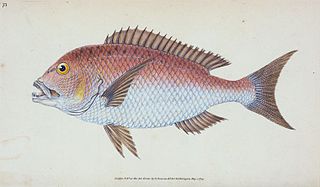
Edward Donovan was an Anglo-Irish writer, natural history illustrator, and amateur zoologist. He did not travel, but collected, described and illustrated many species based on the collections of other naturalists. His many books were successful in his time. He died penniless in 1837 leaving a large family destitute.
The Perusine War was a civil war of the Roman Republic, which lasted from 41 to 40 BC. It was fought by Lucius Antonius, Fulvia, and the Umbrians of Perusia to support Mark Antony against his political enemy Octavian.
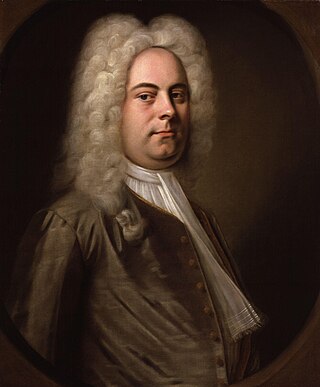
Ezio is an opera seria by George Frideric Handel to a libretto by Metastasio. Metastasio's libretto was partly inspired by Jean Racine's play Britannicus. The same libretto had already been set by many other composers, first of all Nicola Porpora who managed to preempt the official Rome premiere of Pietro Auletta's setting for 26 December 1728 with his own version for Venice on 20 November, a month earlier. The libretto continued to be set and reset for another 50 years, including two versions of Ezio by Gluck. Handel's Ezio is considered one of the purest examples of opera seria with its absence of vocal ensembles.
Asota is a town near Shewa Adda and Union Council of Swabi District in the Khyber-Pakhtunkhwa province of Pakistan. It is located at 34°14'0N 72°21'0E with an altitude of 340 metres.

Ardices curvata, the crimson tiger moth, is a moth of the family Erebidae. It was first described by Edward Donovan in 1805 and it is found in Australia. The species was formerly included in Spilosoma, but later generic status of Ardices was proved by Vladimir Viktorovitch Dubatolov (2005).

Asota is a genus of moths in the family Erebidae first described by Jacob Hübner in 1819. Species are widely distributed throughout Africa, India, Sri Lanka, Myanmar, the Malayan region and tropical parts of the Australian region.
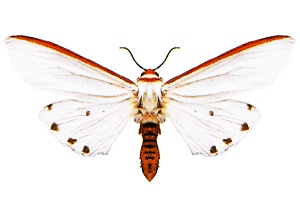
Paramsacta marginata, also called Donovan's tiger moth or Donovan's amsacta, is a moth of the family Erebidae. It is found in most of Australia, New Guinea, Fergusson Island and the Louisiade Archipelago. The species was first described by Edward Donovan in 1805.

Asota caricae, the tropical tiger moth, is a species of noctuoid moth in the family Erebidae. It is found from the Indo-Australian tropics of India and Sri Lanka to Queensland and Vanuatu.

Asota egens is a species of noctuoid moths in the family Erebidae. It is found from Japan and the Oriental tropics, east to New Guinea.

Asota heliconia is a moth in the family Erebidae. It is found from the Indo-Australian tropics east to Queensland and the Solomons.

Asota plana is a moth in the family Erebidae first described by Francis Walker in 1854. It is found from the Oriental tropics east to New Guinea.

Asota javana is a moth of the family Erebidae first described by Pieter Cramer in 1780. It is found in Sundaland, the Philippines, Sulawesi and on Sula Island.
Asota paphos is a moth of the family Erebidae first described by Johan Christian Fabricius in 1787. It is found from the north-eastern Himalayas to Sundaland.
Asota strigosa is a moth of the family Erebidae first described by Jean Baptiste Boisduval in 1832. It is found in Indonesia and the Papua New Guinea.
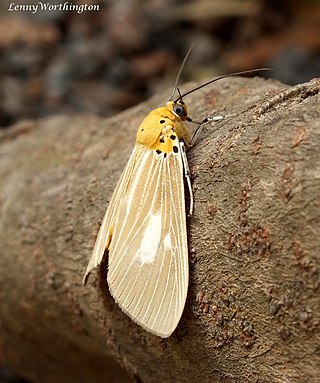
Asota plaginota is a moth of the family Erebidae first described by Arthur Gardiner Butler in 1875. It is found in China, India, Indonesia, Myanmar, Malaysia, Nepal, Papua New Guinea, the Philippines, Sikkim, Singapore, Sri Lanka, Thailand and Vietnam. In Northeast India, it is recorded as a millet pest.

Summer Night is a 1986 Italian comedy film directed by Lina Wertmüller. The film was selected as the Italian entry for the Best Foreign Language Film at the 59th Academy Awards, but was not accepted as a nominee.

Massacre at Marble City is a 1964 German-French-Italian western film directed by Paul Martin and starring Mario Adorf and Brad Harris. It is loosely based on Friedrich Gerstäcker's 1845 novel Die Regulatoren von Arkansas. It was shot on location in Czechoslovakia.


