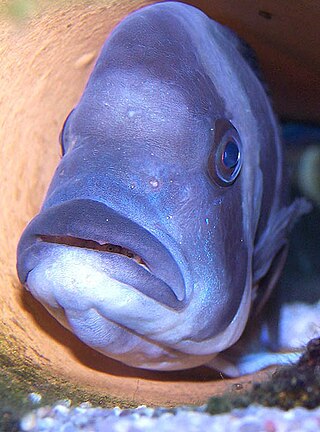
Mouthbrooding, also known as oral incubation and buccal incubation, is the care given by some groups of animals to their offspring by holding them in the mouth of the parent for extended periods of time. Although mouthbrooding is performed by a variety of different animals, such as the Darwin's frog, fish are by far the most diverse mouthbrooders. Mouthbrooding has evolved independently in several different families of fish.

Gouramis, or gouramies, are a group of freshwater anabantiform fish that comprise the family Osphronemidae. The fish are native to Asia—from the Indian Subcontinent to Southeast Asia and northeasterly towards Korea. The name "gourami", of Indonesian origin, is also used for fish of the families Helostomatidae and Anabantidae.
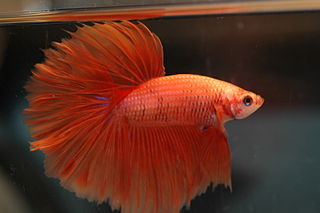
The Siamese fighting fish, commonly known as the betta, is a freshwater fish native to Southeast Asia, namely Cambodia, Laos, Myanmar, Malaysia, Indonesia, Thailand, and Vietnam. It is one of 73 species of the genus Betta, but the only one eponymously called "betta", owing to its global popularity as a pet; Betta splendens are among the most popular aquarium fish in the world, due to their diverse and colorful morphology and relatively low maintenance.
The spotted betta or Java fighting fish is a species of gourami endemic to Indonesia where it inhabits relatively cool, 22‒25 °C (72‒75 °F), highland streams of Java. In 1967, D. S. Johnson reported the species to be common in blackwaters of southern Malaya.

Smerinthus ocellatus, the eyed hawk-moth, is a European moth of the family Sphingidae. The species was first described by Carl Linnaeus in his 1758 10th edition of Systema Naturae.

Betta is a large genus of small, active, often colorful, freshwater ray-finned fishes, in the gourami family (Osphronemidae). The best known Betta species is B. splendens, commonly known as the Siamese fighting fish and often kept as an aquarium pet.
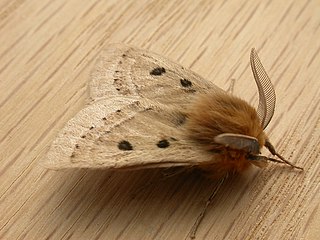
Anthela ocellata, the eyespot anthelid, is a moth of the family Anthelidae. The species was first described by Francis Walker in 1855. It is found in Australia, from Bundaberg to Hobart along the east coast.
Betta gladiator is a species of gourami endemic to Sabah, Malaysia. It is an inhabitant of the acidic waters of heath forest. It is known as a particularly territorial and aggressive species, especially in captivity. This species grows to a length of 5.6 centimetres (2.2 in) SL and are facultative air-breathers.
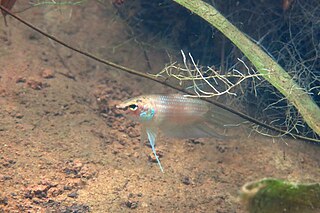
Betta ferox is a species of gourami endemic to Thailand. It is only found in rivers in Songkhla Province, where it resides along shallow riverbanks among vegetation. This species grows to a length of 6.3 centimetres (2.5 in) SL. This species is closely related to Betta pugnax and is also a paternal mouthbrooder. Males and females are dimorphic, with males displaying elongated ventral fins, elongated caudal fins, and green coloration on the gill plates. Females typically display two horizontal brown bars across their bodies, shorter fins, and a more rounded body shape.

The Macropodusinae are a subfamily of freshwater anabantiform fishes in the gourami family Osphronemidae, which includes the paradisefish, fighting fish and licorice gouramis. Like all members of the family, these are air breathing fishes that frequently inhabit oxygen poor environments hostile to other fishes. They are native to Asia, from Pakistan and India to the Malay Archipelago and north-easterly towards Korea. Many members are common aquarium fish; by far the most famous is the Siamese fighting fish, Betta splendens. Most of the 70+ betta species are paternal mouthbrooders; the remaining members of the subfamily are bubblenesters like most osphronemids.
Betta akarensis, the Akar betta, is a species of gourami endemic to south-east Sarawak, and whose species name akar was so named after where it was originally found in the river Sungai Akar. This species is a mouthbrooder, and grows to a length of 10 centimetres (3.9 in) SL. According to Linke, they "live predominantly in mineral-poor, slightly acid water enriched with humic substances".

The giant betta is a species of freshwater ray-finned fish in the subfamily Macropodusinae, part of the gourami family. It is endemic to South Kalimanatan, Katingan, and Sampit in Indonesian Borneo. It is found in a variety of freshwater habitats and is a paternal mouthbrooder. The species reaches 8.2 cm in standard length and is known to be a facultative air-breather.
Betta ibanorum is a species of gourami endemic to southern Sarawak in Malaysia. The species name ibanorum was named after the Iban people, the largest group of people in the Sarawak. This species is a mouthbrooder, and grows to a length of 8.1 centimetres (3.2 in) SL.
Betta obscura is a species of gourami that occurs in the Barito basin in Kalimantan Tengah, Indonesia. This species is a mouthbrooder, and grows to a length of around 9 centimetres (3.5 in) SL.

Betta pi is a species of gourami belonging to the genus Betta. It is found in the Pru Toe-Daeng peat swamps in Narathiwat Province in Southern Thailand, but its range also extends into northern Peninsular Malaysia, most notably the states of Kelantan and Terengganu. It is primarily found in well-shaded peat forest blackwater swamps and creeks where the pH can be as low as 3.0 or 4.0. It is benthopelagic. It can grow to a maximum length of 9.0 cm (3.5 in). It is a fish of mild importance in the aquarium industry. Its diet consists of aquatic invertebrates in the wild, but will also eat frozen, live and dried foods such as larva of Chironomidae, Daphnia, and brine shrimp in aquariums.
Betta compuncta is a species of ray-finned fish in the family Osphronemidae. It reaches 6.2 cm in standard length.
Betta pardalotos is a species of fish in the family Osphronemidae. It is native to Asia, where it occurs in the Musi River basin on the island of Sumatra in Indonesia. The species reaches 7.2 cm in standard length and is known to be a facultative air-breather. It feeds on insects and other small invertebrates such as zooplankton.

Betta fusca, commonly known as the dusky betta, is a species of gourami. It is a freshwater fish native to Asia, where it occurs on the island of Sumatra in Indonesia. The species reaches 8.2 cm in total length and is known to be a mouthbrooder and a facultative air-breather.
Betta schalleri, sometimes known as Schaller's mouthbrooder, is a species of gourami. It is a freshwater fish native to Asia, where it is known only from Bangka Island in Indonesia. It is typically found in hillstreams and peat swamp forests. The species reaches 4.5 cm in standard length and is known to be a facultative air-breather.