
Catalpa, commonly also called catawba, is a genus of flowering plants in the family Bignoniaceae, native to warm temperate and subtropical regions of North America, the Caribbean, and East Asia.

Bignoniaceae is a family of flowering plants in the order Lamiales commonly known as the bignonias or trumpet vines. It is not known to which of the other families in the order it is most closely related.

Campsis radicans, the trumpet vine, yellow trumpet vine, or trumpet creeper, is a species of flowering plant in the family Bignoniaceae, native to eastern North America, and naturalized elsewhere. Growing to 10 metres, it is a vigorous, deciduous woody vine, notable for its showy trumpet-shaped flowers. It inhabits woodlands and riverbanks, and is also a popular garden plant.
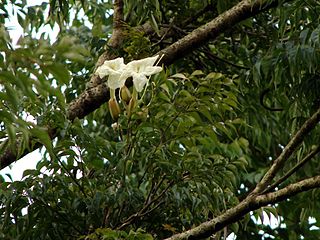
Radermachera sinica, also called china doll, serpent tree or emerald tree, is an evergreen tree in the family Bignoniaceae, native to the subtropical mountain regions of southern China and Taiwan.

Bignonia is a genus of flowering plants in the family Bignoniaceae. Its genus and family were named after Jean-Paul Bignon by his protégé Joseph Pitton de Tournefort in 1694, and the genus was established as part of modern botanical nomenclature in 1753 by Carl Linnaeus. Species have been recorded from the southern USA, Central to most of South America.

Manduca rustica, the rustic sphinx, is a moth of the family Sphingidae. The species was first described by Johan Christian Fabricius in 1775.

Millingtonia hortensis, the tree jasmine or Indian cork tree, is the sole species in the genus Millingtonia, a tree native to South Asia and South East Asia.
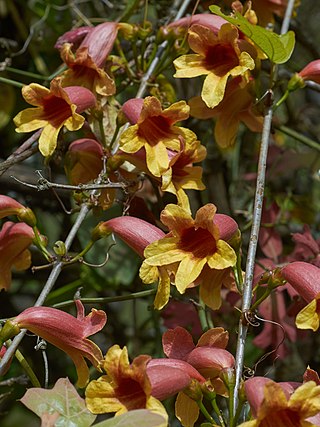
Bignonia capreolata is a vine commonly referred to as crossvine. The common name refers to the cross-shaped pattern revealed when the stem is cut; this pattern results from four radial wedges of phloem embedded within the stem's xylem. It is native to the central and southern United States. The vine climbs without twining but does produce tendrils. It produces long tubular flowers which are red and yellow and frequently have a mocha fragrance. The leaves are dark green to almost purple and produced as opposite pairs with terminal tendrils. The vine often climbs very high, with leaves only remaining on the uppermost portion of the plant. Crossvine can spread aggressively through stolons and may need to be managed in garden or domestic settings.

Chom Dong is a private estate and botanical garden near Hua Hin, Prachuap Khiri Khan Province, Thailand. It is not open to the public aside from infrequent special events.

Galium parisiense is a species of flowering plant in the family Rubiaceae known by the common name wall bedstraw. A native of the Mediterranean area and Western Europe, it has become naturalised in North America and other parts of Europe.
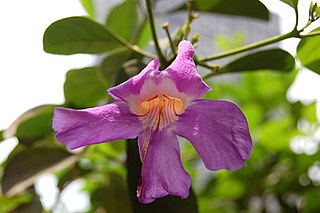
Bignonia magnifica, known as glowvine, is a species in the trumpet-vine family, Bignoniaceae. Originally described in the genus Bignonia in 1879, it was later transferred to the monotypic genus Saritaea as the sole species Saritaea magnifica, but has since been restored to Bignonia. It is native to Panama and northern South America, but has been introduced elsewhere.
Clytostoma was a genus of woody-stemmed vines from tropical America, native to Argentina and the southern part of Brazil. It is now considered a synonym of Bignonia. The botanical name comes from the Greek, klytos means splendid or beauteous, and stoma means mouth; alluding to the beautiful flowers. It was formerly separated from Bignonia chiefly on the basis of its simple slender tendrils, the short disk, and its habit of clambering over adjacent foliage using tendrils to hang on tight. The bright glossy green leaves of species formerly placed in this genus are lobed and divided with 2 leaflets, about 3in (7.6 cm) long and 1.5in (3.8 cm) wide. They are arranged opposite in pairs and tendrils arise at the ends of the leaf stalks. In late spring, the spectacular 1.5in (3.8 cm) trumpet flowers are borne terminally or along the branches. The flowers are pale lavender and delicately detailed with dark violet and purple veins. Flowers are followed by large prickly seed pods. This evergreen ornamental plant easily reaches to 16 feet and is a carefree grower.

Crocidosema lantana, the lantana flower-cluster moth or lantana tortricid moth, is a moth of the family Tortricidae. It was first described by August Busck in 1910. It is native to Mexico and the southern United States, but was introduced to Hawaii in 1902, Australia in 1914 and the Caroline Islands in 1948 and 1949 to aid in the control of Lantana weeds. It has also been recorded from Yunnan, China and in Sri Lanka.
Bignonia noterophila is a flowering plant species in the genus Bignonia. It is native from south Mexico to northern South America.

Astianthus is a monotypic genus of flowering plants in the Bignoniaceae family. The sole species is Astianthus viminalis. It is known by the common names achuchil in Mexico and chilca in Guatemala and Honduras.

Bignonia sciuripabula is a flowering plant species in the family Bignoniaceae.

Amphilophium is a genus of flowering plants in the family Bignoniaceae, native to South America. Amphilophium crucigerum has escaped from cultivation elsewhere, and has become an invasive weed in Australia.

Amphilophium crucigerum is a species of flowering plant in the family Bignoniaceae, native from Mexico through Central America into South America as far south as Argentina. It was first described by Carl Linnaeus in 1753. The synonym Pithecoctenium crucigerum has often been used.

Bignonia callistegioides, also known as violet trumpet vine and lavender trumpet vine, is a vine native to southern Brazil and Argentina.
