| Boljoon | |
|---|---|
| Municipality | |
Boljoon | |
Map of Cebu with Boljoon highlighted | |
| Coordinates: 9°38′N123°26′E / 9.63°N 123.43°E Coordinates: 9°38′N123°26′E / 9.63°N 123.43°E | |
| Country | Philippines |
| Region | Central Visayas (Region VII) |
| Province | Cebu |
| District | 2nd district of Cebu |
| Founded | 1600 |
| Barangay | 11 (see § Barangays)
|
| Government [1] | |
| • Type | Sangguniang Bayan |
| • Mayor | Merlou Derama (LP) |
| • Vice mayor | Ervin Villanueva |
| • Town Council | Members |
| • Representative | Wilfredo Caminero |
| Area [2] | |
| • Total | 117.00 km2 (45.17 sq mi) |
| Population (2015 census) [3] | |
| • Total | 16,344 |
| • Density | 140/km2 (360/sq mi) |
| • Voter (2016) [4] | 10,216 |
| Time zone | PHT (UTC+8) |
| ZIP code | 6024 |
| IDD : area code | +63 (0)32 |
| Income class | 5th class |
| PSGC | 072212000 |
| Website | www |
Boljoon (also Boljo-on) is a 5th municipal income classmunicipality in the province of Cebu, Philippines. According to the 2015 census, it has a population of 16,344. [3] In the 2016 electoral roll, it had 10,216 registered voters. [4]
Cebu is a province of the Philippines located in the Central Visayas (Region VII) region, and consists of a main island and 167 surrounding islands and islets. Its capital is Cebu City, the oldest city and first capital of the Philippines, which is politically independent from the provincial government.
The Philippines, officially the Republic of the Philippines, is an archipelagic country in Southeast Asia. Situated in the western Pacific Ocean, it consists of about 7,641 islands that are categorized broadly under three main geographical divisions from north to south: Luzon, Visayas, and Mindanao. The capital city of the Philippines is Manila and the most populous city is Quezon City, both part of Metro Manila. Bounded by the South China Sea on the west, the Philippine Sea on the east and the Celebes Sea on the southwest, the Philippines shares maritime borders with Taiwan to the north, Vietnam to the west, Palau to the east, and Malaysia and Indonesia to the south.
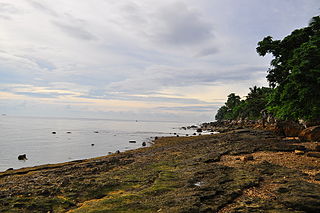
Boljoon has a total land area of 117.00 km2 (45.17 sq mi). It is bounded to the north by Alcoy, to the west by Malabuyoc, to the south by Oslob, and to the east by Bohol Strait.
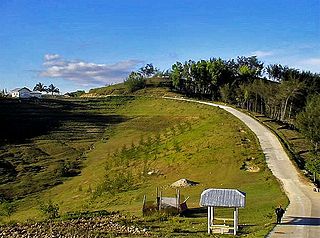
Alcoy, officially the Municipality of Alcoy,, is a 5th class municipality in the province of Cebu, Philippines. According to the 2015 census, it has a population of 16,979 people.
Oslob, officially the Municipality of Oslob,, is a 4th class municipality in the province of Cebu, Philippines. According to the 2015 census, it has a population of 27,893 people.
The Boljoon Church is currently in the tentative list for UNESCO World Heritage Sites under the Baroque Churches of the Philippines (Extension). A proposal has been suggested by scholars to make a separate UNESCO inclusion for the Old Centre of Boljoon which includes the Boljoon Church. The same would be made for other churches listed in UNESCO's tentative sites, where each town plaza and surrounding heritage buildings would be added. No government agency has yet to take action on the proposal.
The United Nations Educational, Scientific and Cultural Organization is a specialized agency of the United Nations (UN) based in Paris. Its declared purpose is to contribute to peace and security by promoting international collaboration through educational, scientific, and cultural reforms in order to increase universal respect for justice, the rule of law, and human rights along with fundamental freedom proclaimed in the United Nations Charter. It is the successor of the League of Nations' International Committee on Intellectual Cooperation.
The Baroque Churches of the Philippines are a collection of four Spanish Colonial-era baroque churches in the Philippines, which were included in UNESCO's World Heritage List in 1993. The churches are also considered as national cultural treasures of the country.
Boljoon comprises 11 barangays, of which six (including Poblacion) are coastal, and the rest inland:
| PSGC | Barangay | Population | ±% p.a. | |||
|---|---|---|---|---|---|---|
| 2015 [3] | 2010 [5] | |||||
| 072212008 | Arbor | 6.6% | 1,076 | 1,035 | 0.74% | |
| 072212001 | Baclayan | 2.9% | 468 | 438 | 1.27% | |
| 072212002 | El Pardo | 20.0% | 3,264 | 2,953 | 1.92% | |
| 072212003 | Granada | 7.7% | 1,253 | 1,046 | 3.50% | |
| 072212004 | Lower Becerril | 7.9% | 1,297 | 1,153 | 2.27% | |
| 072212009 | Lunop | 5.6% | 916 | 874 | 0.90% | |
| 072212010 | Nangka | 4.2% | 679 | 590 | 2.71% | |
| 072212005 | Poblacion | 25.0% | 4,082 | 3,709 | 1.84% | |
| 072212006 | San Antonio | 6.8% | 1,114 | 1,125 | −0.19% | |
| 072212011 | South Granada | 5.1% | 839 | 813 | 0.60% | |
| 072212007 | Upper Becerril | 8.3% | 1,356 | 1,291 | 0.94% | |
| Total | 16,344 | 15,027 | 1.61% | |||
| Population census of Boljoon | ||
|---|---|---|
| Year | Pop. | ±% p.a. |
| 1903 | 7,299 | — |
| 1918 | 9,121 | +1.50% |
| 1939 | 10,087 | +0.48% |
| 1948 | 11,299 | +1.27% |
| 1960 | 9,151 | −1.74% |
| 1970 | 11,049 | +1.90% |
| 1975 | 11,359 | +0.56% |
| 1980 | 10,735 | −1.12% |
| 1990 | 11,646 | +0.82% |
| 1995 | 12,318 | +1.06% |
| 2000 | 13,380 | +1.79% |
| 2007 | 14,877 | +1.47% |
| 2010 | 15,027 | +0.37% |
| 2015 | 16,344 | +1.61% |
| Source: Philippine Statistics Authority [3] [5] [6] [7] | ||
In the 2016 electoral roll, it had 10,216 registered voters, meaning that 63% of the population are aged 18 and over . [4]
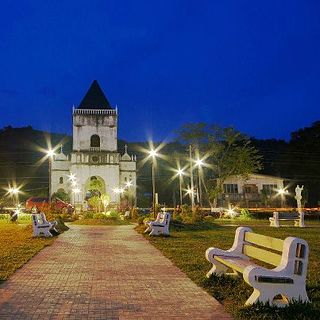
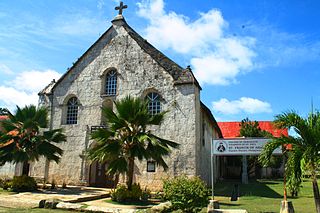
Nuestra Señora de Patrocinio Parish Church of Boljoon shows old and intricate carvings and bas-reliefs. It is in a pseudo-baroque rococo style. It has a main nave, a transcript, and twenty-eight pillars which support the walls. The walls are as thick as the pillars which are two metres (6 ft 7 in) thick and made of mortar and lime.
Boljoon became a visita of Carcar founded according to some authors in 1599. It became an independent vicariate on 31 October 1690, and on 5 April 1692, Fr. Nicolas de la Cuadra was appointed as prior. Because of the lack of priests, the church was turned over to the Jesuits on 27 September 1737, following the recommendation of the intermediate chapter of 1732. In the year 1747, the General of the Augustinians Order proposed the recovery of the parishes left off in the Visayas. [8]
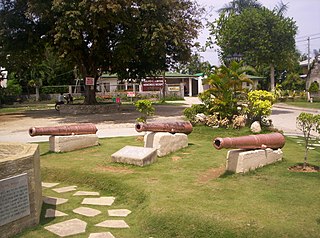
Boljoon's earlier building had been destroyed in a raid in 1782, and its pastor Fr. Ambrosio Otero started rebuilding the following year. The work was continued by Fr. Manuel Cordero in 1794 but when Fr. Julian arrived, the work was not yet completed. He decided to build a blockhouse 120 by 80 metres (390 ft × 260 ft) on which artillery was mounted, and he enclosed the church perimeter with a wall. He finally completed the church. The church and the adjoining convento were restored by Fr. Leandro Moran (1920–1948) the last Augustinian friar to be assigned to Boljoon. [9]
In 1999 the National Historical Institute declared it a National Historical Landmark. The following year, the National Museum declared it as a National Cultural Treasure.
Nuestra Señora de Patrocinio Parish Church was lucky enough to withstand the 7.2 magnitude earthquake in 2013 which affected Bohol and Cebu.
On February 2008, archaeologists discovered 26 human remains (with china plates on top of heads) and 16th-century artefacts beneath the parvis of Boljoon Church. [10]
Toledo, officially the City of Toledo,, or simply known as Toledo City, is a 3rd class city in the province of Cebu, Philippines. According to the 2015 census, it has a population of 170,335 people.
Catmon, officially the Municipality of Catmon,, is a 4th class municipality in the province of Cebu, Philippines. According to the 2015 census, it has a population of 30,471 people.
Alcantara, officially the Municipality of Alcantara,, is a 5th class municipality in the province of Cebu, Philippines. According to the 2015 census, it has a population of 15,160 people.
Alegria, officially the Municipality of Alegria,, is a 4th class municipality in the province of Cebu, Philippines. According to the 2015 census, it has a population of 23,300 people.
Argao, officially the Municipality of Argao,, is a 1st class municipality in the province of Cebu, Philippines. According to the 2015 census, it has a population of 72,366 people.
Balamban, officially the Municipality of Balamban,, is a 1st class municipality in the province of Cebu, Philippines. According to the 2015 census, it has a population of 87,177 people.
Compostela, officially the Municipality of Compostela,, is a 3rd class municipality in the province of Cebu, Philippines. According to the 2015 census, it has a population of 47,898 people.
Ginatilan, officially the Municipality of Ginatilan,, is a 5th class municipality in the province of Cebu, Philippines. According to the 2015 census, it has a population of 15,919 people.
Madridejos, officially the Municipality of Madridejos,, is a 4th class municipality in the province of Cebu, Philippines. According to the 2015 census, it has a population of 36,429 people.
Minglanilla, officially the Municipality of Minglanilla,, is a 1st class municipality in the province of Cebu, Philippines. According to the 2015 census, it has a population of 132,135 people.
Ronda, officially the Municipality of Ronda,, is a 5th class municipality in the province of Cebu, Philippines. According to the 2015 census, it has a population of 20,360 people.
San Fernando, officially the Municipality of San Fernando,, is a 2nd class municipality in the province of Cebu, Philippines. According to the 2015 census, it has a population of 66,280 people.
Sogod, officially the Municipality of Sogod,, is a 4th class municipality in the province of Cebu, Philippines. According to the 2015 census, it has a population of 35,108 people.
Tabuelan, officially the Municipality of Tabuelan,, is a 4th class municipality in the province of Cebu, Philippines. According to the 2015 census, it has a population of 25,630 people.
Lazi, officially the Municipality of Lazi, is a 4th class municipality in the province of Siquijor, Philippines. According to the 2015 census, it has a population of 20,490 people.
Siquijor, officially the Municipality of Siquijor, is a 4th class municipality and capital of the province of Siquijor, Philippines. According to the 2015 census, it has a population of 26,861 people.
Calape, officially the Municipality of Calape,, is a 3rd class municipality in the province of Bohol, Philippines. According to the 2015 census, it has a population of 30,863 people.
The Nuestra Señora del Patrocinio de Maria Parish Church, commonly known as Boljoon Church, is a Roman Catholic Church dedicated to the Our Lady of Patrocinio in the municipality of Boljoon, Cebu, Philippines, under the Roman Catholic Archdiocese of Cebu.
| Wikimedia Commons has media related to Boljoon . |