
The Irrawaddy dolphin is a euryhaline species of oceanic dolphin found in scattered subpopulations near sea coasts and in estuaries and rivers in parts of the Bay of Bengal and Southeast Asia. It closely resembles the Australian snubfin dolphin, which was not described as a separate species until 2005. It has a slate blue to a slate gray color. Although found in much of the riverine and marine zones of South and Southeast Asia, the only concentrated lagoon populations are found in Chilika Lake in Odisha, India and Songkhla Lake in southern Thailand.
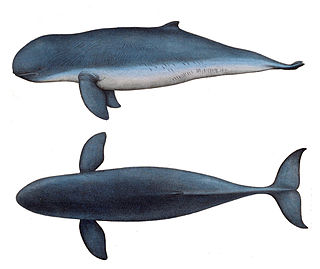
The snubfin dolphins (Orcaella) are a genus of cetaceans containing two members: the Irrawaddy dolphin and the Australian snubfin dolphin. The genus was long believed to be monotypic with the only species being the Irrawaddy dolphin; however, in 2005, supposed Irrawaddy dolphin populations inhabiting the Australian/New Guinean regions were found to be significantly different and were declared a separate new species named the Australian snubfin dolphin.

Caiman is a genus of caimans within the alligatorid subfamily Caimaninae. They inhabit Central and South America. They are relatively small sized crocodilians, with all species reaching lengths of only a couple of meters and weighing 6 to 40 kg on average.

The lemon shark is a species of shark from the family Carcharhinidae, known for its yellowish color, which inspires its common name. It is classified as a Vulnerable species by the International Union for the Conservation of Nature. Lemon sharks can grow to 3.4 metres (11 ft) in length. They are often found in shallow subtropical waters and are known to inhabit and return to specific nursery sites for breeding. Often feeding at night, these sharks use electroreceptors to find their main source of prey, fish. Lemon sharks enjoy the many benefits of group living such as enhanced communication, courtship, predatory behavior, and protection. This species of shark gives birth to live young, and the females are polyandrous and have a biennial reproductive cycle. Lemon sharks are not thought to be a large threat to humans; there have been 10 recorded bites, none of which were life-threatening. The lemon shark's life span is unknown, but the average shark is 25 to 30 years old. The oldest recorded lemon shark in captivity died in 2023 at the age of 40 years.

Kittlitz's murrelet is a small alcid found in the waters off Alaska and Eastern Siberia. This near threatened species is, like the closely related marbled murrelet, unusual for seabirds in not being colonial, nesting instead in isolated locations on mountain tops, where the nests were known to Native Americans for many years before skeptical ornithologists described and photographed them. It is a poorly known and little studied species, although concern over its status and that of the closely related marbled murrelet has led to a recent increase in research.

Pachycrocuta is an extinct genus of prehistoric hyenas. The largest and most well-researched species is Pachycrocuta brevirostris, colloquially known as the giant short-faced hyena as it stood about 90–100 cm (35–39 in) at the shoulder and it is estimated to have averaged 110 kg (240 lb) in weight, approaching the size of a lioness, making it the largest known hyena. Pachycrocuta first appeared during the late Miocene. By 800,000 years ago, it became locally extinct in Europe, with it surviving in East Asia until at least 500,000 years ago, and possibly later elsewhere in Asia.

The weebill is a species of bird in the family Acanthizidae. It is an insectivorous passerine that is found throughout mainland Australia. At 8 to 9 cm long, it is Australia's smallest bird. It was originally described by John Gould in 1838, and four subspecies are recognised. The weebill's plumage is nondescript, with olive-grey upperparts and paler, more yellowish underparts. It grades from more brownish plumage in the southern regions of Australia to more yellow in tropical areas.

The Cameroon forest tree frog is a species of frog in the family Arthroleptidae. It is found in southern Nigeria, Cameroon, Equatorial Guinea, and Gabon. It is expected to occur in southwestern Central African Republic and in the Republic of the Congo, but no records have been confirmed from those countries.
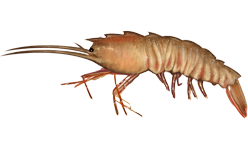
Sicyonia brevirostris, the brown rock shrimp, is a species of prawn. It is found along the coasts of the western Atlantic Ocean and Gulf of Mexico from Norfolk, Virginia to Yucatán, including Cuba and the Bahamas. It is used in cooking and has a taste and texture similar to lobster.
The short-snouted thicket rat is a species of rodent endemic to Kenya.
Exoprosopa brevirostris is a species of bee flies in the family Bombyliidae.

Ellescus is a genus of true weevils in the beetle family Curculionidae. There are about 16 described species in Ellescus.
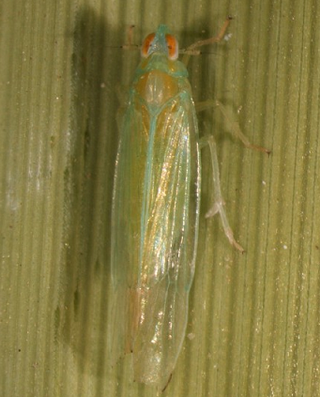
Saccharosydne is a genus of delphacid planthoppers in the family Delphacidae. There are about nine described species in Saccharosydne.
Plagiognathus brevirostris is a species of plant bug in the family Miridae. It is found in North America.

Leptoglossus brevirostris is a species of leaf-footed bug in the family Coreidae. It is found in Central America and North America.
Physatocheila brevirostris is a species of lace bug in the family Tingidae. It is found in North America.
Tominotus is a genus of burrowing bugs in the family Cydnidae. There are about 11 described species in Tominotus.

Callipallene is a genus of sea spiders in the family Callipallenidae. There are more than 30 described species in Callipallene.

Malacanthus brevirostris, the quakerfish, flagtail blanquillo, false whiting or stripetail tilefish, is a species of marine ray-finned fish, a tilefish belonging to the family Malacanthidae. It has a wide Indo-Pacific distribution.
Caiman brevirostris is an extinct species of caiman that lived during the Late Miocene, around 11.6 million years ago, to the end of the Miocene 5.3 million years ago in Acre and Amazonas, Brazil as well as Urumaco, Venezuela. Several specimens have been referred to the species, but only 3 of them are confidently placed in the species. C. brevirostris was originally named in 1987 on the basis of a single, incomplete rostrum with an associated mandibular ramus that had been found in Acre, Brazil. C. brevirostris is very distinct among Caiman species and caimaninae overall in that it preserves a characteristically short and robust skull that bears blunt posterior teeth that were built to break down harder foods. This was an adaption for durophagy, likely to crush shells of mollusks and clams which were common in the wetlands that C. brevirostris resided in.


