
Sea spiders are marine arthropods of the order Pantopoda, belonging to the class Pycnogonida, hence they are also called pycnogonids. They are cosmopolitan, found in oceans around the world. The over 1,300 known species have leg spans ranging from 1 mm (0.04 in) to over 70 cm (2.3 ft). Most are toward the smaller end of this range in relatively shallow depths; however, they can grow to be quite large in Antarctic and deep waters.

Colossendeidae is a family of sea spiders. This family includes more than 100 species distributed among six genera. These sea spiders inhabit the deep sea mostly but are also found in shallower waters, especially in Antarctic and Arctic waters.

Hedgpethia is a genus of sea spider, in the family Colossendeidae. The genus was named after the marine biologist and sea spider specialist Joel Hedgpeth.

The Polyceridae are a taxonomic family of sea slugs, dorid nudibranchs, marine gastropod mollusks within the superfamily Polyceroidea.

Xerocrassa is a genus of small, air-breathing land snails, terrestrial pulmonate gastropod molluscs in the subfamily Helicellinae of the family Geomitridae.
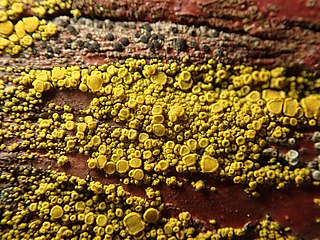
Candelariella is a genus of bright yellow, ocher, or greenish yellow crustose or squamulose lichens in the family Candelariaceae. Members of the genus are commonly called eggyolk lichens, goldspeck lichens, or yolk lichens. The genus was circumscribed in 1894 by Swiss lichenologist Johannes Müller Argoviensis, with Candelariella vitellina assigned as the type species.

Wilhelm Giesbrecht (1854–1913) was a Prussian zoologist, specialising in copepods, during the "golden age of copepodology".

Palaeoniscidae is an extinct family of "palaeoniscoid" ray-finned fishes (Actinopterygii). The family includes the genus Palaeoniscum and potentially other Palaeozoic and Mesozoic early actinopterygian genera. The name is derived from the Ancient Greek words παλαιός and ὀνίσκος.
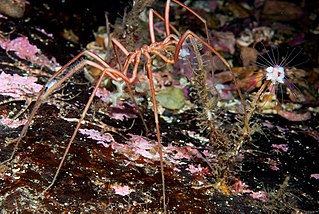
Nymphon is a genus of sea spiders in the family Nymphonidae. The species of sea spiders within the genus Nymphon are all benthic organisms and are found in abyssal and bathyal areas of the ocean. This is a fully marine group and can be found at various depths ranging from the littoral zones to the deep sea. They are found in most major oceans across the globe with a strong distribution around polar regions: Arctic and Antarctic waters. Out of the sea spider genus, Nymphon is the most rich, with a majority of the species within the genis being found in the Southern Ocean region. This genus may also contain bioluminescent species.

Pycnogonum is a genus of sea spiders in the family Pycnogonidae. It is the type genus of the family.
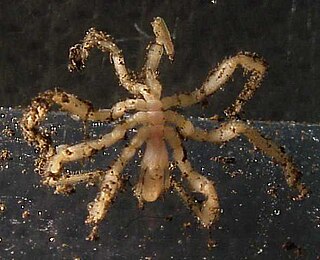
Ammotheidae is the most diversified group of the class Pycnogonida, with 297 species described in more than 20 genera, of which only Nymphopsis and Sericosura were found to be monophyletic. Despite its internal taxonomic uncertainty, studies on 18S rRNA supports its monophyly, and the subdivision on Achelinae and Ammotheinae subfamilies.

Achelia is a genus of pycnogonids in the family Ammotheidae.

Tanystylum is a genus of pycnogonids in the family Ammotheidae.
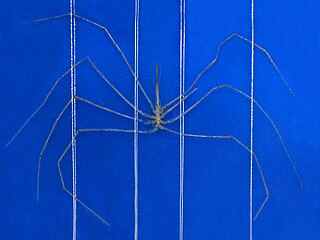
Colossendeis is a genus of sea spider belonging to the family Colossendeidae. These sea spiders are typically found in the deep sea. This genus includes the largest pycnogonids, with leg spans frequently ranging from 40 to 50 cm. The largest sea spider, Colossendeis colossea, can reach a leg span of 70 cm. This genus also includes some bioluminescent sea spiders.

Coptocheilus is a genus of land snails with an operculum, terrestrial gastropod mollusks in the subfamily Pupinellinae of the family Pupinidae.

Phoxichilidium is a genus of sea spiders within the family Phoxichilidiidae. Members of this genus can be found in all oceans at depths up to 1074 meters.

Brasidas cavernosus is a representative of the stick insects native to the Philippine island Luzon. It is considered one of the largest species in the subfamily Obriminae.


