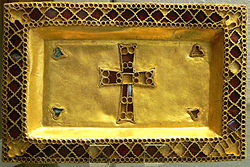
Copy of the signet ring of Childeric (original stolen in 1831). Inscription CHILDIRICI REGIS ("of king Childeric").[1] The original was found in his tomb at Tournai (Monnaie de Paris).
Childeric I (died about 481/482 AD) was a 5th-century Frankish leader in the northern part of Roman Gaul, during the period when this region became permanently disconnected from the central Roman government in 461, and the last emperor based in Italy was dethroned in 476. He was the ancestor of the early medieval Merovingian dynasty, and father of Clovis I, who acquired effective control over all or most Frankish kingdoms, and a significant part of Roman Gaul.
Childeric was described as a king (Latin: rex), both on his Roman-style seal ring, which was buried with him in Tournai, and in fragmentary later records of his life, but the correct interpretation of the term rex in northern Gaul in this period is a subject of scholarly uncertainty. He also apparently held at least one major official position within the Roman administration of northern Gaul, and the Frankish forces loyal to him seem to have coordinated with the Roman forces during a period when Roman chains of command were no longer stable.
The background of Childeric is uncertain but he was reputed to be a descendant of Chlodio, and he was probably one of the several Gaulish military leaders in his generation who had served when younger under the powerful Roman military leader and statesman Aëtius, who died in 454, and was himself strongly associated with the Huns of Attila both as an ally, and later as an enemy. Among those who certainly served under Aëtius were the emperor Majorian, the king-maker Ricimer who had Majorian enthroned in 457, and the Gaulish military commander Aegidius, who rejected the legitimacy of the new emperor in Rome after the murder of Majorian in 461—effectively separating northern Gaul from Italian control.
The only near-contemporary source to mention Childeric is the 6th-century History of the Franks written by Gregory of Tours, who mentions him twice, once concerning a legend about him spending time in exile, and once in a compressed account of conflicts near the river Loire which at the time represented a zone of confrontation against the expanding power of the Visigoths in what is now southwestern France. Both of these passages associate Childeric with the Gallo-Roman general Aegidius. Two later works which drew upon Gregory also mention Childeric, the Chronicle of Fredegar, and the Liber Historiae Francorum. They are considered less reliable overall for this period. However they added information which may reflect other sources which the authors had available.
Ancestry
Gregory of Tours, whose 6th-century History of the Franks is one of the only near-contemporary sources to mention Childeric, names the father of Childeric as Merovech. The Merovingian dynasty was named after Merovech but no information about his life has survived. Gregory mentioned that some people in his time said that Merovech was descended from Chlodio, who took control of some Roman populated areas including Cambrai in the early 5th century.[2]
Later medieval sources do not always agree about Childeric's ancestry, and some are elaborate and unreliable. The Fredegar chronicle (III.10) says that Merovech was born after a sea beast attacked the wife of Chlodio while she was swimming, making it uncertain whether Chlodio or the monster was the father.
In modern times it has been suggested for example that Childeric descended from Merovech on his mother's side.[3]
Halsall speculates that Childeric probably began a Roman military career in the service of Flavius Aetius who defeated Attila in Gaul, and he argues that his military career appears to have played out far from the Frankish homelands, in areas where he was fighting for Roman interests.[4]
Exile legend
The first of the two parts of Childeric's life which Gregory (II.12) narrates is that as king he was excessively wanton and began to dishonor the daughters of his fellow Franks. They ejected him from his position and wanted to kill him, so he escaped to "Thuringia" (a term which sometimes seems to represent the Tongeren region in this part of Gregory's work). He left an ally among the Franks to try to calm them. He and his friend agreed that he would receive a secret signal when the time was right for Childeric to return, and he went to stay with king Basinus and Basina his wife. According to Gregory, it was eight years before Childeric received the signal to return.[5]
Many modern scholars find it remarkable that the Gregory reports that while Childeric was gone, the Franks elected the Roman Aegidius, described as the commander of the Roman troops, as their "king", in the place of Childeric.
When he left Thuringia, Basina left her husband to come with Childeric: "I know your worth," said she, "and that you are very strong, and therefore I have come to Hve with you. For let me tell you that if I had known of anyone more worthy than you in parts beyond the sea I should certainly have sought to live with him." This part of the story explains the origins of the mother of Clovis.[5]
The Chronicle of Fredegar names the friend of Childeric as "Wiomad", and says that he was a Frank who had once rescued Childeric by flight when he and his mother were being led away captive by the Huns. The Liber Historiae Francorum calls him Viomad. They tell stories about Wiomad deliberately advising Aegidius to make bad decisions which made him unpopular, so that Childeric could return.
Guy Halsall connects the 8 year period to the period when Aegidius led the Roman forces of northern Gaul, from 457 until his death in 465.[6] He also suggested that the story might be connected to the refusal of Aegidius to accept Severus as emperor after the murder of Majorian in 461, putting his Roman position in doubt, proposing that, "to legitimise his position", Aegius took the Frankish title instead.[7]
Ulrich Nonn (map p.37, and pp.99–100), following his teacher Eugen Ewig, believes that the exile story reflects a real sequence of events whereby Childeric was a leader of "Salian" or "Belgian" Franks based in the Romanized areas conquered by Chlodio. He believes they not constituted a Roman allied force under the lordship of Aegidius, which he was temporarily able to take over when Chlodio and his imperial patron died.
The Battle of Orleans (463)
In a passage normally considered to have come from a lost collection of annals, Gregory (II.18-19) gave a sequence of events which are very difficult to interpret. Modern scholars consider it to be "only loosely connected to together, and ambiguous in terms of chronology and cause and effect".[8]
In the first part, Childeric is said to have been in battle at Orleans. This is generally equated to the Battle of Orléans (463), which other sources (Hydatius, Marius of Avranches, and the Gallic Chronicle of 511) all report as a battle where Frederic, the brother of the Visigothic king Theoderic II, was killed fighting Aegidius and the Franks, although none of these sources mention Childeric. It then lists several other events including the death of Aegidius which is known from other sources to have happened about 465.[9]
This battle of Orleans was part of the Gothic war against Aegidius, in which the Visigoths are believed to have attacked Aegidius in northern Gaul as allies of the Roman king-maker Ricimer and his puppet emperor Libius Severus, who granted the Visigoths the coastal region of Narbonne.
Further fighting near the Loire (c. 469)
In the next part of the passage, after the death of Aegidius, Childeric and a Roman named Count Paul, who is unknown from any other record, led Roman and Frankish forces in the Loire region against both Saxons in Angers, who were mentioned before the note about the death of Aegidius, and the Visigoths, who were not yet mentioned in this passage. These events are normally dated to the period around 469 during the Gothic revolt of Euric, when the Visigoths attempted to expand their territory into northern Gaul, but this time without a Roman alliance. According to the 6th-century writer Jordanes the emperor Anthemius called upon a force from Britain led by Riothamus to help, and the passage of Gregory notes that "the Britons were driven out of the territory of the Bituriges [around Bourges] by the Goths, many having been killed near the village of Déols.[10]
Next, Gregory mentions that Count Paul attacked the Goths together with Romans and Franks, and took booty, presumably indicating a victory against the Goths who had fought the Britons. Next in the listing of events given by Gregory: Adovacrius came to Angers, and King Childeric arrived on the following day; Count Paul having been killed, he [Childeric] took possession of the city. After these events, war was waged between the Saxons and the Romans. But the Saxons turned their backs in flight, and, as the Romans pursued them, left many of their own men behind to the sword. Their islands were captured by the Franks and destroyed, with a large number of people killed.
The Saxons were under a leader named "Adovacrius", sometimes given by modern authors in an Anglo-Saxon spelling form, Eadwacer, or in a spelling the same as used for his contemporary the future King of Italy Odoacer, with whom he is sometimes equated. The origin of these "Saxons" is, however, unclear, and before this conflict they are described as being based upon islands somewhere in the Loire region.
Detail of golden bees with garnet insetsGolden bee or fly jewellery from the tomb of Childeric I in Tournai. Drawn by Jacob van Werden and engraved by Cornelis Galle the Younger
Alliance with Italy
In the following line, Gregory of Tours (II.19) reports that Odovacrius (with variants Odovacrus and Adovachrius), entered into an alliance with Childeric, and they subdued the Alamanni, who had overrun part of Italy. Earlier in the passage Adovacrius (with variants Adovagrius and Odovacrio), had led the Saxon forces in Angers.
Many scholars see this as a record of an alliance between Childeric and Odoacer who became ruler of Italy after 476, but this has been controversial because of the mention of "Adovacrius" leading Saxons in the same passage.
For example, the PLRE interpretation equates both Adovacrius and Odovacrius in this text with Odoacer who "may have gone to Gaul to seek his fortune after the death of Attila and the break-up of the Hun empire" and he "apparently became leader of a group of Saxons in Gaul".[11] In 1986 Krautschick noted that Gregory of Tours never says that this Adovacrius was himself a Saxon.[12] Furthermore he felt that this name was not common enough to make it likely that there were two at the same time. He proposed that in 463 Odoacar would have been old enough to lead a warband, and if he had fought for Attila on the Catalaunian Plains in 451, he may have made his way from there to the Saxons. Alternatively, as the son of a high-ranking Hunnic dignitary, he could have begun working with the Saxons as part of a commission under Attila, who lived until 453.[13]
Other historians there must be an error. Some believe that Adovacrius and Odovacrius must be different people, and some argue that neither of the mentions in this passage is the king of Italy. Bachrach for example interprets these Alemanni to be a mistaken reference to the Alans, a people established in the Loire region in this period, despite the mention of Italy.
In 1946, Reynolds and Lopez interpreted the passage as showing that Gregory must "have had reason to fuse" the Saxon leader and the later King of Italy, and they argued that this was likely to be correct. Odoacer the king of Italy grew up among the allies of Attila, and the period of the battles on the Loire was between the Battle of the Catalaunian Plains in 451, when the Huns and their allies were defeated by their former ally Aëtius in Gaul, and the 470s when Odoacer took up service in the Roman military in Italy.[14]
In 1988 James noted that many scholars assumed that the Alamanni mentioned in this passage must in fact be Alans, who had a settlement in the Loire region, "on the grounds that Childeric could hardly have been fighting in Italy". However, as most scholars presumed Adovacrius and Odovacrius to be the same person, and the second one is "almost certainly" the ruler of Italy, he argued that the passage shows that Childeric was playing a political role within what was left of the Roman empire.[15]
In contrast, 2003 MacGeorge argued on the grounds of spelling variations that Gregory was not deliberately meaning to imply that he was referring to one person. She noted that in "virtually all the manuscripts the name in chapter 18 is Adovacrius (or Adovagrius) and in chapter 19 Odovacrius" saying it is "interesting" that he divided the material into two chapters, and arguing that while II.18 and II.19 were linked by Gregory, this is only "because they referred to conflicts in the same region, and because both mentioned Childeric".[16]
In 2004 Matthias Springer noted that Odoacer the future king of Italy is often understood to have had an ancestral connection to the early Thuringians, and these in turn were not yet clearly distinguished from the Saxons to their north. He believed that this could explain the connection between the young Odoacer and a group of Saxons.[17]
In 2007 Halsall wrote that many scholars "almost certainly incorrectly" equate Adovacrius and Odoacer. He noted that these Saxons may have come from Britain, and may have been working with the Goths who were also mentioned in the same passage. Concerning their island bases he notes that "whether these are in the Loire, such as were used by the Vikings later on, or off the coast of Gaul is also unclear".[18]
Roman authority
Especially after the death of Aegidius it is unclear how political power in Northern Gaul was divided between various leaders, or how many leaders there were. There was clearly more than one Roman (civitas) (city district) which was ruled by a king—Gregory mentioning several Frankish kings of cities such as Ragnachar in Cambrai. Apart from Syagrius the son of Aegidius who ruled as "king" in Soissons two letters from contemporary Romans mention a Roman named Arbogast, based in Trier, who is referred to in one letter with the Roman title of comes (count), even though the other letter mentions that Roman law is no longer in effect around Trier.[19]
Childeric on the other hand was not associated with a specific city in contemporary documents, even though archaeological evidence shows that he was buried in Tournai. Some historians such as Edward James have proposed that Childeric may have had a Roman leadership role over a larger area, and might even have been seen as a Roman office-holder in the way that the Burgundian kings were even after the dethroning of the last Western emperor by Odoacer in Italy in 476. James noted that a letter by Saint Remigius to Clovis stated that his ancestors had administered the Roman province of Belgica Secunda which included Tournai, Cambrai, Reims, and Soissons, and the biography of Saint Genevieve mentions Childeric twice as an important person in the context of the Paris region. Childeric's grave also shows the insignia of a Roman military commander, and so when Gregory mentions that Childeric worked with Odoacer against Allamanni who were threatening a part of Italy, James takes the possibility seriously.[20]
Marriage, children, and death
Gregory of Tours, in his History of the Franks, mentions several siblings of Clovis within his narrative, apparently thus children of Childeric:
Audofleda, Queen of the Ostrogoths, wife of Theodoric the Great. Gregory III.31 also mentions their daughter Amalasuntha.
Lanthechild. Gregory II.31 mentions she had been an Arian but converted to Catholicism with Clovis.
Albofleda (died approximately 500). Gregory II.31 mentions that she died soon after being baptized with Clovis.
Childeric is generally considered to have died in 481 or 482 based on Gregory's report (II.43) that his son Clovis had ruled 30 years when he died about 511.[21]
Tomb
Childeric's tomb was discovered in 1653[22] not far from the 12th-century church of Saint-Brice in Tournai, now in Belgium.[23] Numerous precious objects were found, including jewels of gold and garnetcloisonné, gold coins, a gold bull's head, and a ring with the king's name inscribed. Also present were some 300 golden winged insects (usually viewed as bees or cicadas), which had been placed on the king's cloak.[22]Archduke Leopold William, governor of the Southern Netherlands (today's Belgium), had the find published in Latin. The treasure went first to the Habsburgs in Vienna, then as a gift to King Louis XIV, who was not impressed with the treasure and stored it in the royal library, which became the Bibliothèque Nationale de France during the Revolution.
On the night of 5–6 November 1831, the treasure of Childeric was among 80kg of treasure stolen from the Library and melted down for the gold. A few pieces were retrieved from where they had been hidden in the Seine, including two of the bees. The record of the treasure, however, now exists only in the fine engravings made at the time of its discovery and in some reproductions made for the Habsburgs.[24]
↑G. Salaün, A. McGregor & P. Périn (2008), "Empreintes inédites de l'anneau sigillaire de Childéric Ier: état des connaissances", Antiquités Nationales, 39, pp. 217–224 (esp. 218).
Heather, Peter (2006). The Fall of the Roman Empire: A New History of Rome and the Barbarians. Oxford, UK: Oxford University Press. ISBN978-0-19-532541-6.
James, Edward (1988). The Franks. Basil Blackwell. ISBN0-631-17936-4.
Krautschick, Stefan (1986), "Zwei Aspekte des Jahres 476", Historia: Zeitschrift für Alte Geschichte, 35 (3): 344–371, JSTOR4435971
MacGeorge, Penny (2002). Late Roman Warlords. Oxford: Oxford University Press. ISBN978-0-199-25244-2.
This page is based on this Wikipedia article Text is available under the CC BY-SA 4.0 license; additional terms may apply. Images, videos and audio are available under their respective licenses.