
A seahorse is any of 46 species of small marine bony fish in the genus Hippocampus. "Hippocampus" comes from the Ancient Greek hippókampos (ἱππόκαμπος), itself from híppos (ἵππος) meaning "horse" and kámpos (κάμπος) meaning "sea monster" or "sea animal". Having a head and neck suggestive of a horse, seahorses also feature segmented bony armour, an upright posture and a curled prehensile tail. Along with the pipefishes and seadragons they form the family Syngnathidae.

The big-belly seahorse or pot-bellied seahorse is one of the largest seahorse species in the world, with a length of up to 35 cm (14 in), and is the largest in Australia. Seahorses are members of the family Syngnathidae, and are teleost fishes. They are found in southeast Australia and New Zealand, and are listed on Appendix II of CITES.
Hippocampus angustus, commonly known as the narrow-bellied seahorse, western Australian seahorse, or western spiny seahorse, is a species of marine fish of the family Syngnathidae. It is found in waters off of Australia, from Perth to Hervey Bay, and the southern portion of Papua New Guinea in the Torres Strait. It lives over soft-bottom substrates, adjacent to coral reefs, and on soft corals at depths of 3–63 metres (9.8–206.7 ft). It is expected to feed on small crustaceans, similar to other seahorses. This species is ovoviviparous, with males carrying eggs in a brood pouch before giving birth to live young. This type of seahorse is monogamous in its mating patterns. The males only fertilize one female's eggs for the mating season because of the population distribution. While some seahorses can be polygamous because they are denser in population, this type of seahorse is more sparsely distributed and the cost of reproduction is high. Therefore, the risk to reproduce due to predatory and distributary factors limits this breed to one mate, often finding the same mate season after season.

Barbour's seahorse is a species of fish of the family Syngnathidae.

The knobby seahorse, also known as the short-headed seahorse or short-snouted seahorse, is a species of marine fish of the family Syngnathidae. It inhabits coastal waters in southwestern and southeastern Australia, from Gregory to Bremer Bay, and from Denial Bay to Newcastle.
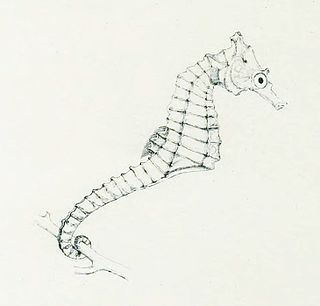
The giraffe seahorse is a species of fish of the family Syngnathidae. It is found in coastal waters off of the south and east coasts of Africa, from South Africa to Tanzania, and possibly north to Kenya. It lives in estuarine seagrass beds, algae beds, and shallow reefs to depths of 45 metres (148 ft), where it can grow to lengths of 10 centimetres (3.9 in). It is expected to feed on small crustaceans, similar to other seahorses. This species is ovoviviparous, with males carrying eggs in a brood pouch before giving birth to live young. Individuals are sexually mature at around 6.5 centimetres (2.6 in). Major threats to this species could be habitat loss, through coastal development and pollution, and overexploitation through bycatch. Some other threats include human use by drying out the seahorse for traditional medicine or as a curio.

Hippocampus fisheri, commonly known as Fisher's seahorse, or the Hawaiian seahorse, is a species of fish of the family Syngnathidae. It is known from the Hawaiian Islands, although previous misidentifications indicated species occurrences in Australia and New Caledonia. Habitat preferences are unknown, but it has been found far away from shore and at depths greater than 100 metres (330 ft). Feeding habits are also unknown, but individuals are expected to feed on small crustaceans similar to other seahorses. Hippocampus fisheri is one out of the three species of Hippocampus genus found in the Hawaiian islands. They are also expected to be ovoviviparous, with males carrying eggs in a brood pouch before giving birth to live young. Individuals can grow to lengths of 8 centimetres (3.1 in). The specific name and the common name honour "Walter V. Fisher” of Stanford University. There was a Walter Kenrick Fisher who was Jordan and Evermann's colleague at Stanford and the “V” is assumed to be a typo.

Hippocampus guttulatus, commonly known as the long-snouted seahorse and in Great Britain as the spiny seahorse, is a marine fish belonging to the family Syngnathidae, native from the northeast Atlantic, including the Mediterranean.

Jayakar's seahorse is a species of coastal fish of the family Syngnathidae. It is found in the Western Indian Ocean, from the Red and Arabian seas to the central coast of Pakistan. It lives in seagrass beds, algae, soft-bottom substrates, sponges, and rocky habitats, where it can grow to lengths of 14 centimetres (5.5 in). It can inhabit depths to 20 metres (66 ft), though it is more commonly found at 2–3 metres (6.6–9.8 ft). It is expected to feed on small crustaceans, similar to other seahorses. This species is ovoviviparous, with males carrying eggs in a brood pouch before giving birth to live young. Individuals reach sexual maturity at 11 centimetres (4.3 in). The specific name and the common name honours the Indian physician, linguist and ichthyologist Dr. Surgeon-Major Atmaram Sadashiv "Muscati" Jayakar (1844-1911).
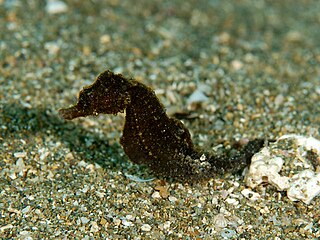
The Japanese seahorse or lemur-tail seahorse is a species of fish in the family Syngnathidae. The Japanese seahorse reaches a maximum length of 8.0 cm, is usually dark brown and has a relatively long tail, a ridgelike coronet and flattened spines. Many seahorse species look similar, so in addition to any distinguishing features, individual specimens are identified using a series of specific measurements and counts of anatomical features such as spines and tail rings.

Shiho's seahorse or Sindo's Seahorse, painted seahorse is a species of fish in the family Syngnathidae. It is endemic to the Pacific coastal waters of Japan. This species reaches a length of ca. 8 cm. It was listed by the IUCN Red List as Vulnerable in 1996 and Data Deficient in 2003, but was later reclassified as Least Concern. The specific name honours Michitaro Sindo, who was originally from Yamaguchi and who was assistant curator of fishes at Stanford University.

The hedgehog seahorse is a species of fish of the family Syngnathidae. It inhabits coastal waters from India and Sri Lanka to Taiwan and northern Australia. It is threatened by overfishing, as both targeted catch and bycatch. This species is ovoviviparous, with males carrying eggs in a brood pouch before giving birth to live young.
The false-eye seahorse, or flatface seahorse is a species of marine fish of the family Syngnathidae. It is endemic to Australia, from Shark Bay to Broome, where it is found in intertidal rockpools, shallow algae and weedy or rubble reef habitats. It is expected to feed on harpacticoid, calanoid, and cyclopoid copepods, caridean and gammaridean shrimps, and mysids, similar to other seahorses. This species is ovoviviparous, with males brooding eggs in a brood pouch before giving birth to live young.

Hippocampus whitei, commonly known as White's seahorse, New Holland seahorse, or Sydney seahorse, is a species of marine fish of the family Syngnathidae. It is thought to be endemic to the Southwest Pacific, from Sydney, New South Wales and southern Queensland (Australia) to the Solomon Islands. It lives in shallow, inshore habitats, both natural and anthropogenic. This species is ovoviviparous, with males brooding eggs in a brood pouch before giving birth to live young.

The Gulf pipefish is a species of pipefish in the member of the taxonomic family Sygnathidae. Syngnathus scovelli is native to the region of south Florida, United States, the Atlantic Ocean, etc. S. scovelli is similar to Microphis brachyurus.
Hippocampus debelius, commonly known as the softcoral seahorse, is a species of marine fish of the family Syngnathidae. It is known from only two specimens collected from the Gulf of Suez in the Red Sea, at depths of 15–30 metres (49–98 ft). Individuals were found associated with soft corals. Although little is known of this species, it is expected to feed on crustaceans, similar to other seahorses. It is also expected to be ovoviviparous, with males carrying eggs in a brood pouch before giving birth to live young.
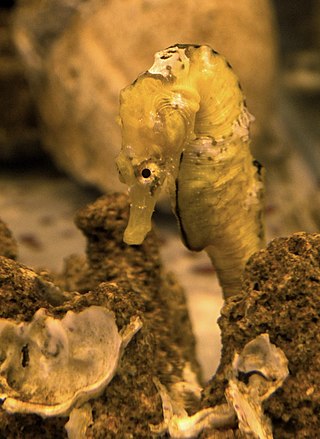
The Patagonian seahorse is a species of marine fish of the family Syngnathidae. It inhabits coastal waters from northeastern Brazil to Chubut, Argentina. It generally is found at shallow depths attached to natural or artificial substrates. This species is ovoviviparous, with males brooding eggs in a brood pouch before giving birth to live young.

Hippocampus haema, the Korean seahorse, is a seahorse of the family Syngnathidae native to the northern Pacific Ocean, and it usually lives in Sargassum and weeds on shallow soft bottom habitats from 0 to 18 m depth. The Korean seahorse is the most common seahorse in Korean waters so that the scientific name 'haema' is named from 'seahorse' in Korean. The Japanese name 'Himetatsu' is derived from its smaller shape such as body and coronet rather than the shape of a sister species, crowned seahorse. This species had been repeatedly misidentified as crowned seahorse and Shiho's seahorse before a taxonomic review. However, the two genuine species do not live in Korean waters, therefore this species was handled by naming a new scientific name, Hippocampus haema. It can grow to lengths of 11 centimeters, but more commonly 6 to 8 centimeters as adult. Namely, the length of juvenile is 1 to 5 centimeters, whereas and the lengths of males and females reaching sexual maturity are considered as ca. 5 centimeters with or without male brood pouch. However, sex determination of this species is considered as ca. 2 centimeters from anatomic examination of gonad. This species has sexual dimorphism, the difference is male has a longer tail, while female has a longer trunk for same size. Breeding season of this species is from April to October or May to November, relating to warm water temperature. The number of fertilized egg or larvae inside the male brood pouch were 38.3±14.8 (20-76), and the number of fecundity identified from female were 47.2±8.6 (31-59). The female-to-male ratio was 1:1.7, indicating the dominance of males.
Hippocampus casscsio, the Beibu Bay seahorse, is a species of marine fish of the family Syngnathidae. It is found off the coast of Hainan, China, and from sites around Beibu Bay/the Gulf of Tonkin. It inhabits shallow coastal waters to depths of 15 metres (49 ft). It is expected to consume small benthic and planktonic crustaceans such as copepods, shrimps, and mysids, similar to other seahorses. This species is ovoviviparous, with males brooding eggs in a brood pouch before giving birth to live young. It grows to a length of 13.3 centimetres (5.2 in).
Hippocampus dahli is a fish species of the family Syngnathidae. It is endemic to the Australian northeastern coast, from Darwin to Brisbane, where it inhabits estuarine channels and rubble or soft substrates to depths of 21 metres (69 ft). Little is known of its feeding habits, but it is likely to feed on small crustaceans such as copepods, amphipods, and gammarid, caprellid, and caridean shrimps, similar to other seahorses. This species is ovoviviparous, with males carrying eggs in a brood pouch before giving birth to live young. This species is not listed in FishBase and many authorities treat it as a synonym of Hippocampus trimaculatus.


 Juvenile crowned seahorse
 Close-up of the head of crowned seahorse
 A dried crowned seahorse specimen
 Crowned seahorse skeleton


