The Dongpo Formation can be found within the North China Craton, currently amongst the oldest known cratons in the world, alongside its southern edge. The formation itself is primarily composed of yellowish-green shale, siltstone, and fine-grained sandstone.[1]
The formation is dominated by macroalgae forms, like Glomulus, alongside tubular forms such as Wutubus and Shaanxilithes. There are also some Ediacaran-type fossils, and some rare trace fossils, all of which has helped to constrain the age of the formation to the terminal Ediacaran, between 550Ma and 538.8Ma.[1]
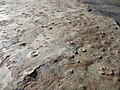
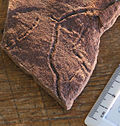
The reported frondose forms from the formation have had their biotic origins put into question, as some researchers suggest that they may actually be chevron marks produced by clasts being transported above the seabed, due to their similarity with other tool marks found in other formations, such as the Carboniferous aged Gull Island Formation in Ireland.[2]
Slender frondose fossils, which bear some similarities with petalonamids, although poor preservation makes proper taxonomic assignment difficult. May be sedimentary markings produce by transported clasts.[2]
12345678910111213Wang, Xin; Zhang, Xingliang; Dai, Tao; Liu, Wei; Zhang, Yuan; Li, Luoyang (March 2026). "New occurrence of a postglacial Ediacaran macrofossil assemblage from North China and its evolutionary implication". Precambrian Research. 434 107992. doi:10.1016/j.precamres.2025.107992.
12McIlroy, Duncan; Peakall, Jeffrey (May 2026). "Comment on "New occurrence of a postglacial Ediacaran macrofossil assemblage from North China and its evolutionary implication" by Wang et al. (2026), Precambrian Research 434, 107992". Precambrian Research. 436: 108041. doi:10.1016/j.precamres.2026.108041.{{cite journal}}: CS1 maint: article number as page number (link)
↑Chumakov, N. M. (August 2009). "The Baykonurian glaciohorizon of the Late Vendian". Stratigraphy and Geological Correlation. 17 (4): 373–381. doi:10.1134/S0869593809040029.
This page is based on this Wikipedia article Text is available under the CC BY-SA 4.0 license; additional terms may apply. Images, videos and audio are available under their respective licenses.