Related Research Articles

The South African Republic, also known as the Transvaal Republic, was an independent Boer republic in Southern Africa which existed from 1852 to 1902, when it was annexed into the British Empire as a result of the Second Boer War.

The Second Boer War, also known as the Boer War, Transvaal War, Anglo–Boer War, or South African War, was a conflict fought between the British Empire and the two Boer republics over the Empire's influence in Southern Africa.
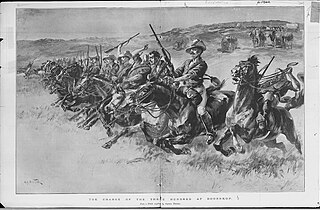
The Jameson Raid was a botched raid against the South African Republic carried out by British colonial administrator Leander Starr Jameson, under the employment of Cecil Rhodes. It involved 500 British South Africa Company police launched from Rhodesia over the New Year weekend of 1895–96. Paul Kruger, for whom Rhodes had great personal hatred, was president of the South African Republic at the time. The raid was intended to trigger an uprising by the primarily British expatriate workers in the Transvaal but it failed.
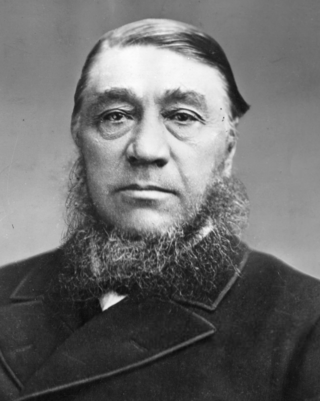
Stephanus Johannes Paulus Kruger, better known as Paul Kruger, was a South African politician. He was one of the dominant political and military figures in 19th-century South Africa, and State President of the South African Republic from 1883 to 1900. Nicknamed Oom Paul, he came to international prominence as the face of the Boer cause—that of the Transvaal and its neighbour the Orange Free State—against Britain during the Second Boer War of 1899–1902. He has been called a personification of Afrikanerdom and admirers venerate him as a tragic folk hero.

The Orange Free State was an independent Boer sovereign republic under British suzerainty in Southern Africa during the second half of the 19th century, which ceased to exist after it was defeated and surrendered to the British Empire at the end of the Second Boer War in 1902. It is one of the three historical precursors to the present-day Free State province.
The year 1870 in the history of the Cape Colony marks the dawn of a new era in South Africa, and it can be said that the development of modern South Africa began on that date. Despite political complications that arose from time to time, progress in Cape Colony continued at a steady pace until the outbreak of the Anglo-Boer Wars in 1899. The discovery of diamonds in the Orange River in 1867 was immediately followed by similar finds in the Vaal River. This led to the rapid occupation and development of huge tracts of the country, which had hitherto been sparsely inhabited. Dutoitspan and Bultfontein diamond mines were discovered in 1870, and in 1871 the even richer mines of Kimberley and De Beers were discovered. These four great deposits of mineral wealth were incredibly productive, and constituted the greatest industrial asset that the Colony possessed.

The First Boer War, was fought from 16 December 1880 until 23 March 1881 between the United Kingdom and Boers of the Transvaal. The war resulted in a Boer victory and eventual independence of the South African Republic. The war is also known as the First Anglo–Boer War, the Transvaal War or the Transvaal Rebellion.

Sir Leander Starr Jameson, 1st Baronet, was a British colonial politician, who was best known for his involvement in the ill-fated Jameson Raid.
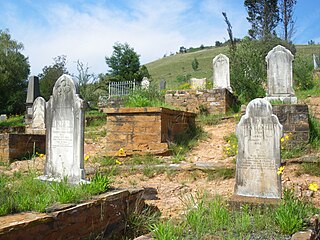
An uitlander, Afrikaans for "foreigner", was a foreign migrant worker during the Witwatersrand Gold Rush in the independent Transvaal Republic following the discovery of gold in 1886. The limited rights granted to this group in the independent Boer Republics was one of the contributing factors behind the Second Boer War.
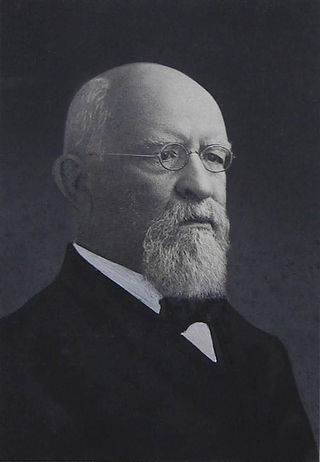
Jan Hendrik Hofmeyr was a politician in the Cape Colony. He was affectionately known as Onze Jan, "our Jan" in Dutch.

The Witwatersrand Gold Rush was a gold rush that began in 1886 and led to the establishment of Johannesburg, South Africa. It was a part of the Mineral Revolution.
The Netherlands–South African Railway Company or NZASM was a railway company established in 1887. The company was based in Amsterdam and Pretoria, and operated in the South African Republic (ZAR) during the late 19th century. At the request of ZAR president Paul Kruger, the NZASM constructed a railway line between Pretoria and Lourenço Marques in Portuguese East Africa.

Field Marshal Jan Christian Smuts, OM, CH, ED, KC, FRS was a prominent South African and Commonwealth statesman, military leader, and philosopher. He served as a Boer General during the Boer War, a British General during the First World War and was appointed Field Marshal by King George VI during the Second World War. In addition to various cabinet appointments, he served as Prime Minister of the Union of South Africa from 1919 until 1924 and from 1939 until 1948. From 1917 to 1919 he was one of five members of the British War Cabinet, helping to create the Royal Air Force. He played a leading part in the post-war settlements at the end of both world wars, making significant contributions towards the creation of the League of Nations and the United Nations. He did much to redefine the relationship between Britain and the Dominions and Colonies, leading to the formation of the British Commonwealth.

Sir James Percy FitzPatrick,, known as Percy FitzPatrick, was a South African author, politician, mining financier and pioneer of the fruit industry. He authored the classic children's book, Jock of the Bushveld (1907). As a politician, he defended British Imperial interests before and during the Anglo-Boer War. FitzPatrick is responsible for the creation of the two-minute silence observed on Armistice Day.

The Bloemfontein Conference was a meeting that took place at the railway station of Bloemfontein, capital of the Orange Free State from 31 May until 5 June 1899. The main issue dealt with the status of British migrant workers called "Uitlanders", who mined the gold fields in Transvaal.

The Reform Committee was an organisation of prominent Johannesburg citizens that existed late 1895 and early 1896.

The South African Wars, including but also known as the Confederation Wars, were a series of wars that occurred in the southern portion of the African continent between 1879 and 1915. Ethnic, political, and social tensions between European colonial powers and indigenous Africans led to increasing hostilities, culminating in a series of wars and revolts, which had lasting repercussions on the entire region. A key factor behind the growth of these tensions was the pursuit of commerce and resources, both by countries and individuals, especially following the discoveries of diamonds in the region in 1867 and gold in 1862.

The South African Railways Class B 0-6-4T of 1893 was a steam locomotive from the pre-Union era in Transvaal.
Sir Johannes John Wilhelmus Wessels (1862–1936) was an Afrikaner judge of the Appellate Division from 1923 to 1936 and Chief Justice of South Africa from 1932 to 1936.
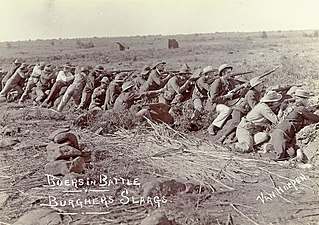
In the Boer Republics of 19th century South Africa, a burgher was a fully enfranchised citizen. Burgher rights were restricted to white men, in particular Boers.
References
- 1 2 3 4 Mills, William G. "Origins of Afrikaner Nationalism". stmarys.ca. Archived from the original on 10 May 2005. Retrieved 12 September 2008.
- 1 2 3 4 5 6 7 8 Olson, James Stuart; Robert Shadle (1996). Historical Dictionary of the British Empire. Westport, CT: Greenwood Press.
- 1 2 3 4 "The second Anglo-Boer War". sahistory.org.za. Retrieved 12 September 2008.
- 1 2 Blainey, G. (1965). "Lost Causes of the Jameson Raid". The Economic History Review. 18 (2): 350–366. doi:10.1111/j.1468-0289.1965.tb02280.x.
- 1 2 Longford, Elizabeth (1982). Jameson Raid: The prelude to the Boer War. Weidenfeld and Nicolson. ISBN 0-297-78136-7.
