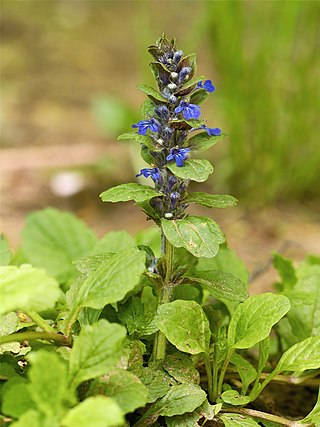
Ajuga, also known as bugleweed, ground pine, carpet bugle, or just bugle, is a genus of flowering plants in the Ajugeae tribe of the mint family Lamiaceae. There are over 60 species of annual or perennial, mostly herbaceous plants. They are native to Europe, Asia, Africa, and Australia.

Triuridaceae are a family of tropical and subtropical flowering plants, including nine genera with a total of approximately 55 known species. All members lack chlorophyll and are mycoheterotrophic. The heterotrophic lifestyle of these plants has resulted in a loss of xylem vessels and stomata, and a reduction of leaves to scales.
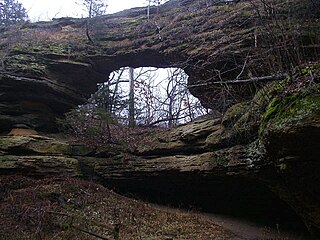
Natural Bridge State Park is a 530-acre (214 ha) state park of Wisconsin, United States, featuring Wisconsin's largest natural arch. Directly beneath the arch is the Raddatz Rockshelter, a rock shelter once used by Paleo-Indians and now listed on the National Register of Historic Places. The park is located southwest of Baraboo between the unincorporated communities of Leland and Denzer, in the town of Honey Creek.

Anemonoides is a genus of flowering plants in the buttercup family Ranunculaceae. Plants of the genus are native to the temperate regions of the Northern Hemisphere, on the continents of North America, Europe, and Asia. The generic name Anemonoides means "anemone-like", a reminder that many of the species were formerly included within the genus Anemone.
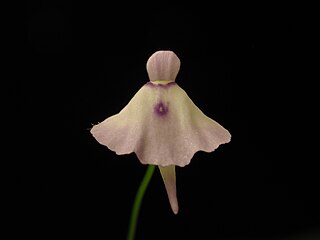
Utricularia pubescens is a small to medium-sized, probably annual, terrestrial or lithophytic carnivorous plant that belongs to the genus Utricularia and is the only member of Utricularia sect. Lloydia. U. pubescens is native to India, tropical Africa, and Central and South America. It was originally published and described by James Edward Smith in 1819 and placed in its own section, Lloydia, by Peter Taylor in 1986. It grows as a terrestrial or lithophytic plant in boggy grasslands in damp peaty soils at altitudes from sea level to 1,900 m (6,234 ft). This species possesses small peltate leaves, which are diagnostic for this species in the genus.

Lacandonia is a mycoheterotrophic plant that contains no chlorophyll and has the unusual characteristic of inverted positions of the male (androecium) and female (gynoecium) floral parts, something that had not been seen in any other plants, with the exceptions of Trithuria and on occasion the related Triuris brevistylis.

Celypha rufana, common name lakes marble, is a small moth species of the family Tortricidae, long known under the junior synonym C. rosaceana.
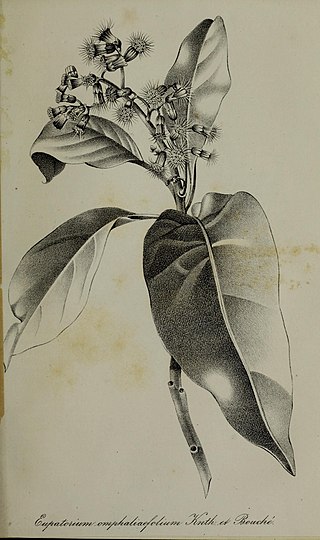
Neomirandea is a genus of Central American and South American flowering plants in the boneset tribe within the sunflower family.

The Cnephasiini are a tribe of tortrix moths.

Sciaphila is a genus of mycoheterotrophic plants in the family Triuridaceae. These plants receive nutrition from fungi and neighboring trees and have less need for photosynthesis. It is widespread in tropical and subtropical regions, found in Africa, China, Japan, the Indian Subcontinent, Southeast Asia, Latin America and on various islands Pacific Islands. The most noteworthy feature of the genus is the number of the various flower parts 99.9 percent of Monocots are trimerous, but Sciaphila spp. can have eight or even ten parts in a whorl.

Cola is a genus of trees native to the tropical forests of Africa, classified in the family Malvaceae, subfamily Sterculioideae. Species in this genus are sometimes referred to as kola tree or kola nut for the caffeine-containing fruit produced by the trees that is often used as a flavoring ingredient in beverages. The genus was thought to be closely related to the South American genus Theobroma, or cocoa, but the latter is now placed in a different subfamily. They are evergreen trees, growing up to 20 m tall, with glossy ovoid leaves up to 30 cm long and star-shaped fruit.

Brady's Bluff Prairie State Natural Area is a Wisconsin Department of Natural Resources-designated State Natural Area featuring a steep, southwest-facing bluff rising over 450 feet above the Mississippi River. Over 100 species of prairie plants have been found at this site.

Parfrey's Glen, located within Devil's Lake State Park, is a Wisconsin Department of Natural Resources-designated State Natural Area. The glen is a deep gorge cut through the sandstone of the south flank of the Baraboo Hills. It was the first State Natural Area to be designated in Wisconsin. The valley was named for Robert Parfrey.
Solidago sciaphilia is known as shadowy goldenrod or cliff goldenrod. The species is endemic to bluffs along the Mississippi River in southern Minnesota, and the driftless area of southwestern Wisconsin, northern Iowa and Illinois. Throughout its range, S. sciaphila is strongly associated with dolomite and sandstone bedrock, especially dry cliffs. It can be similar to Solidago speciosa but has more serrate lower and mid stem leaves and is generally smaller to much smaller when growing in pockets of shallow soil on cliffs. Small plants are similar to Solidago hispida in general appearance. Blooming occurs late August through late September; fruiting occurs throughout September. Shadowy Goldenrod is considered a Special Concern species in Wisconsin and Minnesota, and considered threatened in Illinois. This species can be significantly impacted by rock climbing activities.

Solidago roanensis, the Roan Mountain goldenrod, is a North American species of goldenrod in the family Asteraceae. It is native to the eastern United States, primarily the Appalachian Mountains from Pennsylvania to Georgia, with some populations in the lowlands of South Carolina.
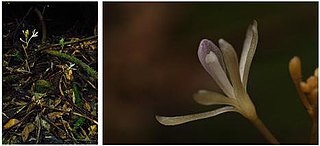
Lecanorchis tabugawaensis is a species of orchid which belongs to the group of mycoheterotrophic plants. Mycoheterotrophs are known for feeding off of the roots of fungal hosts, instead of utilizing photosynthesis. Myco-heterotrophy refers to the harmonious relationship between particular plants and fungi. After a thorough exploration of the plant's shape, size, and structure, it was determined to be closely associated with orchidaceous Lecanorchis amethystea, although inward variations confirmed this unique species.
Sciaphila thaidanica is one of the members of the genus Sciaphila, It has light purple coloration with large flowers and inflorescence. It is characterized by one of the smallest plastomes ever encountered, which at the same time are very compact. It was recently discovered in Borneo.
Pelochrista agrestana is a species of moth belonging to the family Tortricidae.
Ficus sciaphila is a species of flowering plant, a tree in the family Moraceae. It is closely related to Ficus copiosa.
