Related Research Articles
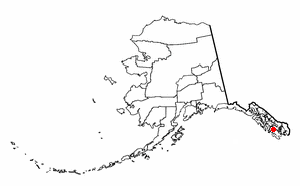
Naukati Bay is a census-designated place (CDP) in the Prince of Wales-Hyder Census Area of the Unorganized Borough of the U.S. state of Alaska. The population was 113 at the 2010 census, down from 135 in 2000.
The Forrestal Range is a largely snow-covered mountain range, about 105 km (65 mi) long, standing east of Dufek Massif and the Neptune Range in the Pensacola Mountains of Antarctica. Discovered and photographed on 13 January 1956 on a transcontinental patrol plane flight of U.S. Navy Operation Deep Freeze I from McMurdo Sound to the vicinity of the Weddell Sea and return.


Possession Bay is a bay 2 miles (3.2 km) wide on the north coast of South Georgia, an island in the southern Atlantic Ocean. It recedes southwest for 5 miles (8 km), and is separated from Cook Bay to the north by Black Head promontory. It is connected to King Haakon Bay by Shackleton Gap, a mountain pass.
Barff Peninsula is a peninsula forming the east margin of Cumberland East Bay, South Georgia Island. It is 8 miles (13 km) long and extends northwest from Sörling Valley to Barff Point, its farthest extremity. It was probably first seen by the British expedition under James Cook in 1775. The peninsula as a whole takes its name from Barff Point, which was named for Royal Navy Lieutenant A.D. Barff of HMS Sappho, who, assisted by Captain C.A. Larsen, sketched a map of Cumberland Bay in 1906. Barff Point is considered the eastern headland of East Cumberland Bay.
Fortuna Bay is a bay 3 miles (5 km) long and 1 mile (1.6 km) wide. Its entrance is defined by Cape Best on the west and Robertson Point to the east, near Atherton Peak on the north coast of South Georgia. It was named after the Fortuna, one of the ships of the Norwegian–Argentine whaling expedition under C.A. Larsen which participated in establishing the first permanent whaling station at Grytviken, South Georgia, in 1904–05. The Second German Antarctic Expedition (SGAE) under Wilhelm Filchner explored Fortuna Bay in 1911–12. Discovery Investigations (DI) personnel charted the area during their 1929–30 expedition.

The Bay of Isles is a bay 9 miles (14 km) wide and receding 3 miles (5 km), lying between Cape Buller and Cape Wilson along the north coast of South Georgia. It was discovered in 1775 by a British expedition under James Cook and so named by him because numerous islands lie in the bay. Of South Georgia's 31 breeding bird species, 17 are found here.
Jason Harbour is a bay 1 mile (1.6 km) wide, lying west of Allen Bay in the north side of Cumberland West Bay, South Georgia. It was charted and named by the Swedish Antarctic Expedition, 1901–04, under Otto Nordenskiöld. The bay was previously visited by the Jason, Captain C.A. Larsen, in 1894.
Greene Peninsula is a mountainous peninsula within Cumberland East Bay, separating Moraine Fjord to the west from the main arm of Cumberland East Bay, on the north coast of South Georgia Island. The entire area was charted by the Swedish Antarctic Expedition (SAE), 1901–04, under Otto Nordenskjöld. The peninsula was named by the UK Antarctic Place-Names Committee (UK-APC) in 1979 after Stanley Wilson Greene, a British bryologist who worked in South Georgia.
The Skrap Skerries are two small groups of islands and rocks (skerries) lying midway between Cape George and Barff Point, close off the northern coast of the Barff Peninsula of South Georgia Island in Antarctica. The Skerries are divided into the West Skerry, 3.2 mi (5.1 km) east of Barff Point, and the East Skerry, 2 mi (3.2 km) northwest of Cape George. The present name for this pair of skerries appears on a chart based upon a survey of this area by Discovery Investigations personnel in the period 1926–30, but it may reflect earlier terms "skrapskjaer" or "skrapskjar" used by Norwegian whalers.
Hestesletten is a glacial plain between the Hamberg Lakes and Cumberland East Bay, South Georgia. It is covered with tussock and is almost 2 miles (3.2 km) long in a northeast–southwest direction and 0.75 miles (1.2 km) wide. It is, along with Salisbury Plain, one of the few substantial flat areas on the island.
Bill Rock is a rock which lies 0.3 nautical miles (0.6 km) east of the south end of Grass Island in Stromness Bay, South Georgia. It was charted and named in 1928 by Discovery Investigations personnel.

The Canso Rocks are two rocks lying west of Bone Bay, 2 nautical miles (4 km) northwest of Notter Point on Belitsa Peninsula, Trinity Peninsula in Graham Land, Antarctica. They were named by the UK Antarctic Place-Names Committee after the Canso, one of the types of aircraft used by the Falkland Islands and Dependencies Aerial Survey Expedition (1955–57).
The Contrast Rocks are a small group of rocks 0.5 nautical miles (1 km) east of Antarctic Point, along the north coast of South Georgia. The group was charted and named in the period 1926–30 by Discovery Investigations personnel.
Cook Bay is an irregular bay, 1.3 nautical miles (2.4 km) wide at its entrance between Cape Crewe and Black Head, narrowing into two western arms, Lighthouse Bay and Prince Olav Harbour, along the north coast of South Georgia. It was charted by Discovery Investigations (DI) personnel during the period 1926–30, and named by them for Captain James Cook, who explored South Georgia and landed in this general vicinity in 1775.
The Jonassen Rocks are a small group of rocks lying off the south coast of South Georgia, 1 nautical mile (2 km) west of the south end of Novosilski Bay. They were surveyed by the South Georgia Survey in the period 1951–57, and named by the UK Antarctic Place-Names Committee for Idar Jonassen (1889–1933), a gunner of the Compañía Argentina de Pesca, Grytviken, 1924–33.
The Freberg Rocks are a small group of rocks lying off Rocky Bay, 1.5 nautical miles (3 km) west-northwest of Ducloz Head, South Georgia. They were surveyed by the South Georgia Survey in the period 1951–57, and were named by the UK Antarctic Place-Names Committee for Hjalmar Freberg, a gunner of the Tonsberg Hvalfangeri, Husvik, 1946–54.
Middle Ground Rock is a submerged kelp-covered rock lying 1.5 nautical miles (3 km) east of Framnaes Point, in the middle of the entrance of Stromness Bay, South Georgia in the South Atlantic Ocean. The name appears to be first used on a 1952 British Admiralty chart.
Humpback Rocks is a small group of rocks lying 0.25 nautical miles (0.5 km) north of Cape Saunders, off the north coast of South Georgia. The South Georgia Survey reported in 1951–52 that the descriptive name "Knolrokset" has been used for this feature by the whalers and sealers at South Georgia. An English form of the name, Humpback Rocks, was recommended by the UK Antarctic Place-Names Committee in 1954.
References
- ↑ "Framnaes Point". Geographic Names Information System . United States Geological Survey, United States Department of the Interior . Retrieved 16 April 2019.
- ↑ "Black Rocks". Geographic Names Information System . United States Geological Survey, United States Department of the Interior . Retrieved 16 April 2019.
Capital: King Edward Point | |||||||
| General | |||||||
| Settlements / Whaling stations | |||||||
| South Georgia islands | |||||||
| South Sandwich Islands |
| ||||||
| Seamounts | |||||||
| Landmarks |
| ||||||

 | This South Georgia and the South Sandwich Islands location article is a stub. You can help Wikipedia by expanding it. |