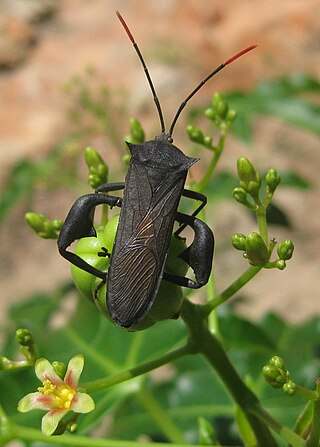
Coreidae is a large family of predominantly sap-sucking insects in the Hemipteran suborder Heteroptera. The name "Coreidae" derives from the genus Coreus, which derives from the Ancient Greek κόρις (kóris) meaning bedbug.

The Lygaeidae are a family in the Hemiptera, with more than 110 genera in four subfamilies. The family is commonly referred to as seed bugs, and less commonly, milkweed bugs, or ground bugs. Many species feed on seeds, some on sap or seed pods, others are omnivores and a few, such as the wekiu bug, are insectivores. Insects in this family are distributed across the world.

Alydidae, commonly known as broad-headed bugs, is a family of true bugs very similar to the closely related Coreidae. There are at least 60 genera and 300 species altogether. Distributed in the temperate and warmer regions of the Earth, most are tropical and subtropical animals; for example Europe has a mere 10 species, and only 2 of these occur outside the Mediterranean region.

Leptoglossus is a genus of true bugs in the leaf-footed bug family and the tribe Anisoscelini. Species are distributed throughout the Americas, with some records in eastern & southern Asia and Europe. Several species are economic pests of agricultural crops. Like members of some other genera in the family, these bugs have leaflike dilations of the hind tibia. Several species are of economic importance, and one species, L. chilensis, has been reported to bite humans.

Coreinae is a subfamily in the hemipteran family Coreidae. They have been shown to be paraphyletic with respect to Meropachyinae.

Anisoscelini is a tribe of leaf-footed bugs in the family Coreidae. It was formerly spelled Anisoscelidini, but the tribal name spelling was incorrectly formed.
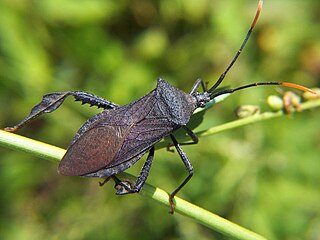
Acanthocephala, also known as spine-headed bugs, is a New World genus of true bugs in the family Coreidae. The scientific name is derived from the Greek ἄκανθα (akantha) meaning "thorn/spine" and κεφαλή (kephale) meaning "head". This name refers to the diagnostic spine on the front of the head.

Thasus is an insect genus of the Coreidae, or leaf-footed bugs. It is a genus in the New World Nematopodini tribe that feeds on plants. It is chiefly found in Central America, but species also occur in South America, and as far north as the American Southwest.
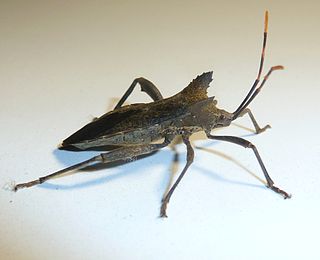
Elasmopoda is a genus in the "true bug" family Coreidae, order Hemiptera. The genus is native to parts of eastern and southern Africa. The species are large "twig wilter" bugs, generally brown or greyish. The femora of the hind legs are somewhat enlarged and bent, but less than those of some related genera, and either unarmed, or less armed with spikes.

Spilostethus is a genus of bugs in the family Lygaeidae. Most species in this genus are from the Palearctic and Oriental regions.
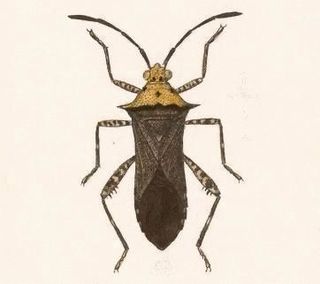
Zicca is a genus of leaf-footed bugs in the family Coreidae. There are about 19 described species in Zicca.

Pseudophloeinae is a subfamily of leaf-footed bugs in the family Coreidae. There are at least 100 described species in Pseudophloeinae, distributed worldwide.

Anisoscelis is a genus of leaf-footed bugs in the family Coreidae. There are about 11 described species in the genus Anisoscelis.

Mozena is a genus of leaf-footed bugs in the family Coreidae. There are more than 30 described species in Mozena.
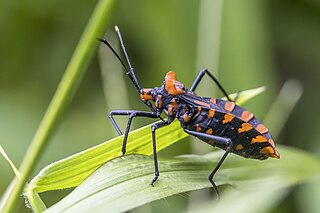
Spartocera is a genus of leaf-footed bugs in the family Coreidae. There are about 18 described species in Spartocera.
Althos is a genus of leaf-footed bugs in the family Coreidae. There are more than 20 described species in Althos.

Cimolus is a genus of leaf-footed bugs in the family Coreidae. There are at least four described species in Cimolus.
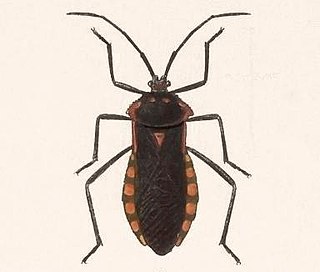
Sephina is a genus of leaf-footed bugs in the family Coreidae. There are more than 20 described species in Sephina.

Anisoscelis discolor is a species of leaf-footed bug in the family Coreidae endemic to Ecuador. It was first described by Swedish entomologist Carl Stål in 1854. Stål originally described the species as coming from "Taiti" (sic). However, Brailovsky (2016) notes that the Anisoscelis genus has an exclusive Neotropical distribution and the original data must have been the result of a mistaken label.

Anisoscelis scutellaris is a species of leaf-footed bug in the family Coreidae endemic to Colombia. It was first described by Swedish entomologist Carl Stål in 1870.

