This is a list of structures, sites, districts, and objects on the National Register of Historic Places in North Carolina:

Stagville Plantation is located in Durham County, North Carolina. With buildings constructed from the late 18th century to the mid-19th century, Stagville was part of one of the largest plantation complexes in the American South. The entire complex was owned by the Bennehan, Mantack and Cameron families; it comprised roughly 30,000 acres (120 km2) and was home to almost 900 enslaved African Americans in 1860.
The Alice Freeman Palmer Memorial Institute, better known as Palmer Memorial Institute, was a school for upper class African Americans. It was founded in 1902 by Dr. Charlotte Hawkins Brown at Sedalia, North Carolina near Greensboro. Palmer Memorial Institute was named after Alice Freeman Palmer, former president of Wellesley College and benefactor of Dr. Brown.

SS Copenhagen is a shipwreck off the town of Lauderdale-by-the-Sea, Florida, United States. The single screw steamer was built in Sunderland, England in 1898, sinking in 1900. Located on the Pompano Dropoff reef south of Hillsboro Inlet, it became the fifth Florida Underwater Archaeological Preserve when it was dedicated in 1994. There is a plaque noting this distinction south of the wreck. This was followed on 31 May 2001 with its addition to the US National Register of Historic Places.

Maple Leaf is a United States National Historic Landmark in Jacksonville, Florida, United States. Maple Leaf, a side paddlewheel steamship, was first launched as a freight and passenger vessel from the Marine Railway Yard in Kingston, Upper Canada in 1851. The 181-foot (55 m) sidewheel paddle steamer measured 24.7-foot (7.5 m) at the beam.
Rockford is an unincorporated community and former town in southern Surry County, North Carolina.

Bath Historic District is a historic district in Bath, Beaufort County, North Carolina. The district is now a North Carolina Historic Site belonging to the North Carolina Department of Natural and Cultural Resources and known as Historic Bath, and includes a visitor center offering guided tours of the Bonner House and Palmer-Marsh House, which is also a National Historic Landmark. Visitors can also tour the Van der Veer House and St. Thomas Episcopal Church.

The Stone Plantation, also known as the Young Plantation and the Barton Warren Stone House, is a historic Greek Revival-style plantation house and one surviving outbuilding along the Old Selma Road on the outskirts of Montgomery, Alabama. It was added to the Alabama Register of Landmarks and Heritage on September 28, 2000, and to the National Register of Historic Places on December 31, 2001.
Barnett House may refer to:

Halifax Historic District is a national historic district located at Halifax, Halifax County, North Carolina, US that was listed on the National Register of Historic Places in 1970. It includes several buildings that are individually listed on the National Register. Halifax was the site of the signing of the Halifax Resolves on April 12, 1776, a set of resolutions of the North Carolina Provincial Congress which led to the United States Declaration of Independence gaining the support of North Carolina's delegates to the Second Continental Congress in that year.

Henry House is a two-and-a-half-storey stone house located on Barrington Street in Halifax, Nova Scotia, Canada. The house is designated a National Historic Site, and is both a Provincially Registered Property and a Municipally Registered Property under the provincial Heritage Property Act.

The Midway Plantation House and Outbuildings are a set of historic buildings constructed in the mid-19th century in present-day Knightdale, Wake County, North Carolina, as part of a forced-labor farm.
Charles T. Holt House is a historic home located at Haw River, Alamance County, North Carolina. It was designed by architect George Franklin Barber and built in 1897. The house is a 2+1⁄2-story, rectangular dwelling sheathed in wood, slate, brick and stone in the Queen Anne style. It features peaks, turrets and decorative chimney stacks. Also on the property are the contributing carriage house, servant's quarters, gas house, corn crib, barn, and well house / flowerhouse. It was built for textile businessman Charles T Holt, the son of Thomas Michael Holt, governor of North Carolina, and his wife Gena Jones Holt, the daughter of Thomas Goode Jones, governor of Alabama.
James Monroe Thompson House, also known as Shady Rest, is a historic home located near Saxapahaw, Alamance County, North Carolina. The original one-story, single-pen, log house was built about 1850. In 1872, a two-story log addition was built, and the original building used as a kitchen. The log house is sheathed in weatherboard and sits on a stone foundation.
Polly Fogleman House is a historic home located near Burlington, Alamance County, North Carolina. It was built about 1825, and is a tall 1+1⁄2-story log house measuring 24 feet, 9 inches by 16 feet. It has a rear shed roofed addition and stone and brick chimney. Also on the property are the contributing fruit drying kiln, a 1+1⁄2-story log storage building with an attached open woodshed, and a small log building.

Northside Historic District is a national historic district located at Elizabeth City, Pasquotank County, North Carolina. The district encompasses 398 contributing buildings in a predominantly residential section of Elizabeth City. The district developed from the mid-19th to mid-20th century, and includes representative examples of Greek Revival, Queen Anne, Colonial Revival, Bungalow / American Craftsman, and Classical Revival style architecture. Notable contributing buildings include the John S. Burgess House, Scott-Culpepper House, Luther C. Lassiter House (1908-1913), William F. Williams House (1908-1914), Miles Pritchard House, Mack N. Sawyer House (1895), the Godfrey-Foreman House, Dr. Walter W. Sawyer House (1915), City Road United Methodist Church (1900-1902), Blackwell Memorial Baptist Church (1902), former Elizabeth City High School (1923), and S. L. Sheep School (1940).
The Bollinger-Hartley House is a historic house located at 423 North Main Street in Blowing Rock, Watauga County, North Carolina.

The Dillard B. and Georgia Sewell House is a historic summer house at 64 Clipper Lane in western Henderson County, North Carolina. It is a 1+1⁄2-story rustic stone structure, with a wood shake roof and a full-width porch fronting a stone patio. It is located southeast of Penrose, atop Jeter Mountain on a 9-acre (3.6 ha) parcel straddling the county line between Henderson and Transylvania Counties. The house was built in 1924 for Dillard Sewell, an insurance company executive from Charleston, South Carolina, and his wife Georgia. It is a well-preserved example of Rustic Revival architecture.
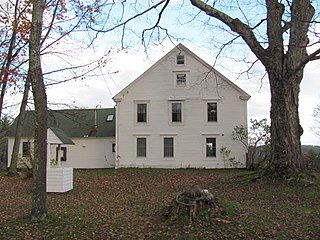
The Zachariah Spaulding Farm is a historic farmstead on South Hill Road in Ludlow, Vermont. With a history dating back to 1798, it is a well-preserved example of diversified 19th-century farmstead, made further distinctive by the remains of a sauna, the product of ownership by two Finnish families in the 20th century. It was listed on the National Register of Historic Places in 1993.