The bushtits or long-tailed tits, Aegithalidae, are a family of small, drab passerine birds with moderately long tails. The family contains 13 species in four genera, all but one of which are found in Eurasia. Bushtits are active birds, moving almost constantly while they forage for insects in shrubs and trees. During non-breeding season, birds live in flocks of up to 50 individuals. Several bushtit species display cooperative breeding behavior, also called helpers at the nest.

The tits, chickadees, and titmice constitute the Paridae, a large family of small passerine birds which occur mainly in the Northern Hemisphere and Africa. Most were formerly classified in the genus Parus.
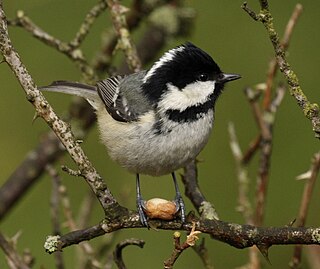
The coal tit or cole tit, Periparus ater, is a small passerine bird in the tit family, Paridae. It is a widespread and common resident breeder in forests throughout the temperate to subtropical Palearctic, including North Africa. The black-crested tit is now usually included in this species.
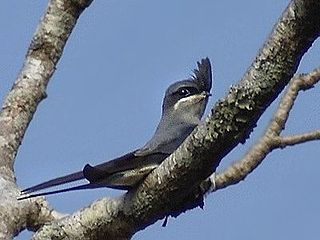
Treeswifts or crested swifts are a family, Hemiprocnidae, of aerial near passerine birds, closely related to the true swifts. The family contains a single genus, Hemiprocne, with four species. They are distributed from India and South East Asia through Indonesia to New Guinea and the Solomon Islands.

The European crested tit, or simply crested tit, is a passerine bird in the tit family Paridae. It is a widespread and common resident breeder in coniferous forests throughout central and northern Europe and in deciduous woodland in France and the Iberian peninsula. In Great Britain, it is chiefly restricted to the ancient pinewoods of Inverness and Strathspey in Scotland, and seldom strays far from its haunts. A few vagrant crested tits have been seen in England. It is resident, and most individuals do not migrate.

The great tit is a passerine bird in the tit family Paridae. It is a widespread and common species throughout Europe, the Middle East, Central Asia and east across the Palearctic to the Amur River, south to parts of North Africa where it is generally resident in any sort of woodland; most great tits do not migrate except in extremely harsh winters. Until 2005 this species was lumped with numerous other subspecies. DNA studies have shown these other subspecies to be distinctive from the great tit and these have now been separated as two distinct species, the cinereous tit of southern Asia, and the Japanese tit of East Asia. The great tit remains the most widespread species in the genus Parus.

The pitohuis are bird species endemic to New Guinea. The onomatopoeic name is thought to be derived from that used by New Guineans from nearby Dorey (Manokwari), but it is also used as the name of a genus Pitohui which was established by the French naturalist René Lesson in 1831. The unitalicized common name however refers to perching birds that belong to several genera of multiple bird families. The genera include Ornorectes, Melanorectes, and Pseudorectes apart from Pitohui.

The hooded pitohui is a species of bird in the genus Pitohui found in New Guinea. It was long thought to be a whistler (Pachycephalidae) but is now known to be in the Old World oriole family (Oriolidae). Within the oriole family this species is most closely related to the variable pitohuis in the genus Pitohui, and then the figbirds.

The crested shriketit, or Australian shriketit, is a bird endemic to Australia where it inhabits open eucalypt forest and woodland. It is the only species contained within both the family Falcunculidae and the genus Falcunculus.
Sattal or Sat Tal is an interconnected group of seven freshwater lakes situated in the Lower Himalayan Range near Bhimtal, a town of the Nainital district in Uttarakhand, India. During the British Raj, the area had a tea plantation, one of four in the Kumaon area at that time.
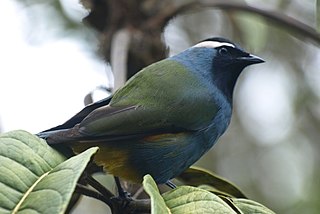
The painted berrypeckers, Paramythiidae, are a very small bird family restricted to the mountain forests of New Guinea. The family comprises two species in two genera: the tit berrypecker and the crested berrypecker. These are colourful medium-sized birds which feed on fruit and some insects. These species were formerly included in the Dicaeidae, but DNA–DNA hybridization studies showed these species were related to each other but distinct from the flowerpeckers. Some sources group painted berrypeckers as two genera belonging to the berrypecker family Melanocharitidae.

Stenostiridae, or the fairy flycatchers, are a family of small passerine birds proposed as a result of recent discoveries in molecular systematics. They are also referred to as stenostirid warblers.

The black-crested tit-tyrant or Marañón tit-tyrant is a species of bird in the family Tyrannidae. It is found in Ecuador and Peru. Its natural habitats are subtropical or tropical moist montane forests and subtropical or tropical high-altitude shrubland.

The pied-crested tit-tyrant is a species of bird in the family Tyrannidae. It is found in coastal Peru and far northern Chile.

The grey penduline tit, also known as the African penduline-tit, is a species of bird in the family Remizidae. It is found in Angola, Botswana, Burundi, Republic of the Congo, Democratic Republic of the Congo, Kenya, Malawi, Mozambique, Namibia, Rwanda, South Africa, Swaziland, Tanzania, Uganda, Zambia, and Zimbabwe. Its natural habitats are subtropical or tropical dry forests, dry savanna, and moist savanna. At 8 to 9 cm in length and a weight of 6.5 g (0.23 oz), it is one of the smallest species of bird found in Africa, along with its cousin the Cape penduline tit and the perhaps smaller mouse-colored penduline tit and the tit hylia.

The black-crested tit, also known as the spot-winged tit, is a bird in the family Paridae. It was formerly considered a species, but is now widely considered a subspecies of the coal tit.
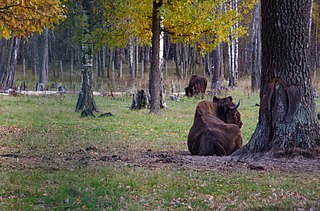
Prioksko-Terrasny Nature Biosphere Reserve is one of Russia's smallest zapovedniks, sprawling over an area of 5,000 hectares along the left bank of the Oka River in the Serpukhov District of Moskva Oblast. It was established in 1945 as part of the Moscow Nature Reserve and is home to 900 plant species, 130 bird species, and 54 mammal species. A wisent nursery was established in 1948 to populate the region with European bison from the Belovezhskaya Pushcha and Western Caucasus. There is also a small herd of American bison.