A pika is a small, mountain-dwelling mammal native to Asia and North America. With short limbs, a very round body, an even coat of fur, and no external tail, they resemble their close relative, the rabbit, but with short, rounded ears. The large-eared pika of the Himalayas and nearby mountains lives at elevations of more than 6,000 m (20,000 ft).
Princeps is a Latin word meaning "first in time or order; the first, foremost, chief, the most eminent, distinguished, or noble; the first person". As a title, princeps originated in the Roman Republic wherein the leading member of the Senate was designated princeps senatus. It is primarily associated with the Roman emperors as an unofficial title first adopted by Augustus in 23 BC. Its use in this context continued until the regime of Diocletian at the end of the third century. He preferred the title of dominus, meaning "lord" or "master". As a result, the Roman Empire from Augustus to Diocletian is termed the "principate" (principatus). Other historians define the reign of Augustus to Severus Alexander as the Principate, and the period afterwards as the "Autocracy".
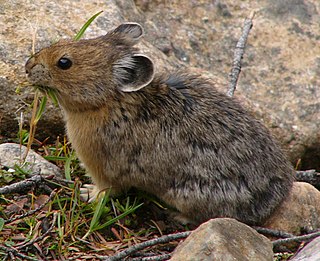
The American pika, a diurnal species of pika, is found in the mountains of western North America, usually in boulder fields at or above the tree line. They are herbivorous, smaller relatives of rabbits and hares. Pikas have two different ways of foraging; they either directly consume food or they cache food in piles for the winter (haying).

The great lanternshark is a shark of the family Etmopteridae found in the northeast and northwest Atlantic. Its name was given because, at the time of its discovery, it was thought to be bioluminescent, but this has been challenged.

Zapus is a genus of North American jumping mouse. It is the only genus whose members have the dental formula 1.0.1.31.0.0.3. Zapus are the only extant mammals aside from the Aye-aye with a total of 18 teeth.

The mountain ground squirrel is a rodent that is native to southwestern Angola, western Namibia, and western South Africa. It is also known as the Kaoko ground squirrel or the Damara ground squirrel.
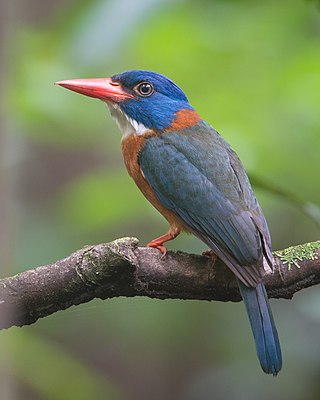
Actenoides is a genus of kingfishers in the subfamily Halcyoninae.

The scaly-breasted kingfisher or regent kingfisher is a species of bird in the family Alcedinidae endemic to central and southwestern Sulawesi in Indonesia. Its natural habitat is subtropical or tropical, moist, montane forests.
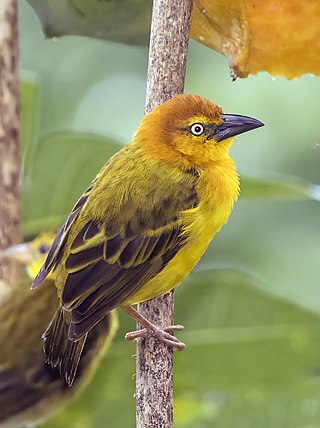
The Príncipe weaver is a species of bird in the family Ploceidae. It is endemic to São Tomé and Príncipe, where it is found on the island of Príncipe. It was described by Charles Lucien Bonaparte in 1851. Its natural habitat is subtropical or tropical moist lowland forests.

The western jumping mouse, is a species of rodent in the family Zapodidae. It is found in Canada and the United States.
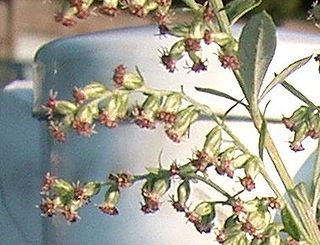
Artemisia princeps, also commonly called yomogi, Japanese mugwort, Korean wormwood, Korean mugwort or wormwood in English, is an Asian plant species in the sunflower family, native to China, Japan and Korea. It is a perennial, very vigorous plant that grows to 1.2 meters. This species spreads rapidly by means of underground stolons and can become invasive. It bears small, buff-colored flowers from July to November which are hermaphroditic, and pollinated by wind. The leaves are feather shaped, scalloped and light green, with white dense fuzz on the underside.

Uromastyx princeps, commonly known as the princely mastigure, princely spiny-tailed lizard, or Somalian mastigure, is a species of lizard in the family Agamidae.

Conus princeps, common name the prince cone, is a species of sea snail, a marine gastropod mollusk in the family Conidae, the cone snails and their allies.
The black prince copepod is a mesopelagic copepod found in temperate and tropical waters worldwide. They have been known to display bioluminescence.
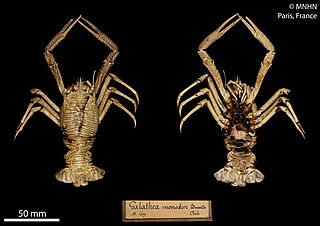
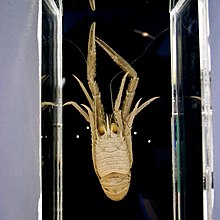
Grimothea monodon, also known as the red squat lobster, is a species of squat lobster from the south-eastern Pacific Ocean, where it is the subject of commercial fishery alongside the species Grimothea johni.

Rhyothemis princeps, known as the sapphire flutterer, is a species of dragonfly of the family Libellulidae. The flight of the genus Rhyothemis is usually fluttering, leading to the common description of "flutterer" for most species in the genus.
Grimothea johni is a species of squat lobster in the family Munididae. It is found in the Pacific Ocean, off the coast of Chile. It is known to be host to the parasite Bathione humboldtensis.

Pteronarcys princeps, the ebony salmonfly, is a species of giant stonefly in the family Pteronarcyidae. It is found in North America.
Acmaeodera princeps is a species of metallic wood-boring beetle in the family Buprestidae. It is found in North America.

Epitheca princeps, the prince baskettail, is a species of emerald dragonfly in the family Corduliidae. It is found in North America.