
The Yellow River or Huang He is the second-longest river in China,after the Yangtze River,and the sixth-longest river system in the world at the estimated length of 5,464 km (3,395 mi). Originating in the Bayan Har Mountains in Qinghai province of Western China,it flows through nine provinces,and it empties into the Bohai Sea near the city of Dongying in Shandong province. The Yellow River basin has an east–west extent of about 1,900 kilometers (1,180 mi) and a north–south extent of about 1,100 km (680 mi). Its total drainage area is about 795,000 square kilometers (307,000 sq mi).

Hohhot,formerly known as Kweisui,is the capital of Inner Mongolia in the north of the People's Republic of China,serving as the region's administrative,economic and cultural center. Its population was 3,446,100 inhabitants as of the 2020 census,of whom 2,944,889 lived in the metropolitan area consisting of 4 urban districts plus the Tümed Left Banner.

Évariste Régis Huc,C.M.,also known as the AbbéHuc (1813–1860),was a French Catholic priest,Lazarite missionary,and traveller. He became famous for his accounts of Qing-era China,Mongolia,and especially the then-almost-unknown Tibet in his book Remembrances of a Journey in Tartary,Tibet,and China. He and his companion Joseph Gabet were the first Europeans who had reached Lhasa since Thomas Manning in 1812.
Shangri-La is a fictional place in Asia's Kunlun Mountains (昆仑山),described in the 1933 novel Lost Horizon by English author James Hilton. Hilton portrays Shangri-La as a mystical,harmonious valley,gently guided from a lamasery,enclosed in the western end of the Kunlun Mountains. Shangri-La has become synonymous with any earthly paradise,particularly a mythical Himalayan utopia –an enduringly happy land,isolated from the world. In the novel,the people who live at Shangri-La are almost immortal,living hundreds of years beyond the normal lifespan and only very slowly aging in appearance.

Altan Khan of the Tümed,whose given name was Anda,was the leader of the Tümed Mongols and de facto ruler of the Right Wing,or western tribes,of the Mongols. He was the grandson of Dayan Khan (1464–1543),a descendant of Kublai Khan (1215–1294),who had managed to unite a tribal league between the Khalkha Mongols in the north and the Chahars (Tsakhars) to the south. His name means "Golden Khan" in the Mongolian language.

The Ordos Desert is a desert/steppe region in Northwest China,administrated under the prefecture of Ordos City in the Inner Mongolian Autonomous Region. It extends over an area of approximately 90,650 km2 (35,000 sq mi),and comprises two sub-deserts:China's 7th-largest desert,the Kubuqi Desert,in the north;and China's 8th-largest desert,the Mu Us Desert,in the south. Wedged between the arable Hetao region to the north and the Loess Plateau to the south,the soil of the Ordos Desert is mostly a mixture of dry clay and sand,and as a result is poorly suited for agriculture.

Jining District is an urban district that serves as the administrative seat of Ulanqab,a region governed as a prefecture-level city in the mid-western part of Inner Mongolia,China. It has an area of approximately 114.2 km2 and is in the southern foothills of the Yinshan mountains.

Shizuishan,formerly Shizuizi,is a prefecture-level city in the Ningxia Hui Autonomous Region of the People's Republic of China. It is the northernmost prefecture in Ningxia and the second most populous,after the regional capital Yinchuan,bordered by Inner Mongolia to all directions except the south. Shizuishan sits on the western bank of the Yellow River on the western side of the Ordos Loop. It was formerly a center for caravans traveling the northern routes to and from Beijing across the Ordos Desert.

Ordos,also known as Ih Ju,is one of the twelve major subdivisions of Inner Mongolia,China. It lies within the Ordos Plateau of the Yellow River. Although mainly rural,Ordos is administered as a prefecture-level city. Its population was 2,153,638 as of the 2020 census,and its built-up area made up of Ejin Horo Banner and Kangbashi District was home to 366,779 inhabitants,as Dongsheng District is not a conurbation yet.

Kumbum Monastery,also called Ta'er Temple,is a Tibetan gompa in Lusar,Huangzhong County,Xining,Qinghai,China. It was founded in 1583 in a narrow valley close to the village of Lusar in the historical Tibetan region of Amdo. Its superior monastery is Drepung Monastery,immediately to the west of Lhasa. It is ranked in importance as second only to Lhasa.

The Helan Mountains,frequently called Alashan Mountains in older sources,are an isolated desert mountain range forming the border of Inner Mongolia's Alxa League and Ningxia. They run north-south parallel to the north-flowing Yellow River in the Ordos Loop section. The river is mostly east of the mountains,but in the north it crosses without making a significant gorge and flows on the west side. To the west lies the extremely arid Tengger Desert,while to the east is an irrigated area beside the Yellow River,in which lie the cities of Yinchuan and Shizuishan - a little further east of which lies the Mu Us portion of the Ordos Desert. To the north lies the Inner Mongolian city of Wuhai.
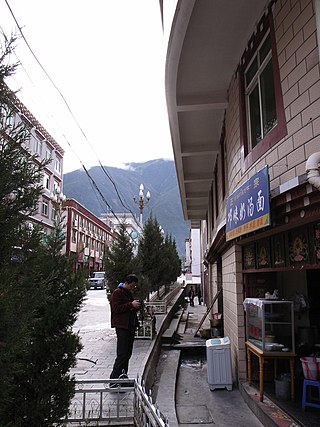
Batang Town,or Xiaqiong Town,is a town in Batang County,GarzêTibetan Autonomous Prefecture,Sichuan Province,in the China on the main route between Chengdu and Lhasa,Tibet,and just east of the Jinsha River,or Upper Yangtze River. It is at an elevation of 2,700 metres.
Batang County is a county located in western GarzêTibetan Autonomous Prefecture,Sichuan Province,People's Republic of China. Government address:Xiaqiong Town,Batang County,Ganzi,Sichuan 627650. Area code:0836. The main administrative centre is known as Batang Town or Xiaqiong Town.
Togtoh County is a county of Inner Mongolia Autonomous Region,North China,it is under the administration of the prefecture-level city of Hohhot,the capital of Inner Mongolia,located on the north bank of the Yellow River at which point that great river turns out of the Ordos Loop toward the south. It is under the administration of the regional capital of Hohhot,78 kilometres (48 mi) to the northeast,with a population of around 166,192.

Hetao is a C-shaped region in northwestern China consisting of a collection of flood plains stretching from the banks of the northern half of the Ordos Loop,a large northerly rectangular bend of the Yellow River that forms the river's entire middle section. The region makes up the northern margin of the Ordos Basin,bounded in the west by the Helan Mountains,the north by the Yin Mountains,the east by the northern portion of Lüliang Mountains,and the south by the Ordos Desert and the Loess Plateau.
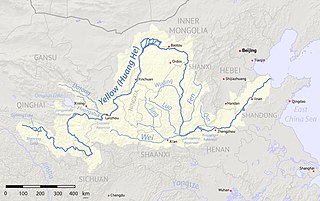
The Ordos Plateau,also known as the Ordos Basin or simply the Ordos,is a highland sedimentary basin in parts of most Northern China with an elevation of 1,000–1,600 m (3,300–5,200 ft),and consisting mostly of land enclosed by the Ordos Loop,a large northerly rectangular bend of the Yellow River. It is China's second largest sedimentary basin with a total area of 370,000 km2 (140,000 sq mi),and includes territories from five provinces,namely Shaanxi,Gansu,Ningxia,Inner Mongolia and a thin fringe of Shanxi,but is demographically dominated by the former three,hence is also called the Shaan-Gan-Ning Basin. The basin is bounded in the east by the Lüliang Mountains,north by the Yin Mountains,west by the Helan Mountains,and south by the Huanglong Mountains,Meridian Ridge and Liupan Mountains.
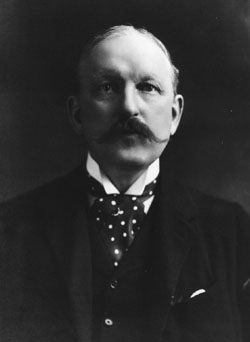
William Woodville Rockhill was a United States diplomat,best known as the author of the U.S.'s Open Door Policy for China,the first American to learn to speak Tibetan,and one of the West's leading experts on the modern political history of China.
Joseph Gabet was a French Catholic Lazarite missionary. He was active in Northern China and Mongolia before traveling to Tibet with Évariste Huc. Expelled and arrested,he died in Rio de Janeiro,Brazil.

Chengguan,also known as Huangyuan and by other names,is a town on the Huangshui River in Qinghai,China. It serves as the seat of Huangyuan County,lying about 45 km (28 mi) upstream (west) from the provincial capital of Xining and approximately 45 km (28 mi) east of Qinghai Lake. Chengguan has a 600-year history as a frontier trading post between the Chinese,Mongolian,and Tibetan cultural spheres.
Dabasun Nor was a former salt lake in the northwest corner of the Ordos Loop in what is now the Hanggin Banner of Ordos Prefecture,Inner Mongolia,China.
