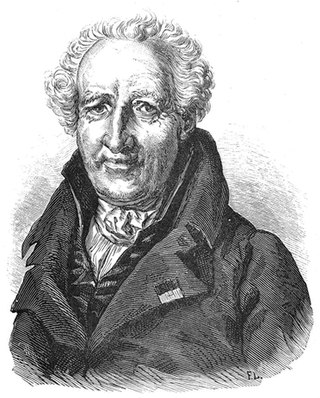
Antoine Laurent de Jussieu was a French botanist, notable as the first to publish a natural classification of flowering plants; much of his system remains in use today. His classification was based on an extended unpublished work by his uncle, the botanist Bernard de Jussieu.

Jean Victor Audouin, sometimes Victor Audouin, was a French naturalist, an entomologist, herpetologist, ornithologist, and malacologist.

Adolphe-Théodore Brongniart FRS FRSE FGS was a French botanist. He was the son of the geologist Alexandre Brongniart and grandson of the architect, Alexandre-Théodore Brongniart. Brongniart's pioneering work on the relationships between extinct and existing plants has earned him the title of father of paleobotany. His major work on plant fossils was his Histoire des végétaux fossiles (1828–37). He wrote his dissertation on the Buckthorn family (Rhamnaceae), an extant family of flowering plants, and worked at the Muséum national d'Histoire naturelle in Paris until his death. In 1851, he was elected a foreign member of the Royal Swedish Academy of Sciences. This botanist is denoted by the author abbreviation Brongn. when citing a botanical name.

Bourse is a station on Paris Métro Line 3, located in the 2nd arrondissement of Paris.
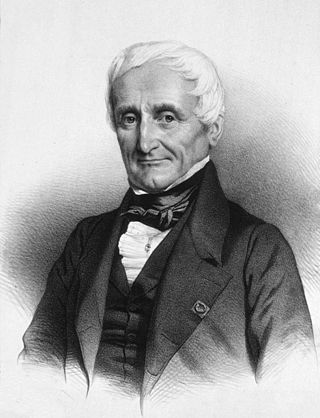
André Marie Constant Duméril was a French zoologist. He was professor of anatomy at the Muséum national d'histoire naturelle from 1801 to 1812, when he became professor of herpetology and ichthyology. His son Auguste Duméril was also a zoologist, and the author citation Duméril is used for both André and his son.

Étienne-Jules Marey was a French scientist, physiologist and chronophotographer.

Alexandre Brongniart was a French chemist, mineralogist, geologist, paleontologist, and zoologist, who collaborated with Georges Cuvier on a study of the geology of the region around Paris. Observing fossil content as well as lithology in sequences, he classified Tertiary formations and was responsible for defining 19th century geological studies as a subject of science by assembling observations and classifications.

The Lonchopteridae are a family of small (2–5 mm), slender, yellow to brownish-black Diptera, occurring all over the world. Their common name refers to their pointed wings, which have a distinct venation. Many are parthenogenic; males are very rare, however, at least in North American species, and have a somewhat different venation than do the females.

Euronext Paris, formerly known as the Paris Bourse, is a securities market which merged with the Amsterdam, Lisbon and Brussels exchanges in September 2000 to form Euronext NV. As of 2022, the 795 companies listed had a combined market capitalization of over US$4.58 trillion. Euronext Paris, the French branch of Euronext which was formerly seated at the Palais Brongniart in Paris, is Europe's second largest stock exchange market as of 2023, behind the London Stock Exchange (LSE).

The Palais Brongniart is a building in Paris that was built at the direction of Napoleon in the early 19th century to house the Paris stock exchange. It is located at the Place de la Bourse, in the 2nd arrondissement in central Paris. It was named after its initial architect, Alexandre-Théodore Brongniart, who died in 1813 prior to its completion. The Palais Brongniart is nowadays used as an events centre, since the trading floor relocated in 1987, followed in 2004 by the last financial institution that was still housed there.

Charles Jules Edmée Brongniart was a French entomologist and paleontologist.
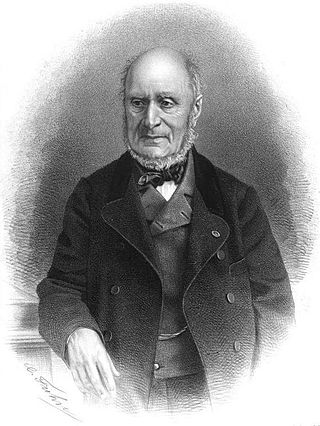
Louis-Hippolyte Lebas was a French architect working in a rational and severe Neoclassical style.
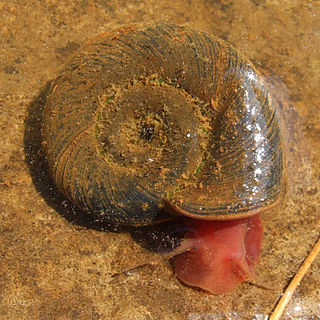
Planorbarius is a genus of air-breathing freshwater snails, aquatic pulmonate gastropod mollusks in the family Planorbidae, the ram's horn snails, or planorbids, which all have sinistral or left-coiling shells.
Mendozachorista is an extinct genus of insect which existed in Argentina during the Late Triassic period. It was named by Carsten Brauckmann, Oscar F. Gallego, Norbert Hauschke, Rafael G. Martins-Neto, Elke Groening, Jan-M. Ilger and María B. Lara in 2010, and the type and only species is Mendozachorista volkheimeri. It is known only from an impression of a Mecopterida-like wing found in the Llantenes Formation in Mendoza Province.
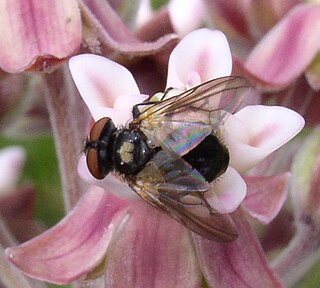
Phasiini is a tribe of flies in the family Tachinidae. As a result of phylogenetic research, most members of this tribe were transferred to other tribes in the subfamily, leaving only the two genera Elomya and Phasia.
Bechala is a genus of insects that existed during the late Carboniferous in what is now Germany. It was first described by Jan-Michael Ilger and Carsten Brauckmann in 2012, and the type species is B. sommeri. Its type specimen was a wing discovered at the Küchenberg quarry, in the Ziegelschiefer Formation. The wing measurements are 39×6 millimetres. Bechala was originally assigned to the extinct order Megasecoptera, but a restudy instead assigned it to the superorder Odonatoptera.

Baron Jérome-Frédéric Pichon was a 19th-century French bibliographer and bibliophile. He was one of the most important French art collectors of his time.
Théâtre de Caen, 135 bd du Maréchal Leclerc, is the principle theatre and opera house of Caen, opened in 1963.
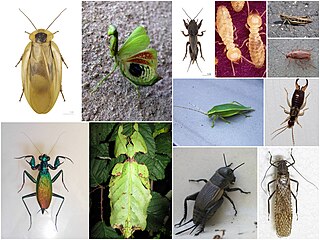
The cohort Polyneoptera is one of the major groups of winged insects, comprising the Orthoptera and all other neopteran insects believed to be more closely related to Orthoptera than to any other insect orders. They were formerly grouped together with the Palaeoptera and Paraneoptera as the Hemimetabola or Exopterygota on the grounds that they have no metamorphosis, the wings gradually developing externally throughout the nymphal stages. Many members of the group have leathery forewings (tegmina) and hindwings with an enlarged anal field (vannus).

Paoliida is an extinct order of winged insects that lived in the late Paleozoic. Historically, both their systematic position and composition were controversial – for instance they had been considered as palaeodictyopterans, as basal Neoptera, or as stem-group of Pterygota – but recent studies have resolved them as the sister group of Dictyoptera.


