Thespesia populnea, commonly known as the portia tree, Pacific rosewood, Indian tulip tree, or milo, among other names, is a species of flowering plant belonging to the mallow family, Malvaceae. It is a tree found commonly on coasts around the world. Although it is confirmed to be native only to the Old World tropics, other authorities consider it to have a wider, possibly pantropical native distribution. It is thought to be an invasive species in Florida and Brazil.

Hibiscus tiliaceus, commonly known as the sea hibiscus or coast cottonwood, is a species of flowering tree in the mallow family, Malvaceae, with a pantropical distribution along coastlines. It has also been introduced to Florida and New Zealand. It has been debated whether this species is native or introduced to Hawaii.
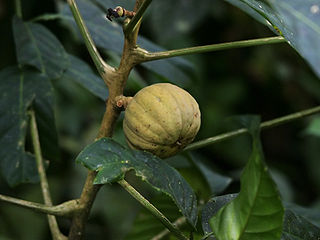
Hura is a genus of trees in the family Euphorbiaceae described by Carl Linnaeus in 1753. It is native to South America, Mesoamerica, and the West Indies.
Hura crepitans, the sandbox tree, also known as possumwood, monkey no-climb and jabillo, is an evergreen tree in the family Euphorbiaceae, native to tropical regions of North and South America including the Amazon rainforest. It is also present in parts of Tanzania, where it is considered an invasive species. Because its fruit explodes when ripe, it has also received the colloquial nickname the dynamite tree.
University High School (UHS) is an accelerated public high school located in Tucson, Arizona. Originally known as Special Projects High School (SPHS), University High School is in the Tucson Unified School District (TUSD). The mission statement of UHS identifies it as "a special function high school which serves students who are academically focused and intellectually gifted and provides curriculum and social support not offered in the comprehensive high school."

The canyon tree frog is a species of tree frog native to the rocky plateau areas of southern United States, primarily in New Mexico and Arizona, but it also ranges to Utah, Texas, and Colorado, and as far south as the Mexican states of Michoacán, México, Guanajuato, Guerrero, and Oaxaca.
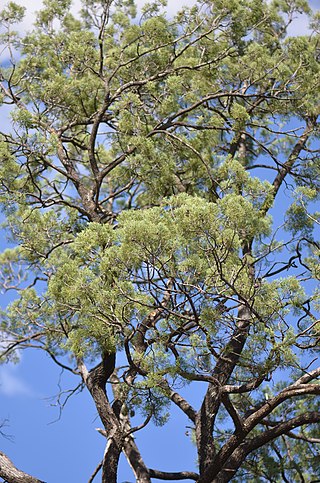
Callitris columellaris is a species of coniferous tree in the family Cupressaceae, native to most of Australia. Common names include white cypress, white cypress-pine, Murray River cypress-pine, and northern cypress-pine. Callitris columellaris has become naturalised in Hawaii and in southern Florida.

Prosopis glandulosa, commonly known as honey mesquite, is a species of small to medium-sized, thorny shrub or tree in the legume family (Fabaceae).

Heritiera littoralis, commonly known as the looking-glass mangrove or tulip mangrove, is a mangrove tree in the family Malvaceae native to coastal areas of eastern Africa, Asia, Melanesia and northern Australia. The common name refers to the silvery appearance of the underside of the leaves, resembling a mirror to some degree. The strong timber has uses in marine applications and elsewhere.
Julostylis polyandra is a species of flowering plant in the family Malvaceae. It is found only in India.

Satakentia liukiuensis, is a species of palm tree. They are endemic to Ishigaki Island and Iriomote Island in the Yaeyama Islands, the south-westernmost of the Ryukyu Islands, Japan. It is the only species in the genus Satakentia.

Alphitonia ponderosa is a species of flowering tree in the family Rhamnaceae, that is endemic to the Hawaiian Islands. It is locally known as kauila, as is the related Colubrina oppositifolia.

Flueggea neowawraea, the mēhamehame, is a species of flowering tree in the family Phyllanthaceae, that is endemic to Hawaii. It can be found in dry, coastal mesic, and mixed mesic forests at elevations of 250 to 1,000 m. Associated plants include kukui, hame, ʻahakea, alaheʻe, olopua, hao, and aʻiaʻi. Mēhamehame was one of the largest trees in Hawaiʻi, reaching a height of 30 m (98 ft) and trunk diameter of 2 m (6.6 ft). Native Hawaiians used the extremely hard wood of this tree to make weaponry.
Shorea polyandra is a species of tree in the family Dipterocarpaceae. It is endemic to Borneo.

An endangered species is a species that is very likely to become extinct in the near future, either worldwide or in a particular political jurisdiction. Endangered species may be at risk due to factors such as habitat loss, poaching and invasive species. The International Union for Conservation of Nature (IUCN) Red List lists the global conservation status of many species, and various other agencies assess the status of species within particular areas. Many nations have laws that protect conservation-reliant species which, for example, forbid hunting, restrict land development, or create protected areas. Some endangered species are the target of extensive conservation efforts such as captive breeding and habitat restoration.

Mount Hamiguitan is a mountain located in the province of Davao Oriental, Philippines. It has a height of 1,620 metres (5,315 ft). The mountain and its vicinity has one of the most diverse wildlife populations in the country. Among the wildlife found in the area are Philippine eagles and several species of Nepenthes. Some of the latter, such as the Nepenthes peltata and Nepenthes micramphora, are endemic to the area. The mountain has a protected forest area of approximately 2,000 hectares. This woodland is noted for its unique pygmy forest of century-old trees in ultramafic soil, with many endangered, endemic and rare species of flora and fauna.
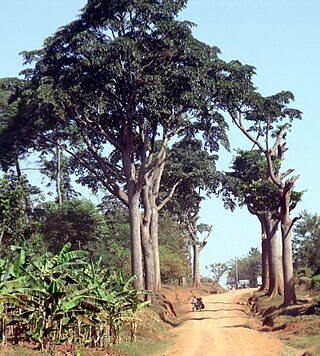
Iroko is a large hardwood tree from the west coast of tropical Africa that can live up to 500 years. This is the common name for the genus Milicia, in which there are two recognized species, which are closely related: Milicia excelsa and Milicia regia.

Anisoptera thurifera is a tree species in the family Dipterocarpaceae. This Asian species has been recorded from Bangladesh through to New Guinea; the IUCN has categorised it as Vulnerable.

Sebastiania pavoniana is a species of tree in the spurge family native to Mexico and northwest Costa Rica. It is the 'bean' part of the Mexican jumping bean, despite not being a legume like true beans. The 'jumping' is provided by the larva of the jumping bean moth.
Senegalia dudgeonii is a small perennial tree that grows up to 9 meters tall. It belongs to the Fabaceae family and endemic Sudano-Sahelian and Guinea savannah zones of West Africa.