An IMC electric bus (In-Motion Charging electric bus[1]), also known as a battery trolleybus or trolleybus with extended autonomous run, is an electrically powered public transport vehicle that draws power from an overhead contact network (catenary) via trolley poles while simultaneously charging an on-board traction battery. This technology allows the vehicle to operate continuously: drawing power and charging while under the overhead wires, and operating as a battery electric bus on sections of the route lacking this infrastructure.[2]
This concept is an evolution of the traditional trolleybus, developing from vehicles with small auxiliary power units for emergency use to modern systems where vehicles can cover significant distances autonomously, often between 15 to 70 kilometres (9.3 to 43.5mi).
Modern In-Motion Charging (IMC) systems can offer significant cost advantages over fully battery-electric bus networks[3]. Studies indicate that upgrading existing trolleybus infrastructure to IMC can reduce capital costs for rolling stock by approximately 50% and lower operational expenses by around 20% over a 15-year lifecycle compared to new battery-electric bus fleets.[4]. When building an IMC system from scratch with partial overhead lines, capital expenditures can still be roughly 10% lower than a fully battery-based system, due to reduced battery capacity requirements and a smaller fleet size[5]
Terminology
The term In-Motion Charging (IMC) was introduced as a branding concept by Erik Lenz of Vossloh Kiepe (now Kiepe Electric) in 2014 during the trolley:motion conference in Hamburg.[6] The terminology was intended to improve the public perception of trolleybuses by highlighting their key advantage over static-charging electric buses: the ability to recharge batteries while transporting passengers, eliminating stationary charging times.
In Germany, the term BOB (Batterie-Oberleitungs-Bus, Battery-Overhead-Bus) is also used by some operators, such as in Solingen.
In Russia and CIS countries, these vehicles are often referred to as a Trolleybus with Extended Autonomous Run (Russian:Троллейбус с увеличенным автономным ходом, abbreviated as TUAH) or simply an Electrobus with dynamic charging.[7]
History
Off-wire power developments
On this articulated trolleybus, the operator guides poles to the wires. Modern IMC buses can often reconnect automatically.
The concept of a trolleybus operating away from wires dates back to the early 20th century. While the word trolleybus originates from 1882, when Werner von Siemens presented an early electrically powered vehicle, the idea of off-wire capability evolved over time.
From the 1980s onward, systems such as Muni in San Francisco, TransLink in Vancouver, and Beijing, among others, began purchasing trolleybuses equipped with auxiliary batteries or diesel engines to allow them to bypass route blockages or travel short distances without overhead lines.
Before the maturation of high-capacity lithium batteries, dual-mode buses were common. These vehicles used overhead wires for electric power and a separate diesel engine for off-wire travel.
With the development of battery technology (specifically Li-ion) in recent years, the focus shifted from diesel auxiliary units to purely electric autonomy. In Shanghai, experiments began in 2006 with "capacitor energy storage" electric buses that charged at stops. By the 2010s, the "TROLLEY project" in Central Europe was established to promote sustainable trolleybus strategies, leading to the widespread adoption of In-Motion Charging to extend routes without installing additional overhead wires.[9]
In-Motion Charging batteries charging at Palmovka, Prague.
IMC trolleybuses are equipped with a high-capacity traction battery adapted to the route's specific requirements. The vehicle typically operates with a mix of wire connection and battery power (e.g., 60% of the time on the wire and 40% on battery).
Charging: Charging occurs dynamically while the vehicle is in motion under existing overhead wires. Current transfer can reach power levels of up to 500 kW (e.g., the IMC500 system).[10]
Range: Modern units can travel significant distances off-wire, often in excess of 15 kilometres (9.3mi).[11]
Advantages: Unlike stationary charging electric buses (Opportunity Charging or Overnight Charging), IMC does not require long charging stops at terminals or the construction of dedicated charging stations in public spaces.[12] It allows for the electrification of bus routes by extending existing trolleybus lines.
Comparison with other electric buses
Feature
Overnight Charging (ONC)
Opportunity Charging (OC)
In-Motion Charging (IMC)
Charging Method
Slow charging at the depot (overnight)
Ultra-fast charging at specific stops
Dynamic charging under overhead wires
Infrastructure
Requires high-power grid connections at depots
Requires charging stations at stops/terminals
Uses existing trolleybus network; no new chargers needed for extensions
Downtime
4–10 hours (in depot)
5–25 minutes (at stops)
None (charges while driving)
Battery Size
Large/Heavy (reduces passenger capacity)
Moderate
Moderate/Small
Heating
Often requires diesel heater in winter
Electrical (limited)
Electrical (powered by overhead wire)
Grid Impact
High peak load at night
High spikes during fast charging
Distributed load throughout the day
Some operational issues have been noted in systems such as Saint Petersburg and Barnaul, where overheating of the contact wire can occur due to high charging currents if the vehicle is moving too slowly or is stationary while charging.
Global adoption
Asia
China: China has been a leader in adopting battery trolleybuses. Beijing and Shanghai operate extensive fleets. In Beijing, BRT lines were converted from diesel to dual-source trolleybuses between 2015 and 2016.[13] The city of Baoding launched a system exclusively based on battery trolleybuses.
Saudi Arabia: In 2011, the King Saud University in Riyadh established a system with 12 articulated trolleybuses for campus transport.
Europe
Germany
Solingen: The municipal utility (SWS) tested four "Battery-Overhead-Buses" (BOB) from Solaris and Kiepe Electric beginning in June 2018. These vehicles were capable of charging under overhead wires and operating on battery power for non-electrified sections, allowing for the conversion of diesel lines to electric operation. The maiden voyage with passengers took place on 16 June 2018.[14] These buses were deployed on Line 695, a 14.3 kilometres (8.9mi) route where only 2.8 kilometres (1.7mi) is wired. Electric operation on Line 695 officially launched on 31 October 2019.[15] Following this success, SWS ordered additional vehicles, and by early 2024, new Solaris Trollino 12 buses were introduced on lines 691 and 694 (previously diesel-operated) and lines 685 and 686. To support this, charging funnels were installed at the Aufderhöhe bus station for intermediate stationary charging.[16]
The "BOB" bus at the Solingen municipal utility grounds during its maiden voyage (2018)
Control units and battery
Central control unit for switching on/off
Operation mode selection (600 V = Overhead wire)
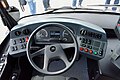
Driver's cockpit
Power consumption display under full load
Central unit for video storage (above the driver)
Esslingen am Neckar: With a fleet renewal in late 2015, Esslingen integrated bus line 113 into the trolleybus network in May 2016 without building new overhead lines. The line operates in combined wire and battery mode; buses switch to battery power to serve the Berkheim district, utilizing reactivated infrastructure from former duo-bus lines for rewiring.[17] Similarly, line 118 was converted to IMC operation, allowing buses to serve sections that are only wired in one direction by running on batteries for the return leg. The city plans to expand the network to 100% electric mobility by 2040, with further expansions planned for the Pliensauvorstadt and Zollberg districts.[18]
Other cities: In 2020, Berlin announced plans for a new trolleybus system with 190 battery trolleybuses,[19] though plans were shifted toward battery-only buses in early 2023.[20]
USA & Canada:San Francisco (Muni), Seattle (King County Metro), and Dayton operate large fleets of trolleybuses with battery off-wire capability (replacing older dual-mode diesel units). Vancouver also utilizes these systems.
Argentina: Cities like Rosario and Córdoba have imported Trolza vehicles with autonomous capabilities.
Mexico:Mexico City has integrated Yutong battery trolleybuses into its updated fleet.[22]
The region has seen rapid development of "Trolleybuses with Extended Autonomous Run" (TUAH).
Saint Petersburg: Launched a major initiative in 2017 to expand the network without installing new overhead lines. By late 2023, over 13 routes and 200 vehicles were operating, linking metro stations to new housing developments.[23]
Belarus: Manufacturers BKM Holding and MAZ produce IMC buses used domestically (Minsk, Gomel, Vitebsk, Grodno) and exported abroad. Minsk has utilized IMC technology to return trolleybus service to the entire length of Independence Avenue.
This page is based on this Wikipedia article Text is available under the CC BY-SA 4.0 license; additional terms may apply. Images, videos and audio are available under their respective licenses.