In 1834 a group of Polish immigrants came through the Portsmouth docks. The Poles who arrived in Portsmouth had previously been staying in Prussia seeking refuge from war when they were ordered back to Poland, but many Polish soldiers refused, and a lot of them were consequently killed. Prussia then received them back, but as labourers on public works along with criminals. They were then offered the choice of return to Poland or passage to America; the Poles chose America. Three ships left Prussia, one, the Elizabeth, stopping at Le Havre, another, the Union, stopping at Harwich, and the third, the Marianne, docking at Portsmouth due to prolonged bad weather. When the winds abated the Poles passively resisted their Prussian Captain's insistence of transportation to America as they preferred to remain in Europe, closer to Poland.
The people of Portsmouth and Portsea welcomed them immediately. Without encouragement from the authorities, the people of Portsmouth assisted and supported these exiles, army officers particularly treating the Polish refugees with kindness and propriety. One article states "Not the rich and great alone have contributed, but perhaps many a hard- earned shilling has been dropped into the subscription boxes by the artisan or labourer". Many in the town subscribed to support the Poles financially as well, including the body of liberal politicians in Portsmouth. Efforts were at once made to collect funds for the support of the poor foreigners.
Schools in Portsmouth made collections and held charity events to raise money for them. The non-commissioned officers of the 12th regiment contributed £7 and the 77th Depot gave £12, while a concert at the Green Row Rooms brought in £60. "The civil and moral character of the country was sustained by the reaction to the Poles’ arrival from the locals."
A memorial was built, but only half completed before funds ran out and it remained unfinished until 2004. The Polish Memorial Fund succeeded in raising funds to complete the New Memorial, and produced a pamphlet to commemorate the occasion.
Poles in Southampton
After the outbreak of the Springtime of the Nations in 1848 Poles actively supported many European revolutions of that time. A Polish Legion numbering some 2,000 soldiers served under Lajos Kossuth in the Hungarian insurrection. After its defeat Poles and Hungarians fled from Hungary, crossed the border into Turkey and became detained on its territory. The main place of their imprisonment was the citadel of Kutayah in central Turkey where a few hundred Poles and Hungarians, with their leader, Kossuth, were kept for over three years. Thanks to the diplomatic efforts of Viscount Palmerston these soldiers became finally released in 1851 and came to England on board many different ships (Sultan, Mississippi, Euxine). Different groups of refugees have arrived in ports of England between February and October of that year.
By 6 May only about 40 Hungarians remained in Turkey. According to the statistics of the Literary Association of the Friends of Poland 464 Poles arrived in Great Britain in 1851 and over 200 left the country.[2] At that time the general number of Polish refugees numbered about 800 people. The refugees from Turkey came to different English ports: Liverpool, Leeds and Southampton. Many of them decided to emigrate to US.
The Southampton City Council had to spend 1232 – 9 – 6 on those refugees. They were also supported by the Literary Association of the Friends of Poland, which offered a donation of 8 – 5 – 0.[3] There are also records stating that the group of 30 Poles who decided to stay in Southampton received an additional payment of 216 – 14 – 6 in August of that year.[4]
General Bulcharyn and his fellow soldiers arrived in Southampton to find themselves in very miserable conditions. They went to London and sent a special letter to Sir George Grey, Her Majesty's Principal Secretary in which they presented their situation and "humbly begged to extend to them that protection which was granted to many of their fellow countrymen". In support of his petition, Bulcharyn provided the list of the soldiers and their servants, asking for a grant of £10 for each of them.
Most of the refugees who decided to stay in England could expect support only from private sources, as the Government was unwilling to extend its grants on the newcomers. As one of the British politicians stated in his letter to Prince Czartoryski "There is scarcely any sympathy remained for Poles." Although it was the view of political elites, it was shared by the common people. The final stage of these events was the departure of over 100 soldiers from Portsmouth after the outbreak of the Crimean War. These soldiers returned to Turkey to fight against Russia in the army of their former jailer. Many others left to America and the population of the Polish refugees in the 1850s steadily decreased.
Russian Jews in Southampton
There was an increasing hostility towards the Jews since the partitions of Poland that led to outbreaks of pogroms across Russia. The first began in 1881 and spread throughout Southern Russia, lasting four years during which thousands of Jews were injured and their property burnt or destroyed. Further waves of pogroms occurred in 1903 and 1905. Faced with the terrors of the violent pogroms, many Jews opted to leave Russia. It is estimated around 2 million Jews left Russia during this period.[5]
One famous Jewish family, the Rothschilds, did a lot of work to improve the Jewish situation in Russia, being very influential in areas such as education. They also helped those who were leaving Russia to escape the pogroms, by founding the ‘Emigrants Home’ Lodging House. The house was founded in 1894 along with John Doling, in Albert road, within easy reach of Southampton docks. The house was built on four floors and included a large kitchen, pantry, washrooms, drying and ironing rooms in the basement and then three floors containing sleeping quarters. The house officially opened in 1895.
Over 500,000 immigrants stayed in the UK for up to six months before moving onto America, with 4,000 leaving the docks every month to go to the new world. Whilst most only stayed in Southampton as a stopgap, 150,000 immigrants remained and settled throughout the UK, and many of them must have remained in Southampton.[6]
Whilst the ‘Emigrants House’ was created mainly to cater for the Jews escaping the pogroms, they weren't the only community that left Russia at that time. Since the Polish Uprising in 1863, Russia had been distrustful of the different communities, and the pogroms were often used to cloak attacks on poles as well.[7] Therefore, Poles may also have used the home. The ‘Emigrants Home’ became the Atlantic Hotel in 1908, and continued to house immigrants that came in from the docks.
Immigrant areas in Southampton
At the beginning of the 20th century a new wave of immigrants settled in Southampton in what was known as the ditches. The ditches was an area of Southampton, along Canal Street, East Street and Main Street.[8] Its relative proximity to the docks made it an ideal spot for immigrants arriving by sea and it quickly became a cosmopolitan area, known for it multicultural society.
Maie Hodgson was a child growing up in the ditches at the beginning of the 1900s. Her memoirs describe the ditches as having "a sort of fair-ground element" as a result of the immigrants that lived along the streets, remembering a fortune teller, Madame Conrad, who was from Ceylon. There were also Italian and Jewish communities in this area. She recalls one Italian immigrant family running an ice-cream shop and tea rooms called Donnarumma’s. The family spoke little English and had seven children.[9]
Whilst the residents may have enjoyed its fair-ground atmosphere, others from Southampton considered it an area to be wary of, filled with bargain shops and rife with crime. At night the area was a prime place for prostitutes. Lewishon describes it as ‘a subculture straight out of a Dickens novel, the kind of street mothers forbade their children to visit.’[10] Whilst it is likely to be an over exaggeration such rumours gave the residents of Southampton a bad impression of the immigrant community.
Immigrants in Atlantic Park
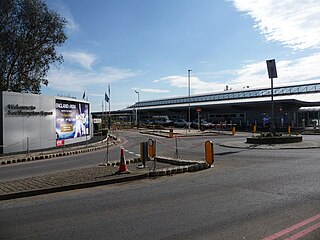
Atlantic Park was opened in the spring of 1922 on the site now known as Southampton Airport in Eastleigh. The park was formed as a way of bringing transmigrants together in one place in order to provide them with better conditions than those previously experienced in a number of boarding houses and to protect them from unscrupulous people who would attempt to prey on those arriving in a new country.[11]
The park was formed as a joint venture between companies such as Cunard, White Star and Canadian Pacific Railways. It became a virtually self-contained township boasting its own school, medical centre, synagogue and even a library containing books in languages such as English, Polish, Russian, German and Yiddish.[12]
Although the aim of the park was to provide short term accommodation to transmigrants passing through Southampton changes in the US policies on quota restrictions meant that some immigrants were trapped at the park for longer periods, unable to carry on with their journey or return home to their country of origin due to the fear of persecution. Some of those affected remained in Southampton for the best part of half a decade.
One family who experienced the problems of quota restrictions were the Shlemowitz family. The four orphaned sisters and their brother arrived in Southampton from Ukraine. Following the revolution their father was forced into road building and beaten mercilessly until his death. The children witnessed their mother's rape and mutilation prior to her death from pneumonia. At this time it was decided that they should be sent to America to live with their uncle Jacob in New York. On arriving in England the children were sent to Atlantic Park where, as Liza, then aged 13 explained, their heads were shaved and they were sprayed with disinfecting water. Eventually, in December 1923 the children set off for America on board the Aquitania but were detained on Ellis Island for a period of 10 days before being deported back to England. The children returned to Atlantic Park where they remained for a period of about 10 months before their uncle Jacob arrived to collect them. Together they headed to South Africa where they would eventually settle.[13]
For many, although far from luxurious, the experiences of Atlantic Park were not especially traumatic. Although in principle they were confined to the hostel, many freely interacted with the local community. The numbers of immigrants held at Atlantic Park slowly diminished from 1928 until its eventual closure in 1931.
The Basque Children's Camp at Stoneham
During the Spanish Civil War the town of Guernica, in April 1937, was bombed by the NaziCondor Legion and was subsequently destroyed. Due to the terror caused by the enemy air raids as well as concerns over the number of children who had been involved in the fighting, the decision was made to send children from the area to England in order to protect them from the reality of war.
The children left for Britain on the steamship the Habana on 21 May 1937, escorted by Royal Oak and HMSForester. The ship carried not just 3,820 children but also 80 teachers, 120 helpers, 15 Catholic priests and 2 doctors. When they arrived in Southampton they were sent in busloads to the camp in North Stoneham in Eastleigh.
The camp was set on a 30-acre (120,000m2) field which had been donated to the relief co-ordinators by a local farmer Mr. G.H. Brown. The camp was made up of 500 bell tents and a hundred or more marquees and also boasted its own cinema and hospital. The generosity of the farmer who donated the land reflects the willingness of the local people as a whole to help the children.
Volunteers from Eastleigh, Southampton and surrounding areas poured into North Stoneham camp and were largely responsible for its coming to life. Children were provided with food, new clothes, shoes and toys and many visitors to the camp with good intentions passed over sweets and chocolate and exchanged their money for Spanish notes and coins. The camp was believed to have cost £1500 a week during its height. Consideration was also given in that pilots were told not to fly over the camp because of the danger of panic among the children who had come to dread the sound of aeroplanes and ships in the harbour were told not to sound sirens as their noise was said to have resembled the air raid warnings.
The camp was not intended however to be a permanent home for the children and they were to be removed from North Stoneham and placed in various hostels throughout the country. Soon after arrival four hundred of the children were quickly moved on to Lower Clapton by luxury coaches to be cared for by the Salvation Army at Congress Hall (now part of the Clapton Girls' Academy).[14] By June parties were leaving almost daily for homes and hostels arranged for them during their stay in England. By July, 2360 had already been drafted or were about to be drafted to homes in various parts of the country. It was in September that the camp was finally closed.
Related Research Articles
The Jedwabne pogrom was a massacre of Polish Jews in the town of Jedwabne, German-occupied Poland, on 10 July 1941, during World War II and the early stages of the Holocaust. Estimates of the number of victims vary from 300 to 1,600, including women, children, and elderly, many of whom were locked in a barn and burned alive.
A pogrom is a violent riot incited with the aim of massacring or expelling an ethnic or religious group, particularly Jews. The term entered the English language from Russian to describe 19th- and 20th-century attacks on Jews in the Russian Empire. Retrospectively, similar attacks against Jews which occurred in other times and places also became known as pogroms. Sometimes the word is used to describe publicly sanctioned purgative attacks against non-Jewish groups. The characteristics of a pogrom vary widely, depending on the specific incident, at times leading to, or culminating in, massacres.
Southampton Airport is an international airport located in both Eastleigh and Southampton, Hampshire, in England. The airport is located 3.5 nautical miles north-northeast of central Southampton. The southern tip of the runway lies within the Southampton unitary authority boundary with most of the airport, including all of the buildings, within the Borough of Eastleigh.
The history of the Jews in Poland dates back at least 1,000 years. For centuries, Poland was home to the largest and most significant Ashkenazi Jewish community in the world. Poland was a principal center of Jewish culture, because of the long period of statutory religious tolerance and social autonomy which ended after the Partitions of Poland in the 18th century. During World War II there was a nearly complete genocidal destruction of the Polish Jewish community by Nazi Germany and its collaborators of various nationalities, during the German occupation of Poland between 1939 and 1945, called the Holocaust. Since the fall of communism in Poland, there has been a renewed interest in Jewish culture, featuring an annual Jewish Culture Festival, new study programs at Polish secondary schools and universities, and the opening of Warsaw's Museum of the History of Polish Jews.
The Polish diaspora comprises Poles and people of Polish heritage or origin who live outside Poland. The Polish diaspora is also known in modern Polish as Polonia, the name for Poland in Latin and many Romance languages.
The Kielce pogrom was an outbreak of violence toward the Jewish community centre's gathering of refugees in the city of Kielce, Poland, on 4 July 1946 by Polish soldiers, police officers, and civilians during which 42 Jews were killed and more than 40 were wounded. Polish courts later sentenced nine of the attackers to death in connection with the crimes.
The Blue Army, or Haller's Army, was a Polish military contingent created in France during the latter stages of World War I. The name came from the French-issued blue military uniforms worn by the soldiers. The symbolic term used to describe the troops was subsequently adopted by General Józef Haller von Hallenburg to represent all newly organized Polish Legions fighting in western Europe.
The history of the Jews in 19th-century Poland covers the period of Jewish-Polish history from the dismemberment of the Polish–Lithuanian Commonwealth, until the beginning of the 20th century.
Following the establishment of the Second Polish Republic after World War I and during the interwar period, the number of Jews in the country grew rapidly. According to the Polish national census of 1921, there were 2,845,364 Jews living in the Second Polish Republic; by late 1938 that number had grown by over 16 percent, to approximately 3,310,000, mainly through migration from Ukraine and the Soviet Russia. The average rate of permanent settlement was about 30,000 per annum. At the same time, every year around 100,000 Jews were passing through Poland in unofficial emigration overseas. Between the end of the Polish–Soviet War of 1919 and late 1938, the Jewish population of the Republic grew by nearly half a million, or over 464,000 persons. Jews preferred to live in the relatively-tolerant Poland rather than in the Soviet Union and continued to integrate, marry into Polish Gentile families, to bring them into their community through marriage, feel Polish and form an important part of Polish society. Between 1933 and 1938, around 25,000 German Jews fled Nazi Germany to sanctuary in Poland.
Stawiski is a town in northeastern Poland, situated within Kolno County, in Podlaskie Voivodeship, approximately 16 kilometres east of Kolno and 74 kilometres west of the regional capital Białystok. Stawiski is the administrative seat of Gmina Stawiski. From 1946 to 1975 it belonged administratively to Białystok Voivodeship, and from 1975 to 1998 to Łomża Voivodeship. The town is situated on the Dzierzbia River.
The Lwów Ghetto was a Nazi ghetto in the city of Lwów in the territory of Nazi-administered General Government in German-occupied Poland.
Wizna is a village in Łomża County of Podlaskie Voivodeship, in north-eastern Poland, situated on the Narew River. Wizna is known for the battle of Wizna which took place in its vicinity during the 1939 Invasion of Poland at the start of World War II.
The Holocaust in Poland was the ghettoization, robbery, deportation, and murder of Jews, simultaneously with other people groups for identical racial pretexts, in occupied Poland, organized by Nazi Germany. Three million Polish Jews were murdered, primarily at the Chelmno, Belzec, Sobibor, Treblinka, and Auschwitz II–Birkenau extermination camps, representing half of all Jews murdered during the Europe-wide Holocaust.
The Wąsosz pogrom was the World War II mass murder of Jewish residents of Wąsosz in German-occupied Poland, on 5 July 1941. The massacre was carried out by local Polish residents without participation of Germans.
Anti-Jewish violence in Poland from 1944 to 1946 preceded and followed the end of World War II in Europe and influenced the postwar history of the Jews and Polish-Jewish relations. It occurred amid a period of violence and anarchy across the country caused by lawlessness and anti-communist resistance against the Soviet-backed communist takeover of Poland. The estimated number of Jewish victims varies, ranging up to 2,000. In 2021, Julian Kwiek published the first scientific register of incidents and victims of anti-Jewish violence in Poland from 1944 to 1947; according to Kwiek's calculations, the number of victims was 1,074 to 1,121. Jews constituted between two and three percent of the total number of victims of postwar violence in the country, including Polish Jews who managed to escape the Holocaust in territories of Poland annexed by the Soviet Union, and returned after the border changes imposed by the Allies at the Yalta Conference. Incidents ranged from individual attacks to pogroms.
The Lwów pogrom was a pogrom perpetrated by Polish soldiers and civilians against the Jewish population of the city of Lwów. It happened on 21–23 November 1918, during the Polish–Ukrainian War that followed World War I.
As the Spanish Civil War proceeded on the Northern front, the Spanish Republican authorities arranged the evacuation of children, some of whom had insufficient documentation to enable their repatriation.
Following the Soviet invasion of Poland at the onset of World War II, in accordance with the Nazi-Soviet Pact against Poland, the Soviet Union acquired more than half of the territory of the Second Polish Republic or about 201,000 square kilometres (78,000 sq mi) inhabited by more than 13,200,000 people. Within months, in order to de-Polonize annexed lands, the Soviet NKVD rounded up and deported between 320,000 and 1 million Polish nationals to the eastern parts of the USSR, the Urals, and Siberia. There were four waves of deportations of entire families with children, women, and elderly people aboard freight trains from 1940 until 1941. The second wave of deportations by the Soviet occupational forces across the Kresy macroregion, affected 300,000 to 330,000 Poles, sent primarily to Kazakhstan.
Szczuczyn pogrom was the massacre of some 300 Jews in the community of Szczuczyn carried out by its Polish inhabitants in June 1941 after the town was bypassed by the invading German soldiers in the beginning of Operation Barbarossa. The June massacre was stopped by German soldiers after Jewish women bribed them to intervene.
The Radziłów pogrom was a World War II massacre committed on 7 July 1941 in the town of Radziłów, in German-occupied Poland. Local Poles, under SS orders or with German encouragement, forced most of the Jews of the town into a barn and set it on fire, Jews were also murdered in surrounding villages. Death toll estimates vary between 600 and 2,000; only some 30 Jews survived the massacre due to help from local Poles.
References
↑ G. F. Wilson, Southampton Through the Ages: Mini History
↑ Marchlewicz, K. "Continuities and Innovations: Polish Emigration after 1849" in Freitag S., Exiles from European revolutions: refugees in mid-Victorian England, pp. 103-120.
This page is based on this Wikipedia article Text is available under the CC BY-SA 4.0 license; additional terms may apply. Images, videos and audio are available under their respective licenses.