The Alice Freeman Palmer Memorial Institute, better known as Palmer Memorial Institute, was a school for upper class African Americans. It was founded in 1902 by Dr. Charlotte Hawkins Brown at Sedalia, North Carolina near Greensboro. Palmer Memorial Institute was named after Alice Freeman Palmer, former president of Wellesley College and benefactor of Dr. Brown.
Phillips House may refer to:
The Shepard Street–South Road Street Historic District is a national historic district located at Elizabeth City, Pasquotank County, North Carolina. The district encompasses 161 contributing buildings in a historically African-American section of Elizabeth City. The district developed from the mid-19th to mid-20th century, and includes representative examples of Greek Revival, Gothic Revival, Italianate, Queen Anne, Colonial Revival, Bungalow, and American Foursquare style architecture. Notable contributing buildings include the Sawyer–Pailin–Overman House, Antioch Presbyterian Church, (former) St. Catherine Catholic Church (1941), Olive Branch Missionary Baptist Church (1904), Corner Stone Missionary Baptist Church (1888), (former) St. Phillips Episcopal Church (1893), the Sundry Shop, Rex Cleaning Works (1932), Good Samaritan Hall (1896), and Republican Star Odd Fellows Hall.

South Broad Street Row is a national historic district located at Mooresville, Iredell County, North Carolina. It encompasses six contributing buildings in a predominantly residential section of Mooresville, with notable examples of Late Victorian style architecture. They are the former First Presbyterian Church Manse (1891), Dr. James Young House, Tom Hall House, John Pinkney Mills House, J. Frank Brawley House, and the Johnston Family House.

John McLure House, also known as the Hans Phillips House, Lawrence Sands House, and Daniel Zane House, is a historic home located on Wheeling Island at Wheeling, Ohio County, West Virginia. It was built between 1853 and 1856 [when the island was a part of Virginia], and is a three-story, Federal-style brick dwelling. A two-story rear addition was built before 1870. A semi-circular columned portico and two-story, projecting side bay, were added in the late 19th century and added Classical Revival elements to the home.

The Ayden Historic District is a national historic district located at Ayden, Pitt County, North Carolina. The 146-acre (59 ha) district encompasses 319 contributing buildings and six contributing structures in the town of Ayden. It includes buildings dated from the late-19th to mid-20th century and notable examples of Bungalow / American Craftsman, Colonial Revival, and Queen Anne architecture. Notable buildings include the original Ayden Town Hall (1915), Turnage Brothers Building, Moore House, John Stanley Hart House, Thelbert Worthington House (1930) designed by Leila Ross Wilburn, Ayden Baptist Church (1941), the Lloyd and Lillian Turnage House (1923) and Ayden Methodist Church (1926) designed by Benton & Benton Associates, Zion Chapel Free Will Baptist Church (1924), and Mount Olive Baptist Church.
Norma N. Bonniwell (1877–1961) was an American architect who worked with her father, George C. Bonniwell, in the strikingly named Bonniwell and Daughter firm of North Carolina. Her sister Josephine and brother James Gaither also worked in the business.

Red Doe, also known as the Evander Gregg House, is a historic home located near Florence, Florence County, South Carolina. It was built about 1840, and is a one-story, rectangular frame farmhouse on a raised brick basement foundation. It has a central hall plan, a two-room rear ell on the rear, and low-pitched gable roof. The front façade features six solid octagonal wooden piers support the porch roof and full-width verandah. Also on the property is a small frame building that appears to have been used as an office or store.
Walter James Lenoir House is a historic home located near Yadkin Valley, Caldwell County, North Carolina. It was built in 1893, and is a two-story, "T"-shaped, frame I-house with late Victorian decorative detailing. It has a two-story rear ell and two-tier, gabled porch.

S. J. Nissen Building, also known as S. J. Nissen Carriage Repository and Repair Shop, S. J. Nissen Company Wagonworks, Kester Machinery Company, and Black Horse Studio is a historic factory building located at Winston-Salem, Forsyth County, North Carolina. The original 1893 primary structure is a three-story Romanesque Revival style brick building with a basement and sub basement. It features two crenellated front towers and round-arched windows. A two-story addition with basement was added in 1953. The building originally housed a wagon making and repair shop and a carriage repository.

John Henry Kapp Farm is a historic farm complex and national historic district located near Bethania, Forsyth County, North Carolina. The district encompasses seven contributing buildings, one contributing site, and four contributing structures dated between about 1870 and 1942. They include a two-story, frame, vernacular I-house ; smokehouse; storage shed ; shop ; chicken house (1920s); corn crib / granary; barn (1870s); fence ; corn crib / granary ; tenant house ; tobacco pack house ; and the agricultural landscape.

McElwee Houses is a national historic district located at Statesville, Iredell County, North Carolina. It encompasses four contributing buildings in a predominantly residential section of Statesville. The district includes notable examples of Classical Revival and Colonial Revival architecture and were built in the first decade of the 20th century. They were built by members of the John H. McElwee family, a prominent family of industrialists in the late-19th and early-20th century.
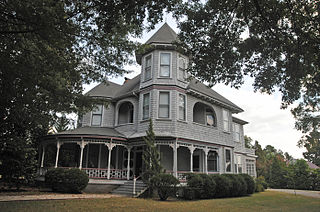
J.C. Black House is a historic home located at Carthage, Moore County, North Carolina. It was built in 1893, and is a large two-story, rectangular Queen Anne style frame dwelling. It sits on a brick foundation and has a hipped roof. It features a three-story, polygonal corner tower, recessed balcony, round two-story bay, and a front porch with decorative sawnwork, turned brackets, and a spindle frieze. Also on the property is a contributing fanciful, polygonal well house.

Chapel Hill Historic District is a national historic district located at Chapel Hill, Orange County, North Carolina. The district encompasses 46 contributing buildings, 2 contributing structures, and 2 contributing objects on the central campus of the University of North Carolina at Chapel Hill and surrounding residential sections of Chapel Hill. The district's buildings date from 1795 to the early-20th century and include notable examples of Classical Revival and Jacobean Revival architecture. Located in the district and separately listed are the Chapel of the Cross, Old East, building and Playmakers Theatre. Other notable contributing resources are the Davie Poplar, Old West (1822), South Building (1798), the Old Well, Person Hall (1797), Gerrard Hall (1822), New East, New West, the Joseph Caldwell Monument (1858), the Y.M.C.A. Building, Battle-Vance-Pettigre11 Dormitory (1913), Horace Williams House (1854), the Phillips Law Office, the Phillips House (1856), the Old Methodist Church (1853), Senlac, Hippol Castle (1920s), and Battle Park.

Salisbury Historic District is a national historic district located at Salisbury, Rowan County, North Carolina. The district encompasses 348 contributing buildings and 1 contributing site in the central business district and surrounding residential sections of Salisbury. It includes notable examples of Late Victorian, Colonial Revival, and Bungalow / American Craftsman style architecture. Located in the district are the separately listed Maxwell Chambers House, McNeely-Strachan House, Archibald Henderson Law Office, and the former Rowan County Courthouse. Other notable buildings include the tower of the former First Presbyterian Church (1891-1893), Rowan County Courthouse (1914), Conrad Brem House, Kluttz's Drug Store, Bell Building, Washington Building, Grubb-Wallace Building, Hedrick Block, Empire Hotel, St. Luke's Episcopal Church (1827-1828), Soldiers Memorial A.M.E. Zion Church (1910-1913), U.S. Post Office and Courthouse (1909), City Hall (1926), Salisbury Fire House and City Building (1897).

Renfro Mill, also known as R. Roberts Leaf Tobacco House, is a historic industrial building located at Mount Airy, Surry County, North Carolina. The original section was built as a tobacco barn about 1893. The largest addition was built in 1946–1947. It is a one- to 4 1/2-story, brick, concrete, steel, wood, and granite industrial building encompassing 100,000 square feet of space. It was originally built to house a tobacco leaf house, and after 1921 the Renfro company, a sock manufacturer. The mill closed in 1997.

Gwyn Avenue–Bridge Street Historic District is a national historic district located at Elkin, Surry County, North Carolina. The district encompasses 124 contributing buildings and 1 contributing site in a predominantly residential section of Elkin. They were primarily built between about 1891 and 1955 and include notable examples of Queen Anne, Colonial Revival, and Bungalow / American Craftsman architecture. Notable buildings include the Elkin Presbyterian Church, First Baptist Church, Alexander Martin Smith House (1893–1897) designed by George Franklin Barber, the Gwyn-Chatham-Gwyn House, Richard Gwyn Smith House, and Mason Lillard House.

Mount Airy Historic District is a national historic district located at Mount Airy, Surry County, North Carolina. The district encompasses 187 contributing buildings in the central business district and surrounding industrial and residential sections of Mount Airy. They were primarily built between about 1880 and 1930 and include notable examples of Late Victorian and Bungalow / American Craftsman architecture. Located in the district are the separately listed W. F. Carter House and Trinity Episcopal Church. Other notable buildings include the Abram Haywood Merritt House (1902), William A. Estes House, Thomas Fawcett House, J. D. Sargent House (1919), Campbell A. Baird House (1913), T. Benton Ashby House, First Baptist Church (1906-1912), Mount Airy Friends (1904), Presbyterian Church (1907-1914), Merritt Building, Banner Building (1906), Prather Block, Midkiff Hardware Store, Welch Block, West Drug Store, Belk's Building, (former) Workman's Federal Savings and Loan, (former) First National Bank (1893), Bank of Mount Airy (1923), U.S. Post Office (1932-1933), and the Sparger Brothers Tobacco Factory.

The Thomas B. Finley House, also known as The Oaks, is a historic home located at North Wilkesboro, Wilkes County, North Carolina. It was designed by architect Norma Bonniwell (1877–1961) and built in 1893. It is a two-story, Queen Anne style frame dwelling with a one-story rear ell. It features a hip and gable roof, corner tower, fish-scale-cut wood shingles, and one-story, hip-roofed, wraparound porch. It was built for prominent attorney Thomas B. Finley (1862–1942), whose firm Finley and Hendren occupied the Thomas B. Finley Law Office at Wilkesboro.

The Samuel Josiah Atkinson House is a historic house and farm located at 586 Atkinson Road in Siloam, Surry County, North Carolina.