
The Khasi people are an ethnic group of Meghalaya in north-eastern India with a significant population in the bordering state of Assam, and in certain parts of Bangladesh. Khasi people form the majority of the population of the eastern part of Meghalaya, that is Khasi Hills, constituting 78.3% of the region's population, and is the state's largest community, with around 48% of the population of Meghalaya. They are among the few Austroasiatic-speaking peoples in South Asia. The Khasi tribe holds the distinction of being one of the few remaining matriarchal tribes of the world. Under the Constitution of India, the Khasis have been granted the status of Scheduled Tribe.

Calotes jerdoni, commonly known as the Indo-Chinese forest lizard or Jerdon's forest lizard, is a species of lizard in the family Agamidae. The species is endemic to China and South Asia.

The green fan-throated lizard is a species of agamid lizard found in Bangladesh, China (Tibet), India and Myanmar, and possibly in Bhutan. The type locality, "Calcutta", is in error fide Zhao & Adler 1993; Ananjeva & Stuart (2001) give it as Margherita, in Patkai Mountains, Upper Assam.
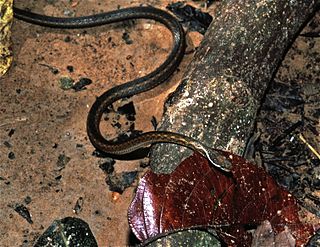
Hebius khasiensis, commonly known as the Khasi Hills keelback or Khasi keelback, is a species of colubrid snake endemic to southeastern Asia.
The eastern trinket snake is a species of snake in the family Colubridae. The species is endemic to South Asia.

The Indo-Pacific gecko also known as Garnot's house gecko, the fox gecko, or the Assam greyish brown gecko, is a species of gecko found in India, the Philippines, Southeast Asia, Australia, and throughout Polynesia. Adults are about 4 to 5 in in total length. They are seen as dark gray or brown with light markings in daylight and a pale, translucent colour at night. The belly is orange or yellow. The head has a long, narrow snout, hence the name fox gecko. The flattened tail has a row of spiny scales on the lateral edges. The species is parthenogenic – all individuals are female and lay eggs that hatch without requiring male fertilisation.

Cyrtodactylus rubidus is a species of gecko found in the Andaman Islands (India) and the Coco Islands (Myanmar). The type locality is Port Blair, Andaman Islands.
Stoliczkia khasiensis is a species of snake in the family Xenodermidae. It is endemic to Meghalaya, Northeast India. The type locality is Khasi Hills.
Cyrtodactylus fasciolatus, also known as the banded bent-toed gecko, is a species of gecko found in Northwest India . Type locality: Subathu, Simla District.
Lawder's bent-toed gecko is a species of gecko, a lizard in the family Gekkonidae. The species is endemic to northern India. Its type locality is "Kumaon", restricted to Almora by Malcolm Arthur Smith. It is named after Mr. A. Lawder who collected the holotype. His identity is not known for sure, but he is likely to have been A.W. Lawder who was a member of the Geological Society of London, as was Ferdinand Stoliczka who described the species. It is sometimes placed in the genus Cyrtopodion.

Gekko lionotum is a species of gecko found in Southeast Asia.

Takydromus khasiensis is a species of lizard. It is found in Northeast India, adjacent Myanmar (=Burma), and northern part of Bangladesh. The type locality is the Khasi Hills.
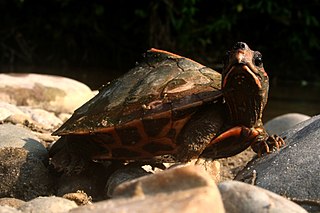
The Assam roofed turtle or Sylhet roofed turtle is a turtle species of the family Geoemydidae found in the Brahmaputra-Meghna drainage in India (Assam) and parts of eastern Bangladesh. It was formerly placed in the genus Batagur and the defunct genus Kachuga.

Eastern Bengal and Assam was an administrative subdivision (province) of British India between 1905 and 1912. Headquartered in the city of Dacca, it covered territories in what are now Bangladesh, Northeast India and Northern West Bengal.

The People of Assam inhabit a multi-ethnic, multi-linguistic and multi-religious society. They speak languages that belong to four main language groups: Tibeto-Burman, Indo-Aryan, Tai-Kadai, and Austroasiatic. The large number of ethnic and linguistic groups, the population composition, and the peopling process in the state has led to it being called an "India in miniature".

Rhacophorus bipunctatus is a frog species in the moss frog family (Rhacophoridae) found from eastern India into Southeast Asia, possibly to southeastern China and south to Malaysia. Due to the identification problems surrounding this species, the eastern and southern limits of its range remain undetermined; all that is known is that the species certainly occurs in the border region of India, Bangladesh, China and Myanmar; its range might extend south to Malaysia, as similar frogs have been reported from Pahang.
Stoliczkia is a genus of snakes in the family Xenodermidae. The genus contains two species, both from India.
The Tamai bent-toed gecko is a species of lizard in the family Gekkonidae. The species is endemic to Myanmar.
Hamilton Vetch (1804–1865) was a British officer of the Bengal Army of the East India Company, who reached the rank of major-general. He was active as a political agent in Upper Assam. The alternative spelling Veitch of his family name was also used.
