Kuwait is a constitutional emirate with a semi-democratic political system. The hybrid political system is divided between an elected parliament and appointed government.

The National Assembly, is the unicameral legislature of Kuwait. The National Assembly meets in Kuwait City. Members are chosen through direct election; the country is divided into five electoral districts with ten members representing each district. There are no official political parties in Kuwait, therefore candidates run as independents during elections; upon winning, members usually form informal parliamentary blocs. The National Assembly is made up of 50 elected members as well as up to 15 appointed government ministers who are ex officio members. On October 16, 2016, the Amir of Kuwait issued a decree dissolving the National Assembly citing security challenges, paving the way for early elections, which were held on November 26, 2016.

The National Assembly is bicameral with the lower house, the Chamber of Deputies, having 40 members elected in single-seat constituencies for a four-year term. The upper house, the Shura Council, has 40 members appointed by the King of Bahrain, with the stated aim of giving a voice to minority communities and technocratic experts within the legislative process. Supporters of the system refer to long established democracies the United Kingdom and Canada operating with this bicameralism with an appointed upper chamber and an elected lower chamber. Opponents of this system point out that unlike the bicameral systems in the UK and Canada, the Bahraini system gives the unelected upper house equal or more legislative power than the elected lower house, allowing the King to control all legislation. Opponents also point out that the current system was imposed unilaterally by the King, violating the 1973 Constitution and a 2001 signed agreement with the Bahraini opposition.
Elections in Malaysia exist at two levels: federal level and state level. Federal level elections are those for membership in the Dewan Rakyat, the lower house of Parliament, while state level elections are for membership in the various State Legislative Assemblies. The heads of executive branch at both the federal and state levels, the Prime Minister and Menteri Besar/Chief Ministers respectively, are indirectly elected, usually filled by a member of the majority party/coalition in the respective legislatures.
Elections in Kuwait are held for both the National Assembly and for the Municipality. Kuwait's constitution calls for elections to the unicameral National Assembly at a maximum interval of four years. Elections are held earlier if the Constitutional Court or Emir dissolve the parliament.

General elections were held in Kuwait on 29 June 2006. They were the first elections in Kuwait in which women were able to vote and run for office.

India held general elections to the 15th Lok Sabha in five phases between 16 April 2009 and 13 May 2009. With an electorate of 714 million, it was the largest democratic election in the world till the Indian General Elections 2014 held from 7 April 2014.
Kuwait is a constitutional emirate with a semi-democratic political system. The hybrid political system is divided between an elected parliament and appointed government.
The first bill which would have given women the right to vote in Kuwait was put to the parliament in 1973. It was ultimately overturned due to pressure from conservatives. Bills continued to be denied through 1985 and 1986. Kuwait then became heavily involved in the Iraq-Iran war, and women began demanding recognition for their efforts in keeping their families and society functional. The parliament agreed and the first woman was finally appointed as the ambassador of the Persian Gulf in 1993. In 1996, 500 women stopped working for an hour to show solidarity in their right for suffrage, and demonstrations continued throughout the next 6 years. In May 1999 a decree that allowed women the right to vote and run for office was issued by the emir, however it was overruled again by the parliament 6 months later.

Sheikh Sabah IV Ahmad Al-Jaber Al-Sabah GCB (Hon) is the Emir of Kuwait and the Commander of the Kuwait Military Forces. He was sworn in on 29 January 2006 after confirmation by the National Assembly. He is the fourth son of Sheikh Ahmad Al-Jaber Al-Sabah. His Highness the Amir of the State of Kuwait Sheikh Sabah Al-Ahmad Al-Jaber Al-Sabah was honored by the United Nations Organization on September 9, 2014 and named leader of humanitarian work. On March 2017, he has been awarded the Honorary Doctorate from Kuwait University for his humanitarian and global role.
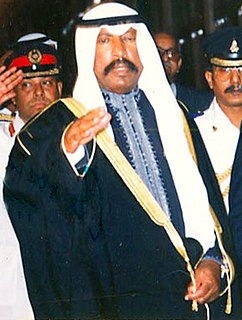
Sheikh Saad Al-Abdullah Al-Salim Al-Sabah, KCMG (Hon) was the Emir of Kuwait and Commander of the Military of Kuwait during a short reign of nine days, succeeding Sheikh Jaber. Sheikh Saad was a general commander in the Military of Kuwait; in addition, the first to head the Kuwaiti Ministry of Interior until February 16 1978 and the first military officer to head the Ministry of Defense since 1964.
The Kuwaiti protests refers to the series of 2011–12 demonstrations for government reforms in the state of Kuwait. In November 2011, the government of Kuwait resigned in response to the protests, making Kuwait one of several countries affected by the Arab Spring to experience major governmental changes due to unrest. The protests began with stateless people (Bedoon).

Early general elections were held in Kuwait on 2 February 2012, the country's second general election in a three-year period. The election's turnout rate was 59%. However, in June 2012 Kuwait's Constitutional Court declared the elections invalid and reinstated the former parliament. The court said the dissolution of Parliament in December 2011 by Emir Sabah Al-Sabah was unconstitutional. In response, opposition MPs resigned from parliament and demanded a full parliamentary system.
Early general elections were held in Kuwait on 1 December 2012 after early elections in February 2012 were declared invalid.

Early general elections were held in Kuwait on 27 July 2013. The elections were required after the Constitutional Court dissolved Parliament and annulled the results of the December 2012 elections. Voter turnout was an estimated 52.5%, which was higher than expected despite an opposition boycott, and only 7% lower than the non-boycotted February 2012 elections.

General elections was held in Sudan on 13-16 April 2015 to elect the President and the National Assembly. They were originally scheduled for 2 April, but were delayed by eleven days. These were the first elections to be held following the secession of South Sudan.
The Council for Coordinating the Reforms Front or the Reformist Front Coordination Council is the umbrella organization, coalition and council of main political groups within the Iranian reform movement. Since 2015, it is overseen by the Reformists' Supreme Council for Policymaking.
General elections were held in Jordan on 20 September 2016 to elect the 18th House of Representatives. The elections were announced after parliament was dissolved by King Abdullah II on 29 May 2016, with the King appointing Hani Mulki as interim Prime Minister following the resignation of Abdullah Ensour.
Early general elections were held in Kuwait on 26 November 2016. They follow the dissolution of the parliament elected in 2013 by Emir Sabah Al-Ahmad Al-Jaber Al-Sabah in October 2016. Under the constitution, elections must be held within two months. Opposition candidates won 24 of the 50 seats in the National Assembly. Voter turnout was around 70 percent.

The next New Zealand general election will be held after the currently elected 52nd New Zealand Parliament is dissolved or expires. The current Parliament was elected on Saturday, 23 September 2017. The last possible date for the next general election to be held is Saturday, 21 November 2020.