A lacrosse stick or crosse is used to play the sport of lacrosse. Players use the lacrosse stick to handle the ball and to strike or "check" opposing players' sticks, causing them to drop the ball. The head of a lacrosse stick is roughly triangular in shape and is strung with loose netting that allows the ball to be caught, carried, passed, or shot.

Lecythis pisonis, the cream nut or monkey pot, is a tropical tree in the Brazil nut family Lecythidaceae. It is known in its native tropical America as sapucaia or castanha-de-sapucaia. The fruit is shaped like a cooking pot and contains edible seeds.

Lecythis is a genus of woody plant in the Lecythidaceae family first described as a genus in 1758. It is native to Central America and South America. Several species produce edible seeds and referred to by a variety of common names including paradise nut, monkey pot, cream nut, and sapucaia nut.

Balsamorhiza deltoidea is a species of flowering plant in the sunflower tribe of the plant family Asteraceae known by the common name deltoid balsamroot. It is native to western North America from British Columbia to California, where it grows in many types of generally mountainous habitat.
Cirsium crassicaule is a species of thistle known by the common name slough thistle. It is endemic to the San Joaquin Valley of California, where it is known primarily from freshwater wetlands. It has been found in only a few locations in Kern, Kings, and San Joaquin Counties.

Cirsium scariosum is a species of thistle known by the common names meadow thistle, elk thistle and dwarf thistle. It is native to much of western North America from Alberta and British Columbia, south to Baja California. There are also isolated populations on the Canadian Atlantic Coast, on the Mingan Archipelago in Québec, where it is called the Mingan thistle.

Enceliopsis nudicaulis is a North American species of flowering plants in the family Asteraceae known by the common name nakedstem sunray, or naked-stemmed daisy.

Grindelia ciliata is a species of flowering plant in the family Asteraceae known by the common names Spanish gold, goldenweed, and waxed goldenweed.

Simarouba amara is a species of tree in the family Simaroubaceae, found in the rainforests and savannahs of South and Central America and the Caribbean. It was first described by Aubl. in French Guiana in 1775 and is one of six species of Simarouba. The tree is evergreen, but produces a new set of leaves once a year. It requires relatively high levels of light to grow and grows rapidly in these conditions, but lives for a relatively short time. In Panama, it flowers during the dry season in February and March, whereas in Costa Rica, where there is no dry season it flowers later, between March and July. As the species is dioecious, the trees are either male or female and only produce male or female flowers. The small yellow flowers are thought to be pollinated by insects, the resulting fruits are dispersed by animals including monkeys, birds and fruit-eating bats and the seeds are also dispersed by leaf cutter ants.

Heterotheca shevockii is a rare species of flowering plant in the family Asteraceae known by the common names Kern Canyon false goldenaster and Shevock's goldenaster. It is endemic to California in the United States, where it is known only from Kern County. It grows along a 21-mile stretch of the Kern River.

Cirsium parryi, or Parry's thistle, is a species of North American flowering plants in the family Asteraceae. It is native to the southwestern United States, where it has been found in Colorado, Arizona, and New Mexico.

Lecythis zabucajo, the sapucaia or paradise nut, is a large nut-producing tree occurring in the Guianas, Suriname, Venezuela, Ecuador, Honduras and Brazil, and which distribution range is much the same as that of the greater spear-nosed bat. Although not singling out Lecythis zabucajo, Jacques Huber noted in 1909 that fruit bats played the most important role in seed dispersal in Amazonian forests. The quality of its nuts led to the species' being introduced to numerous tropical countries, notably Trinidad, where it has flourished. The nuts are a valuable food resource and yield oil suitable for cooking and domestic use.

Lecythis ampla is a species of woody plant in the family Lecythidaceae, which also includes the Brazil nut. Common names include coco, olla de mono, jicaro and salero. It is found in Central and South America. It has been considered an endangered species in Costa Rica.

Camassia howellii, commonly known as Howell's camas, is a species of perennial flowering plant in the family Asparagaceae endemic to western Oregon.
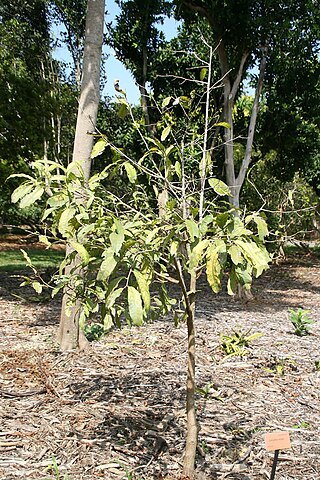
Lecythis minor, the monkey-pot tree, is a small tree with toxic seeds that occurs in South America.

Symphyotrichum estesii is a species of flowering plant in the family Asteraceae, endemic to Coffee County, Tennessee. Commonly called May Prairie aster and Estes's aster, it is a perennial, herbaceous plant that may reach 30 to 85 centimeters in height. Its flowers have white ray florets and yellow disk florets. It is named in honor of botanist Dwayne Estes who discovered it in 2008.

Symphyotrichum molle is a species of flowering plant in the aster family (Asteraceae) endemic to the Bighorn Mountains of Montana and Wyoming in the United States. Commonly known as soft aster, it is a perennial, herbaceous plant that ranges from 30 to 60 centimeters in height.
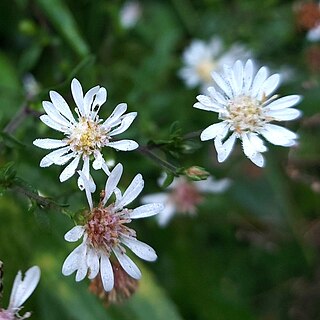
Symphyotrichum schaffneri is a perennial, herbaceous species of flowering plant in the family Asteraceae native to the states of Puebla and Veracruz, Mexico.
Chisocheton macrophyllus in the Mahogany family (Meliaceae) is a pachycaul rainforest tree of the East Indies and Malay Peninsula with very few upright limbs (reiterations) ultimately reaching a height of 115 feet. Each reiteration is topped by a tight rosette of once-pinnate leaves up to ten feet in length with up to 28 pairs of leaflets at any given time, each up to 15.5 inches long by 4.5 inches in width. Like all Chisocheton species, these leaves are indeterminate, forming a new pair of leaflets every few weeks or months. while the oldest pair may die. The cream-colored flowers, 1.5 inches long with 4 or 5 petals, are arranged in a thyrse up to 32 inches long, followed by pyriform capsules up to six inches in diameter with 2 to 4 seeds each the size and shape of a brazilnut.
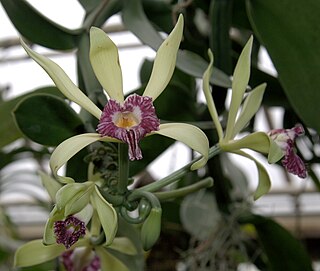
Vanilla imperialis is an orchid found from Sierra Leone eastward to Ethiopia and southward to Tanzania and Angola. It is a root-climbing vine to about 65 feet in height, with a root emerging just above each leaf. Although not as tall as the common vanilla, it is up to a full inch in thickness; the most massive Vanilla species, and the largest of all African orchids. The inflorescence is an unbranched raceme up to six inches long. The flowers are six inches wide with the white or yellow petals and sepals three inches (8 cm) long by 0.75 inch (1.8 cm) in width. The labellum is 2.5 inches in length with the far end flared and pink or purple. Most of the labellum is fused to the column, forming a tube. Each flower is open for at least two days( Chambers says seven days).

