Leptocereus nudiflorus

Last updated

Leptocereus nudiflorus
DendrocereusNudiflorus.jpg
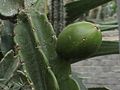
Rooted plant of Leptocereus nudiflorus
Scientific classification OOjs UI icon edit-ltr.svg
Kingdom: Plantae
Clade: Tracheophytes
Clade: Angiosperms
Clade: Eudicots
Order: Caryophyllales
Family: Cactaceae
Subfamily: Cactoideae
Genus: Leptocereus
Species:
L. nudiflorus
Binomial name
Leptocereus nudiflorus
(Engelm. ex C.Wright) D.Barrios & S.Arias
Synonyms
  • Cereus nudiflorusEngelm. 1869
  • Dendrocereus nudiflorus(Engelm. ex C.Wright) Britton & Rose 1920
  • Dendrocereus undulosus subsp. nudiflorus(Engelm. ex C.Wright) Guiggi 2020

Leptocereus nudiflorus is a species of cactus that is native to Cuba. Common names include Flor De Copa and Goblet flower. [1]

Contents

Description

Leptocereus nudiflorus is a tree-like cactus that branches extensively and can grow 7 to 15 meters tall. It is considered one of the largest cacti in the world. Its trunk, up to 1 meter high and 60 centimeters thick, supports short, dull green stem segments that are up to 16 centimeters in diameter. The stem segments feature 3 to 5 wing-like ribs, each up to 7 centimeters high and notched. Spines, which may be absent, are needle-like, gray with darker tips, and measure up to 4 centimeters long. The cactus produces broadly funnel-shaped white flowers, 10 to 12 centimeters long, with a narrow floral tube. Its fruits are typically spherical, greenish, smooth, and range from 8 to 12 centimeters in length. [2] [3]

Distribution

Leptocereus nudiflorus is found growing in Cuba on the northern coast of Cojimar, Tarará, and Maisi. It inhabits dry and rocky coastal areas.

Taxonomy

The first described by George Engelmann in 1869 as Cereus nudiflorus. Then, in 1920, it was reclassified as Dendrocereus nudiflorus by Britton and Rose. Only recently in 2020 was it reclassified as Leptocereus nudiflorus.

References

  1. "Dendrocereus nudiflorus" . Retrieved 2025-04-03.
  2. "Dendrocereus nudiflorus ex.(Engelm. ex C.Wright) D.Barrios & S.Arias" . Retrieved 2025-04-03.
  3. Anderson, Edward F.; Eggli, Urs (2005). Das grosse Kakteen-Lexikon (in German). Stuttgart (Hohenheim): Ulmer. p. 177. ISBN   3-8001-4573-1.