
Lilium is a genus of herbaceous flowering plants growing from bulbs, all with large and often prominent flowers. Lilies are a group of flowering plants which are important in culture and literature in much of the world. Most species are native to the Northern Hemisphere and their range is temperate climates and extends into the subtropics. Many other plants have "lily" in their common names, but do not belong to the same genus and are therefore not true lilies. True lilies are known to be highly toxic to cats.
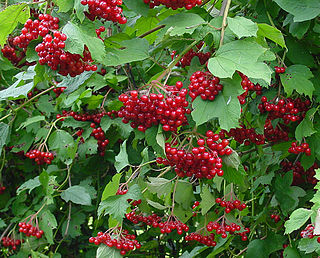
Viburnum is a genus of about 150–175 species of flowering plants in the moschatel family, Adoxaceae. Its current classification is based on molecular phylogeny. It was previously included in the honeysuckle family Caprifoliaceae.

Rubia is the type genus of the Rubiaceae family of flowering plants, which also contains coffee. It contains around 80 species of perennial scrambling or climbing herbs and subshrubs native to the Old World. The genus and its best-known species are commonly known as madder, e.g. Rubia tinctorum, Rubia peregrina, and Rubia cordifolia.

Daucus carota, whose common names include wild carrot, European wild carrot, bird's nest, bishop's lace, and Queen Anne's lace, is a flowering plant in the family Apiaceae. It is native to temperate regions of the Old World and was naturalized in the New World.

Lysimachia is a genus consisting of 182 accepted species of flowering plants traditionally classified in the family Primulaceae. Based on a molecular phylogenetic study it was transferred to the family Myrsinaceae, before this family was later merged into the Primulaceae.

Lilium humboldtii, or Humboldt's lily, is a species of lily native to the US state of California and the Mexican state of Baja California. It is named after naturalist and explorer Alexander von Humboldt. It is native to the South High Cascade Range, High Sierra Nevada, south Outer South Coast Ranges, and the Santa Monica Mountains and others in Southern California, growing at elevations from 600 metres (2,000 ft) to 1,200 metres (3,900 ft).

Coriaria is the sole genus in the family Coriariaceae, which was described by Linnaeus in 1753. It includes 14 species of small trees, shrubs and subshrubs, with a widespread but disjunct distribution across warm temperate regions of the world, occurring as far apart as the Mediterranean region, southern and eastern Asia, New Zealand, the Pacific Ocean islands, and Central and South America.

Lilium pardalinum, also known as the leopard lily or panther lily, is a flowering bulbous perennial plant in the lily family, native to Oregon, California, and Baja California. It usually grows in damp areas. Its range includes California chaparral and woodlands habitats and the Sierra Nevada.

John Gilbert Baker was an English botanist. His son was the botanist Edmund Gilbert Baker (1864–1949).

Ruellia is a genus of flowering plants commonly known as ruellias or wild petunias. They are not closely related to petunias (Petunia) although both genera belong to the same euasterid clade. The genus was named in honor of Jean Ruelle (1474–1537), herbalist and physician to Francis I of France and translator of several works of Dioscorides.

Lilium pomponium, the turban lily, is a European species of lily native to France, Spain, and Italy.
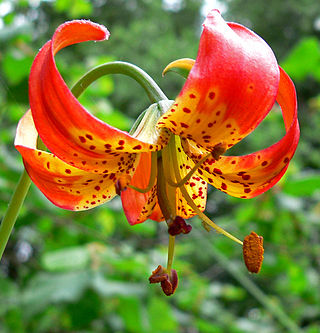
Lilium pardalinum subsp. pitkinense, the Pitkin Marsh lily, is an endangered perennial herb of the family Liliaceae that is endemic to certain wetland areas in the northern California Coast Ranges of Sonoma County, California, United States. It is a subspecies of Lilium pardalinum.

Trichodesma is a genus of flowering plants in the borage family, Boraginaceae. There are 38 species distributed in tropical and subtropical regions of Africa, Asia, and Australia.

Bulbophyllum comosum is a species of flowering plant in the family Orchidaceae.

Piliostigma is a genus of flowering plants in the legume family, Fabaceae. It includes five species of small deciduous trees native to sub-Saharan Africa, the Indian subcontinent, Indochina, Java, the Philippines, and northern Australia. It belongs to the subfamily Cercidoideae and the tribe Bauhinieae. It is dioecious, with male and female flowers on separate plants.
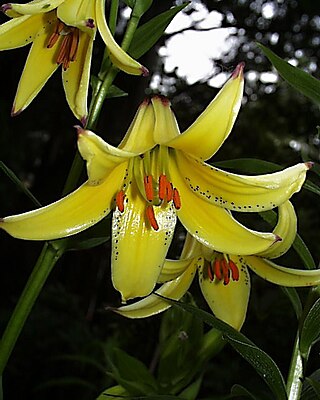
Lilium monadelphum is a bulbous plant native to Crimea and to North and South Caucasus.
Galium orizabense is a species of plants in the family Rubiaceae, named for the town of Orizaba in Veracruz, where the first collections of the species were made. The species is native to Mexico, Costa Rica, Guatemala, Panamá, Venezuela, Colombia, and Hispaniola, plus widely scattered locations in the southeastern United States.

Lonicera hildebrandiana, the giant Burmese honeysuckle, is a species of flowering plant in the family Caprifoliaceae. It is native to southeast Asia, in China, Thailand and Burma at elevations of 1000 to 2300 meters.
Aningeria adolfi-friederici is a species of plant in the family Sapotaceae, a tall, tropical forest tree. It is found in Burundi, the Democratic Republic of the Congo, Ethiopia, Kenya, Malawi, Rwanda, Sudan, Tanzania, Uganda, Zambia and Zimbabwe. The specific name adolfi-friedericii was given in honour of Duke Adolf Friedrich of Mecklenburg, a German explorer in Africa. Its trade name muna is taken from Gĩkũyũ mũna.


