
Banksia is a genus of around 170 species of flowering plants in the family Proteaceae. These Australian wildflowers and popular garden plants are easily recognised by their characteristic flower spikes, and woody fruiting "cones" and heads. Banksias range in size from prostrate woody shrubs to trees up to 30 metres (100 ft) tall. They are found in a wide variety of landscapes: sclerophyll forest, (occasionally) rainforest, shrubland, and some more arid landscapes, though not in Australia's deserts.

Stylidium is a genus of dicotyledonous plants that belong to the family Stylidiaceae. The genus name Stylidium is derived from the Greek στύλος or stylos, which refers to the distinctive reproductive structure that its flowers possess. Pollination is achieved through the use of the sensitive "trigger", which comprises the male and female reproductive organs fused into a floral column that snaps forward quickly in response to touch, harmlessly covering the insect in pollen. Most of the approximately 300 species are only found in Australia, making it the fifth largest genus in that country. Triggerplants are considered to be protocarnivorous or carnivorous because the glandular trichomes that cover the scape and flower can trap, kill, and digest small insects with protease enzymes produced by the plant. Recent research has raised questions as to the status of protocarnivory within Stylidium.

Banksia integrifolia, commonly known as the coast banksia, is a species of tree that grows along the east coast of Australia. One of the most widely distributed Banksia species, it occurs between Victoria and Central Queensland in a broad range of habitats, from coastal dunes to mountains. It is highly variable in form, but is most often encountered as a tree up to 25 metres (82 ft) in height. Its leaves have dark green upper surfaces and white undersides, a contrast that can be striking on windy days.

Banksia serrata, commonly known as the saw banksia, the old man banksia, the saw-tooth banksia or the red honeysuckle and as wiriyagan by the Cadigal people, is a species of woody shrub or tree of the genus Banksia, in the family Proteaceae. Native to the east coast of Australia, it is found from Queensland to Victoria with outlying populations on Tasmania and Flinders Island. Commonly growing as a gnarled tree up to 16 m (50 ft) in height, it can be much smaller in more exposed areas. This Banksia species has wrinkled grey bark, shiny dark green serrated leaves and large yellow or greyish-yellow flower spikes appearing over summer. The flower spikes, or inflorescences, turn grey as they age and pollinated flowers develop into large, grey, woody seed pods called follicles.

Banksia robur, commonly known as swamp banksia, is a species of flowering plant in the family Proteaceae. It grows in sand or peaty sand in coastal areas from Cooktown in north Queensland to the Illawarra region on the New South Wales south coast. It is often found in areas which are seasonally inundated. It grows as a multistemmed shrub to 3 m tall, with large, leathery tough green leaves with serrated margins up to 30 cm (12 in) long and 10 cm (4 in) wide. The new growth is colourful, in shades of red, maroon or brown with a dense felt-like covering of brown hairs.

Banksia dentata, commonly known as the tropical banksia, is a species of tree in the family Proteaceae. It occurs across northern Australia, southern New Guinea and the Aru Islands. Growing as a gnarled tree to 7 m (23 ft) high, it has large green leaves up to 22 cm (8.7 in) long with dentate margins. The cylindrical yellow inflorescences, up to 13 cm (5.1 in) high, appear between November and May, attracting various species of honeyeaters, sunbirds, the sugar glider and a variety of insects. Flowers fall off the ageing spikes, which swell and develop follicles containing up to two viable seeds each.

Banksia oblongifolia, commonly known as the fern-leaved, dwarf or rusty banksia, is a species in the plant genus Banksia. Found along the eastern coast of Australia from Wollongong, New South Wales in the south to Rockhampton, Queensland in the north, it generally grows in sandy soils in heath, open forest or swamp margins and wet areas. A many-stemmed shrub up to 3 m (9.8 ft) high, it has leathery serrated leaves and rusty-coloured new growth. The yellow flower spikes, known as inflorescences, most commonly appear in autumn and early winter. Up to 80 follicles, or seed pods, develop on the spikes after flowering. Banksia oblongifolia resprouts from its woody lignotuber after bushfires, and the seed pods open and release seed when burnt, the seed germinating and growing on burnt ground. Some plants grow between fires from seed shed spontaneously.
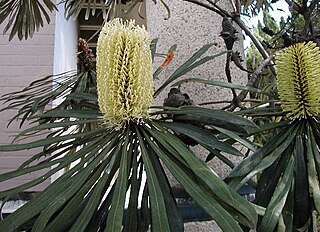
Banksia aquilonia, commonly known as the northern banksia and jingana, is a tree in the family Proteaceae and is endemic to north Queensland on Australia's northeastern coastline. With an average height of 8 m (26 ft), it has narrow glossy green leaves up to 20 cm (7.9 in) long and 6 to 10 cm high pale yellow flower spikes, known as inflorescences, appearing in autumn. As the spikes age, their flowers fall off and they develop up to 50 follicles, each of which contains two seeds.
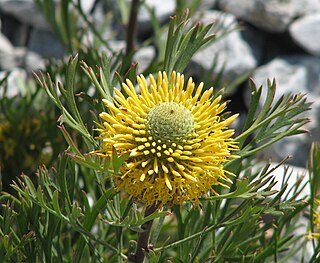
Isopogon anemonifolius, commonly known as broad-leaved drumsticks, is a shrub of the family Proteaceae that is native only to eastern New South Wales in Australia. It occurs naturally in woodland, open forest, and heathland on sandstone soils. I. anemonifolius usually ranges between one and two metres in height, and is generally smaller in exposed heathland. Its leaves are divided and narrow, though broader than those of the related Isopogon anethifolius, and have a purplish tinge during the cooler months. The yellow flowers appear during late spring or early summer and are displayed prominently. They are followed by round grey cones, which give the plant its common name drumsticks. The small hairy seeds are found in the old flower parts.
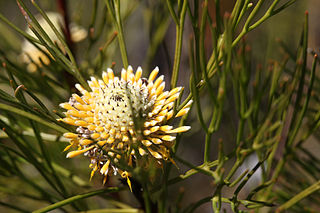
Isopogon anethifolius, commonly known as narrow-leaf drumsticks or narrow-leafed drumsticks, is a shrub in the family Proteaceae. The species is found only in coastal areas near Sydney in New South Wales, and to the immediate west. It occurs naturally in woodland, open forest and heathland on sandstone soils. An upright shrub, it can reach to 3 m (9.8 ft) in height, with terete leaves that are divided and narrow. The yellow flowers appear in the Spring, from September to December, and are prominently displayed. They are followed by round grey cones, which give the plant its common name of drumsticks. The small hairy seeds are found in the old flower parts.
The taxonomy of Banksia integrifolia has a long and complex history, the result of confusion caused by the species' great variability, and similarities with some closely related species. The existence of hybrids between B. integrifolia and related species as well as early attempts to classify the species based on dried specimen material have also contributed to the confusion.
Stylidium graminifolium, the grass triggerplant, is a dicotyledonous plant that belongs to the genus Stylidium. This species used to belong to the Stylidium graminifolium complex, but the name was conserved for this single species when two others were split from the complex and introduced as new species in 2001. S. graminifolium is endemic to Australia and is the Stylidium species with the widest distribution throughout Australia. It is a perennial plant with grass-like leaves and is easily cultivated. It has been considered to be a carnivorous or protocarnivorous plant because it possesses glandular trichomes underneath the flowers that can trap and digest prey.

Grevillea mucronulata, also known as green spider flower or green grevillea, is a species of flowering plant of the family Proteaceae and is endemic to New South Wales in Australia. Described by Robert Brown in 1810, it is found in open sclerophyll forest or woodland around the Sydney region and New South Wales south coast. It grows as a small bush to 3 m (9.8 ft) high and wide, with variable foliage and greenish flowers that appear over the cooler months from May to October. The flowers are attractive to birds.

Lambertia formosa, commonly known as mountain devil, is a shrub of the family Proteaceae, endemic to New South Wales, Australia. First described in 1798 by English botanist James Edward Smith, it is the type species of the small genus Lambertia. It is generally found in heathland or open forest, growing in sandstone-based soils. It grows as a multistemmed shrub to around 2 m (7 ft) with a woody base known as a lignotuber, from which it regrows after bushfire. It has stiff narrow leaves, and the pink to red flowerheads, made up of seven individual tubular flowers, generally appear in spring and summer. It gains its common name from the horned woody follicles, which were used to make small devil-figures.
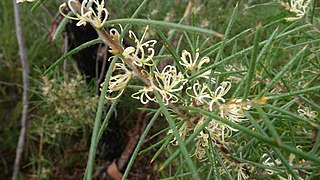
Hakea gibbosa, commonly known as hairy hakea or needlebush hakea, is a shrub of the family Proteaceae, and is endemic to south eastern Australia. It has very prickly foliage, cream-yellowish flowers from April to July, and provides shelter for small birds. It has become an environmental weed in South Africa and New Zealand, where it had been introduced for use as a hedge plant.

Persoonia levis, commonly known as the broad-leaved geebung, is a shrub native to New South Wales and Victoria in eastern Australia. It reaches 5 m (16 ft) in height and has dark grey papery bark and bright green asymmetrical sickle-shaped leaves up to 14 cm (5.5 in) long and 8 cm (3.2 in) wide. The small yellow flowers appear in summer and autumn, followed by small green fleshy fruit, which are classified as drupes. Within the genus Persoonia, it is a member of the Lanceolata group of 58 closely related species. P. levis interbreeds with several other species where they grow together.

Persoonia lanceolata, commonly known as lance-leaf geebung, is a shrub native to New South Wales in eastern Australia. It reaches 3 m (10 ft) in height and has smooth grey bark and bright green foliage. Its small yellow flowers grow on racemes and appear in the austral summer and autumn, followed by green fleshy fruits which ripen the following spring. Within the genus Persoonia, P. lanceolata belongs to the lanceolata group of 58 closely related species. It interbreeds with several other species found in its range.

Monotoca elliptica, the tree broom heath, is a plant in the family Ericaceae, found in south-eastern Australia.
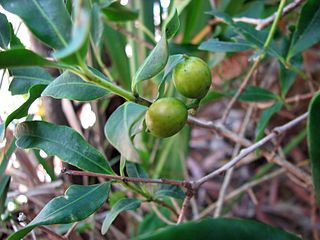
Alyxia spicata, commonly known as chain fruit, is a sprawling shrub or vine in the family Apocynaceae. It is native to New Guinea and the Australian tropics.

Persicaria decipiens, commonly known as slender knotweed, is a species of flowering plant native to Australia and Asia.

