
Antirrhinum is a genus of plants in the Plantaginaceae family, commonly known as dragon flowers or snapdragons because of the flowers' fancied resemblance to the face of a dragon that opens and closes its mouth when laterally squeezed. They are also sometimes called toadflax or dog flower. They are native to rocky areas of Europe, the United States, Canada, and North Africa. Antirrhinum species are widely used as ornamental plants in borders and as cut flowers.
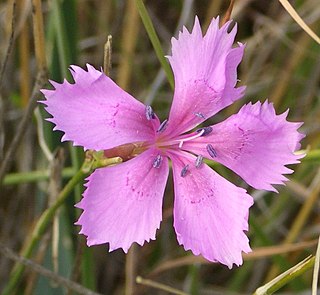
Dianthus is a genus of about 340 species of flowering plants in the family Caryophyllaceae, native mainly to Europe and Asia, with a few species in north Africa and in southern Africa, and one species in arctic North America. Common names include carnation, pink and sweet william.
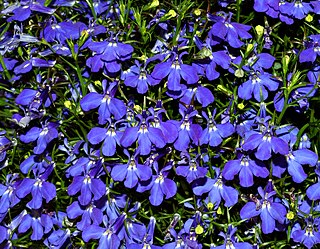
Lobelia is a genus of flowering plants in the family Campanulaceae comprising 415 species, with a subcosmopolitan distribution primarily in tropical to warm temperate regions of the world, a few species extending into cooler temperate regions. They are known generally as lobelias.

Bougainvillea is a genus of thorny ornamental vines, bushes, and trees belonging to the four o' clock family, Nyctaginaceae. They are native to Brazil, Bolivia, Paraguay, Peru, and Argentina. There are between 4 and 22 species in the genus. The inflorescence consists of large colourful sepal-like bracts which surround three simple waxy flowers, gaining popularity for the plant as an ornamental. The plant is named after explorer Louis Antoine de Bougainville (1729-1811), after it was documented on one of his expeditions.

The family Campanulaceae, of the order Asterales, contains nearly 2400 species in 84 genera of herbaceous plants, shrubs, and rarely small trees, often with milky sap. Among them are several familiar garden plants belonging to the genera Campanula (bellflower), Lobelia, and Platycodon (balloonflower). Campanula rapunculus and Codonopsis lanceolata are eaten as vegetables. Lobelia inflata, L. siphilitica and L. tupa and others have been used as medicinal plants. Campanula rapunculoides may be a troublesome weed, particularly in gardens, while Legousia spp. may occur in arable fields.

Weigela is a genus of between six and 38 species of deciduous shrubs in the family Caprifoliaceae, growing to 1–5 m (3–15′) tall. All are natives of eastern Asia. The genus is named after the German scientist Christian Ehrenfried Weigel.

Albizia julibrissin, the Persian silk tree, pink silk tree, or mimosa tree, is a species of tree in the Fabaceae family, native to southwestern and eastern Asia.
Indian pink refers to several different wildflowers in the United States:
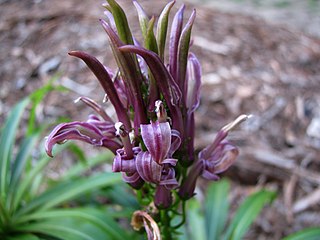
The Hawaiian lobelioids are a group of flowering plants in the bellflower family, Campanulaceae, subfamily Lobelioideae, all of which are endemic to the Hawaiian Islands. This is the largest plant radiation in the Hawaiian Islands, and indeed the largest on any island archipelago, with over 125 species. The six genera involved can be broadly separated based on growth habit: Clermontia are typically branched shrubs or small trees, up to 7 metres (23 ft) tall, with fleshy fruits; Cyanea and Delissea are typically unbranched or branching only at the base, with a cluster of relatively broad leaves at the apex and fleshy fruits; Lobelia and Trematolobelia have long thin leaves down a single, non-woody stem and capsular fruits with wind-dispersed seeds; and the peculiar Brighamia have a short, thick stem with a dense cluster of broad leaves, elongate white flowers, and capsular fruits. The relationships among the genera and sections remains unsettled as of April 2022.

Lobelia cardinalis, the cardinal flower, is a species of flowering plant in the bellflower family Campanulaceae native to the Americas, from southeastern Canada south through the eastern and southwestern United States, Mexico and Central America to northern Colombia.

Microcycas is a genus of cycads in the family Zamiaceae containing only one species, Microcycas calocoma, endemic to a small area in western Cuba in Pinar del Río Province. It is estimated that there are 50-249 mature individuals left in the wild.

Ruellia simplex, the Mexican petunia, Mexican bluebell or Britton's wild petunia, is a species of flowering plant in the family Acanthaceae. It is a native of Mexico, the Caribbean, and South America. It has become a widespread invasive plant in Florida, where it was likely introduced as an ornamental before 1933, as well as in the eastern Mediterranean, South Asia and other parts of the eastern hemisphere.

Oenothera lindheimeri, commonly known as Lindheimer's beeblossom, white gaura, pink gaura, Lindheimer's clockweed, and Indian feather, is a species of Oenothera. Several of its common names derive from the genus Gaura, in which this species was formerly placed.

Lobelia erinus is a species of flowering plant in the bellflower family Campanulaceae, native to southern Africa.

Lobelia dortmanna, Dortmann's cardinalflower or water lobelia, is a species of flowering plant in the bellflower family Campanulaceae. This stoloniferous herbaceous perennial aquatic plant with basal leaf-rosettes and flower stalks grows to 0.7–2 m (2.3–6.6 ft) tall. The flowers are 1–2 cm long, with a five-lobed white to pale pink or pale blue corolla, produced in groups of one to ten on an erect raceme held above the water surface. The fruit is a capsule 5–10 mm long and 3–5 mm wide, containing numerous small seeds.

Pratia is a formerly recognized genus of flowering plants in the family Campanulaceae, native to Asia, Australia and New Zealand. Along with other genera, such as Hypsela and Isotoma, it is now included in Lobelia.

Lobelia kalmii is a species of flowering plant with a distribution primarily across Canada and the northern United States in temperate and boreal regions. It was formerly known as Lobelia strictiflora (Rydb.) It is commonly known as Kalm's lobelia, Ontario lobelia and Brook lobelia.

Lonicera tatarica is a species of honeysuckle known by the common name Tatarian honeysuckle. Native to Eurasia, the plant is one of several exotic bush honeysuckles present in North America, being considered an invasive species there.

Hypericum aciferum is a species of flowering plant in the St John's wort family Hypericaceae. It is a small shrub endemic to the Greek island of Crete. H. aciferum grows in a mat on the ground and has twisting branches, needle-like leaves, and long golden petals. Its flowers are also heterostylous, which means that the species can exhibit one of two flower types on different plants. This trait is unique within the genus Hypericum to H. aciferum, H. russeggeri, and H. aegypticum, the three species in section Adenotrias.

