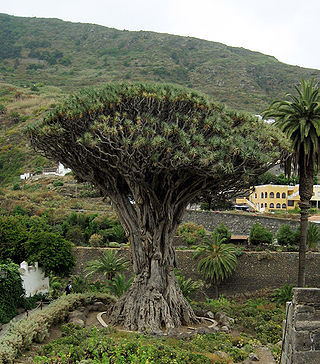
Dracaena draco, the Canary Islands dragon tree or drago, is a subtropical tree in the genus Dracaena, native to the Canary Islands, Cape Verde, Madeira, western Morocco, and possibly introduced into the Azores.

Digitalis purpurea, the foxglove or common foxglove, is a toxic species of flowering plant in the plantain family Plantaginaceae, native to and widespread throughout most of temperate Europe. It has also naturalized in parts of North America, as well as some other temperate regions. The plant is a popular garden subject, with many cultivars available. It is the original source of the heart medicine digoxin. This biennial plant grows as a rosette of leaves in the first year after sowing, before flowering and then dying in the second year. It generally produces enough seeds so that new plants will continue to grow in a garden setting.
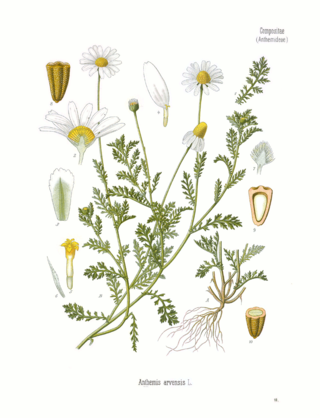
Anthemis arvensis, also known as corn chamomile, mayweed, scentless chamomile, or field chamomile is a species of flowering plant in the genus Anthemis, in the aster family. It is used as an ornamental plant.

Dipteryx charapilla is a little-known species of flowering plant in the family Fabaceae, a large to mid-sized tree growing along rivers in the rainforests of Brazil. and Peru.

Cakile maritima, sea rocket or European searocket, is a common plant in the mustard family Brassicaceae. It is widespread in Europe, North Africa and western Asia, especially on coastlines. It can now be found in many other areas of the world where it has been introduced. It is present on the west and east coasts of North America, where it has the potential to become an invasive species. This is an annual plant which grows in clumps or mounds in the sand on beaches and bluffs. The shiny leaves are fleshy, green and tinted with purple or magenta, and long-lobed. It has white to light purple flowers and sculpted, segmented, corky brown fruits one to three centimetres long. The fruits float and are water-dispersed.
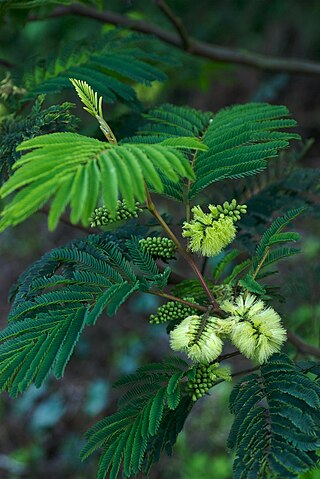
Paraserianthes lophantha, the Cape Leeuwin wattle, Bicol wattle, Cape wattle, crested wattle or plume albizia, is a fast-growing tree with creamy-yellow, bottlebrush like flowers. It is the sole species in genus Paraserianthes.

Acmispon dendroideus, synonym Syrmatium veatchii, is a species of legume native to California. It is known by the common name island broom. It is endemic to the Channel Islands of California, where it grows on coastal bluffs and cliffs. It is a spreading perennial herb or erect shrub approaching 2 meters in height. It is hairless to hairy and gray-green in color. The branches lined with leaves each made up of a few oval leaflike leaflets up to 1.5 centimeters long each. The inflorescence bears up to 10 yellow pealike flowers, each roughly a centimeter long and fading red as they age.

Chersogenes brachyptera is a species of moth in the family Symmocidae. It is found on the Canary Islands.

Erysimum scoparium is a species of flowering plant in the family Brassicaceae, native to the Canary Islands. It is a shrubby species of wallflower with purplish flowers found at high altitudes.

Lotus glaucus is a species of flowering plant in the family Fabaceae, native to Madeira and the Salvage Islands. It is a perennial herbaceous plant with leaves made up of five leaflets. Its flowers are usually orange on opening. Lotus tenellus is included in a more broadly circumscribed L. glaucus by some authors, which extends its distribution to the Canary Islands.

Salix pedicellata is a species of willow. It is a shrub or small tree to about 6–8 m tall, native around the Mediterranean Sea from Portugal to Lebanon and Syria in the north and from the Canary Islands to Tunisia in the south. Salix canariensis may be treated as a subspecies of S. pedicellata.

Aconitum firmum is a species of monkshood that is found in Southern Poland, Slovakia, and Czechia, with a few instances in Ukraine and Romania.

Anthyllis hermanniae, called the lavender-leaved anthyllis, is a species of flowering plant in the family Fabaceae. It is found in Anatolia, Greece, the Balkans, and many Mediterranean islands, including Corsica. Coleophora hermanniella, a species of moth found only on Corsica, feeds exclusively on A. hermanniae. A low perennial shrub, it is cultivated as a garden plant, and was formerly cultivated as far north as the United Kingdom, until the great frost of 1739 wiped them out there.

Cyperus hillebrandii, commonly known as Hillebrand's flatsedge, is a species of sedge that is endemic to Hawaii.
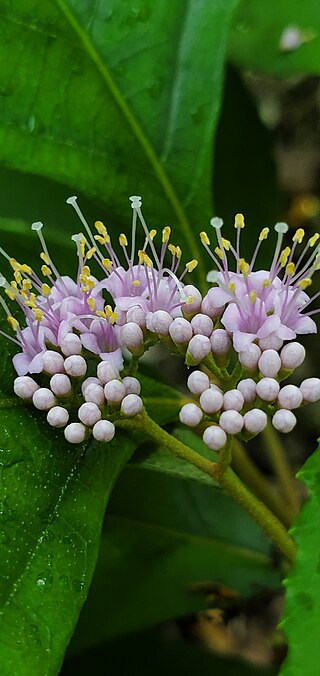
Callicarpa lamii is a plant in the mint family that is endemic to the Mariana Islands. It is one of two Callicarpa plants endemic to the Mariana Islands, the other being Callicarpa candicans var. paucinervia.
Lotus aegaeus is a perennial plant in the family Fabaceae and genus Lotus native from the Balkan Peninsula to Northwestern Iran.
Lotus castellanus is a plant in the genus Lotus native from Western France to the Western Mediterranean.
Lotus argyrodes is a plant species in the genus Lotus endemic to the Azores and Madeira Islands.
Lotus benoistii is a plant in the genus Lotus endemic to Morocco.
Lotus biflorus is a species in the genus Lotus native to southern Italy, Algeria to Tunisia.

